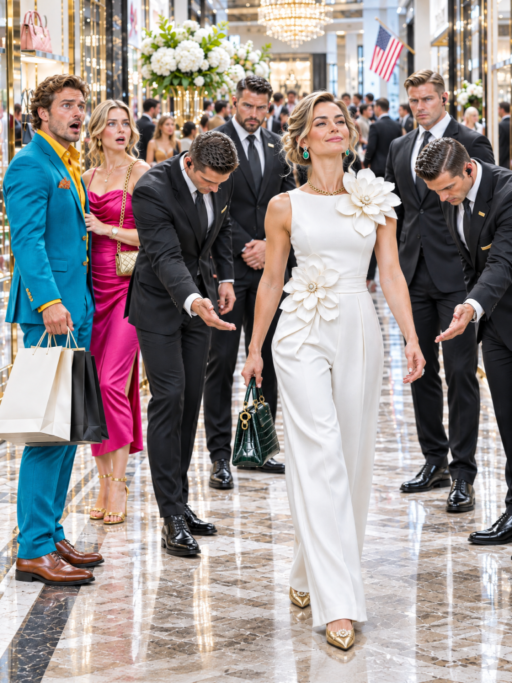
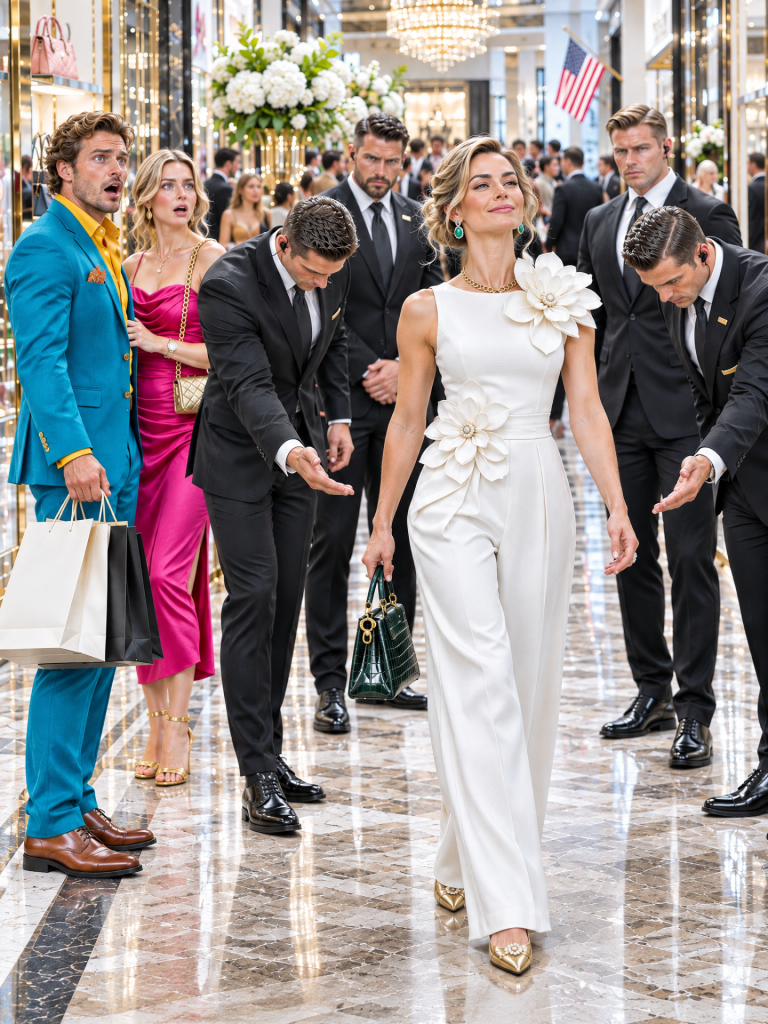

By eleven o’clock, the exhibition hall was filled with retail buyers, industry executives, and journalists. They examined our products, discussed manufacturing capacity, and asked detailed questions about our future collections.
Evelyn stepped onto the presentation platform and introduced Morrow Leatherworks as a company combining traditional American craftsmanship with contemporary design. She emphasized our commitment to quality, responsible production, and the independent artisans who made our products possible.
“Please welcome the founder of Morrow Leatherworks, Laurel Whitcomb.”
The audience applauded as I approached the microphone, and I briefly noticed Graham watching through the glass entrance. His expression was completely different from the arrogance he had displayed earlier that morning.
I explained how the business had begun with a small worktable and a handful of online orders. I also spoke about the customers, suppliers, and craftspeople whose trust had allowed our company to grow.
“Our success didn’t happen overnight. It came from years of careful work and from people who believed that craftsmanship deserves respect.”
Evelyn then announced our new purchasing agreement and plans for a gradual expansion into selected premium retail locations. The initial order represented an extraordinary opportunity, although fulfilling it would require careful financial planning and increased production capacity.
After the presentation, Piper and I received congratulations from several prospective partners. I was still discussing future opportunities when a commotion developed near the exhibition entrance.
Brielle had approached Marcus and demanded admission, insisting that her relationship with Graham entitled her to enter. When Marcus explained that invitations were required, she began accusing me of using Graham’s money to create the business.
“Everyone should know the truth! Laurel spent years living off her husband, and now she’s pretending she built this company herself!”
Her accusations attracted attention from nearby guests, and Evelyn immediately approached the entrance. I followed because I wanted to correct the false claims without allowing another confrontation to overshadow the presentation.
“My company has independent financial records, documented suppliers, and legitimate commercial operations. Every relevant detail was reviewed during our partnership negotiations.”
Brielle dismissed my explanation and reminded everyone that I had been a housewife. I looked directly at her, realizing that she shared Graham’s belief that managing a home somehow diminished the value of a woman’s professional achievements.
“Being a housewife doesn’t make someone’s work worthless. Neither does having been married to Graham.”
Evelyn then turned toward my former husband and asked whether he personally claimed to own or finance Morrow Leatherworks. Brielle watched him expectantly, apparently convinced that he would support her accusations.
Graham glanced at the exhibition displays before lowering his eyes. For the first time, he was being asked to acknowledge the truth in front of people whose professional opinions mattered to him.
“No. I didn’t finance Morrow Leatherworks. Laurel built that company herself.”
Brielle stared at him in disbelief, and the surrounding conversation fell quiet. After twelve years of belittling my ambitions, Graham had finally admitted publicly that my achievements belonged to me.
Before I could fully absorb the moment, another important guest approached from inside the exhibition. Caroline Mercer, a senior purchasing executive for a national luxury department-store chain, wanted to discuss an exclusive collection.
“Ms. Whitcomb, would your company consider developing a special line for our flagship stores?”
I turned toward Caroline, recognizing that the opportunity could take Morrow Leatherworks far beyond anything we had achieved so far. Behind me, Graham remained silent as he began to understand that the business he had dismissed was only getting started.
Caroline Mercer, the purchasing director of a nationwide luxury department-store chain, had approached me with an opportunity I could hardly believe. She wanted Morrow Leatherworks to develop an exclusive collection for her flagship stores, potentially requiring more than three times our current quarterly production.
Although the proposal was exciting, I understood that accepting an order beyond our manufacturing capacity could threaten everything we had built. I thanked Caroline and explained that Piper and I needed to review our resources before making any commitments.
“That’s exactly the kind of thoughtful answer I was hoping to hear,” Caroline replied.
We exchanged contact information and arranged another meeting, while Graham watched from a short distance away. As an experienced commercial sales manager, he understood the significance of the opportunity and finally recognized the professional judgment he had spent years dismissing.
After Caroline departed, Graham approached me and requested a private conversation. I agreed to give him five minutes, and we stepped into a quieter passage beside the exhibition hall.
“Is Morrow Leatherworks really yours? How long has it been this successful?”
His questions reminded me how little he had understood about our marriage. Even now, he seemed more interested in the company’s financial achievements than in the years of effort that had made them possible.
“I told you about our customers, our wholesale contracts, and our plans to expand. You never wanted to listen.”
Graham lowered his eyes and admitted that he had assumed I was simply making handbags at home. He then mentioned the brass clasp displayed on our signature collection, remembering how carelessly he had treated its earliest prototype.
“I remember throwing that design onto the table. I thought it was worthless.”
“That clasp was inspired by something my grandmother made. You never asked why it mattered to me.”
For the first time, Graham appeared to understand that his dismissive behavior had affected more than my confidence. He apologized for humiliating me, ignoring my accomplishments, and betraying our marriage with Brielle.
Once, I would have given anything to hear those words. Now, however, I understood that an apology could acknowledge the past without requiring me to return to it.
“I accept that you’re sorry, Graham, but I don’t owe you another marriage.”
Brielle interrupted us moments later, furious that Graham was apologizing to me. When he admitted that he had been wrong about my abilities, she demanded to know how he could have spent twelve years married to someone without understanding her work.
Graham offered no convincing answer, and Brielle eventually walked away in frustration. Before I returned to the exhibition, he quietly congratulated me, and I thanked him without inviting further discussion.
The following weeks brought new opportunities for Morrow Leatherworks, including expansion proposals from Evelyn’s organization. Piper and I approached each possibility carefully, determined to protect our craftsmanship and the people who depended on our company.
Two weeks after the exhibition, Graham delivered an old blue notebook to my mother’s house. It contained sketches from the earliest years of my business, including an entry describing my dream of opening a studio and celebrating my first major retail contract with him beside me.
Reading those words reminded me how sincerely I had once believed we would share our achievements. Graham later emailed an apology for his behavior throughout our marriage, and I replied that I appreciated his acknowledgment but intended to continue moving forward.
Over the following months, our company expanded through manageable production agreements, new equipment, and additional employees. We encountered ordinary business difficulties, but I no longer viewed every setback through the criticism Graham had once directed at me.
Piper eventually suggested establishing an apprenticeship program for women interested in learning leatherworking. My mother volunteered to teach, and our first group included twelve participants with different backgrounds and levels of experience.
During one lesson, a woman worried that she was too old to begin a new career. Mom handed her a piece of leather and explained that mistakes were part of learning, not proof that someone lacked ability.
“Your hands don’t lose their value just because other people stop noticing what they can do.”
Eight months after the Meridian Galleria presentation, we celebrated our first apprenticeship graduates. Watching those women proudly display their work gave me a deeper sense of accomplishment than the moment Graham had witnessed four security officers greeting me with respect.
That evening, Mom asked whether I still missed my former husband. I considered the question carefully before answering.
“I miss the man I believed he was, but I don’t miss the life I had to live to keep him happy.”
I finally understood that my worth had never depended on Graham’s approval, an impressive retail partnership, or the admiration of strangers. Those achievements mattered, but they had not created my value.
For twelve years, Graham had overlooked the person standing beside him. By the time he finally recognized what I had built, I had discovered something far more important than his respect: I no longer needed it.