
The January cold front swept into North Dakota from Saskatchewan with a force that made even longtime residents nervous. By Wednesday morning, temperatures along the rural roads east of Harvey had dropped to thirty-one degrees below zero, with wind chills approaching fifty-five below.
My name is Connie Weber, and at fifty-four, I thought I understood how dangerous a North Dakota winter could become. But nothing prepared me for what I discovered after my eighty-two-year-old mother stopped answering her telephone.
At first, I wasn’t particularly concerned because Mom frequently fell asleep watching old Lawrence Welk programs. Sometimes she left her phone in another room and couldn’t hear it ringing.
When she failed to answer Wednesday evening, I tried again at nine and nine-thirty. By Thursday night, after several more unanswered calls, I began to fear something was seriously wrong.
I attempted to contact the Schmidts, her nearest neighbors, but their telephone line remained busy. My husband, Steve, was operating a county snowplow and had been working almost continuously since Tuesday.
When I explained the situation, he immediately urged me to go.
“Take the Suburban, fill the tank in Washburn, and bring the emergency supplies. Call me as soon as you reach the farm.”
I left Bismarck alone and drove 115 miles through the bitter darkness. After following Highway 83 and turning east along Highway 200, I traveled through Turtle Lake and McClusky before reaching the isolated gravel roads near Harvey.
Our family farm stood twelve miles east of town, with the final eight miles accessible by a road that rarely received immediate winter maintenance. My grandfather had established the 320-acre property in 1912, and its white farmhouse, green shutters, aging red barn, and surrounding shelterbelt remained familiar landmarks from my childhood.
I reached the farmyard at 11:20 p.m. The outdoor light was burning, but the kitchen windows were dark, and an unsettling silence greeted me when I opened the unlocked back door.
The farmhouse furnace had always been noisy, rumbling through the basement whenever it started. That night, I heard nothing except the ticking of the old rooster-faced Westclox clock hanging above the kitchen table.
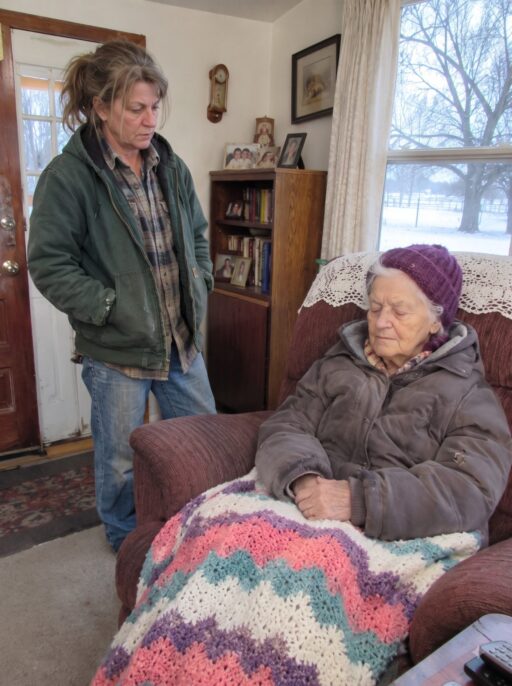
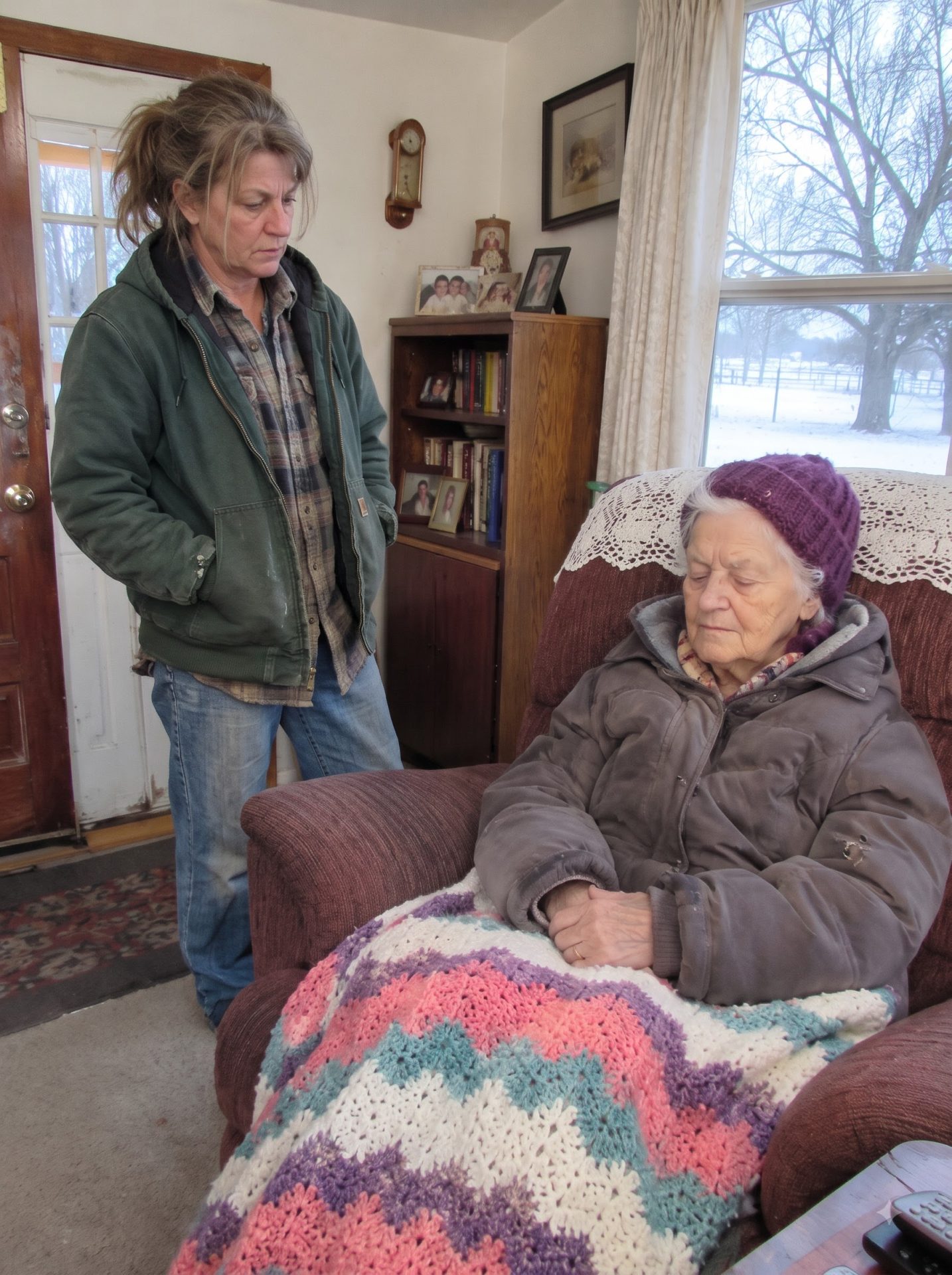
My breath was visible in the freezing kitchen. I hurried into the living room and found Mom sitting motionless in Dad’s old brown recliner.
She wore her thick winter coat, knitted gloves, and a red-and-green hat beneath a crocheted afghan. Frost covered the inside of the windows so heavily that I could barely see the yard light outside.
For several terrifying seconds, I couldn’t tell whether she was breathing. Then I noticed the blanket rising and falling slightly against her chest.
I checked the thermostat and discovered that although it was set to fifty-eight degrees, the actual room temperature had fallen to fifty-one. Mom had refused to leave the farmhouse since Dad died four years earlier, insisting that the place where she had raised her children would always remain her home.
But standing beside her chair that night, I knew something had gone terribly wrong. I couldn’t understand how the house had become so cold when my siblings and I contributed money every autumn to keep her propane tank filled.
My sister Pam lived in Harvey, only twelve miles from our mother’s farm. As the oldest of four children, she had assumed responsibility for most of Mom’s daily needs, including groceries, medical appointments, and managing the propane account.
Our brothers, Rob and Dean, lived farther away, while I worked as a school district payroll clerk in Bismarck. Every October, Rob, Dean, and I each sent Pam $250, and she was supposed to contribute the same amount toward Mom’s heating expenses.
The arrangement had continued for four years without anyone requesting receipts. We trusted Pam because she visited Mom regularly and handled countless responsibilities the rest of us rarely saw.
Rather than wake Mom immediately, I went outside to inspect the large white propane tank beside the farmhouse. After clearing ice from its gauge, I discovered the needle was resting at just five percent.
The 500-gallon tank contained approximately twenty-five gallons, far too little to reliably operate an aging furnace during such extreme weather. With the fuel level dangerously low, the heating system was already struggling to remain lit.
Inside, I searched through the papers attached to Mom’s refrigerator and discovered a pink delivery receipt dated October 19. It showed that Pam had ordered only 200 gallons, leaving the tank at forty-seven percent after delivery.
At roughly two dollars per gallon, that purchase had cost approximately $400. Yet my brothers and I had contributed $750, and Pam’s expected share should have brought the total to $1,000.
There was no evidence of another delivery in December or January. I felt anger rising as I wondered what had happened to the remaining money.
When I gently woke Mom, she seemed confused to find me kneeling beside her chair. But the moment she noticed the delivery receipt in my hand, her expression changed.
“Connie, don’t start an argument with your sister. Pam already has enough problems.”
I explained that the propane tank was nearly empty and that she was sleeping in a house barely above fifty degrees. Mom insisted she was comfortable, although her gloved hands felt painfully cold.
Then she told me about Pam’s husband, Mark, who had undergone back surgery after injuring himself at the grain elevator. He hadn’t worked since September, and their household was surviving on Pam’s clinic wages.
“Propane is expensive this year, Connie. I really don’t mind keeping the house a little cooler.”
I refused to argue while her safety remained uncertain. Instead, I contacted the Harvey Farmers Co-op emergency number until Duane Kessler, a longtime propane driver who had known my father, finally answered.
Duane explained that drifting snow prevented his truck from reaching the farm before morning. He advised me to conserve the remaining propane, close unused rooms, and locate the small electric heater Dad once kept in the basement.
I found the heater behind the water softener and brought it upstairs. After placing it near Mom’s recliner, I wrapped her in additional blankets and my own parka, then stayed beside her throughout the night.
The following morning, county crews cleared the road, and I contacted the co-op to transfer responsibility for the propane account into my name. By afternoon, Duane arrived and delivered 375 gallons at $2.09 per gallon, costing $783.75.
I paid the bill and enrolled Mom in the automatic keep-full program. A tank monitor would now alert the co-op whenever the propane level dropped to thirty percent, preventing another dangerous shortage.
When I raised the thermostat to seventy, the furnace finally started. Within an hour, the farmhouse warmed to sixty-eight degrees, and Mom slowly removed her gloves, hat, and heavy coat.
She carried the coat to the hooks beside the kitchen door and stood there quietly.
“I’d almost forgotten what it feels like to be warm.”
That evening, after Mom fell asleep in her warm bedroom, I contacted Rob and Dean. I told them the propane tank was full, the account was now in my name, and future contributions should come directly to me.
Both brothers immediately sensed something was wrong. I explained only that Mom had been cold and promised to discuss the situation face-to-face at Easter.