
When I returned to my logging truck at Lindholm Lumber Company in Hemlock Run, Pennsylvania, my eighty-year-old father was sitting in the passenger seat, holding a check with both hands. He had remained inside the cab throughout the grading process, claiming his knees hurt, although I suspected he simply didn’t want anyone watching his reaction.
The check was made out to Arvid Lindholm for six hundred dollars. On the memo line, my cousin Lyle had written a single word that explained everything.
“Pallet.”
My name is Pete Lindholm, and I’ve spent twenty-six years hauling timber throughout northern Pennsylvania. I knew immediately that something was wrong because the twenty-two black cherry logs we’d delivered were among the finest I’d ever transported.
They were twelve to fourteen feet long, measuring sixteen to twenty-two inches across at their smaller ends. My father had personally cut every one from the hillside behind his barn, where those trees had grown for nearly eighty years.
Lyle operated the family sawmill, established in 1961 by his father, my uncle Walt. Walt had built his reputation on honest grading, and farmers throughout McKean County trusted him to pay a fair price for their timber.
After Walt died nine years earlier, Lyle took over the operation. Although the lumber market had become difficult, I’d never imagined he’d deliberately undervalue timber belonging to his own uncle.
That morning, his workers had arranged our twenty-two logs on the grading deck. Lyle examined them briefly before marking every single one with a yellow P, classifying them as low-quality pallet wood.
Pallet grade was reserved for timber unsuitable for valuable lumber, often because of defects, decay, or irregular growth. Seeing those beautiful cherry logs classified that way was almost impossible to believe.
The trees had a history that made their value far greater than money alone. My grandfather, Nils Lindholm, immigrated from Sweden in 1922 and purchased our family farm in 1938.
The hillside had been cleared shortly before he bought the property, allowing young cherry trees to grow. Dad remembered walking there as a small boy while his father pointed toward a sapling and told him it would someday provide for his old age.
For decades, Dad watched those trees mature and repeatedly insisted he’d never cut them. But circumstances changed when my seventy-eight-year-old mother, Ingrid, needed extensive dental treatment.
Her dentist estimated that four implants, a bridge, and two crowns would cost $11,400. Their Medicare Advantage plan covered only $1,500 annually for dental expenses, leaving them responsible for nearly everything.
Dad decided to harvest the trees himself rather than ask his children for money. Throughout October, he worked on the steep hillside with his old Stihl chainsaw and Ford tractor, cutting and dragging the timber down toward the barn.
My nineteen-year-old son, Mason, helped whenever he could after his shifts at the Walmart distribution center. Most days, however, Dad worked alone while Mom watched anxiously from the kitchen window.
Now Lyle was offering six hundred dollars for the results of that exhausting labor. I returned to the grading deck and confronted him about the price.
“We’re not selling these logs for that.”
“That’s your decision, Pete. Nobody’s paying much for cherry this season. You won’t find a better offer around here.”
I didn’t argue further because I knew a grader could defend almost any classification with enough excuses. Instead, I turned toward Mason, who was already climbing into the hydraulic loader mounted behind my truck.
He carefully lifted every log back onto the trailer while Lyle retreated into his office. Forty minutes later, all twenty-two logs were secured, and we drove away without accepting the payment.
Dad folded the check and placed it inside his plaid coat. He never cashed it, and I knew we needed someone willing to show us what those trees were actually worth.
We drove the twelve miles back to Dad’s farm without speaking. Mason sat quietly with his arms crossed while Dad watched the hills through the windshield, and I struggled to understand how Lyle could have treated his own family that way.
Mom was waiting on the porch when we arrived. She saw the logs still loaded on my trailer, took one look at Dad’s expression, and returned to the kitchen to prepare coffee.
We gathered around the table with the remaining rhubarb pie. Dad placed Lyle’s folded check in front of Mom, and she immediately noticed the word written on the memo line.
“Lyle,” she said quietly.
“The mill’s having trouble, Ingrid. It’s not entirely his fault.”
“I don’t care how much trouble that mill is in. Those were your father’s cherry trees.”
I understood Dad’s reluctance to condemn his nephew. Lyle had been part of our lives for decades, and he’d supported us during difficult times, including when Dad suffered a heart attack in 2015.
Still, financial hardship couldn’t justify dishonesty. Lyle had borrowed heavily to install a new band saw and kiln in 2022, and falling hardwood prices had placed his business under increasing pressure.
That afternoon, I called an Amish sawmill operator named Levi Yoder, who lived near Smicksburg in Indiana County. I’d delivered oak to his mill several times and knew he understood valuable hardwood.
Levi didn’t have a telephone inside his home, so I called the shared phone booth near his lane. After several unanswered rings, a young woman agreed to fetch him from the barn.
When Levi finally answered, I explained what had happened. I described twenty-two black cherry logs harvested from an old north-facing hillside, their dimensions, and Lyle’s six-hundred-dollar offer.
“How large are the logs?” Levi asked.
“Sixteen to twenty-two inches at the small end, mostly twelve and fourteen feet long.”
“North-facing hillside?”
“Yes. The trees started growing there around 1937.”
After considering the information, Levi gave me a simple instruction.
“Bring them Saturday morning, Pete. And bring your father.”
We left before sunrise on the first Saturday in November. Mom packed sandwiches, coffee, and a rhubarb pie, while Mason followed in his pickup so we’d have another vehicle available if Dad needed assistance.
Dad insisted on riding beside me in the logging truck because he wanted to remain with the timber he’d harvested. We traveled south through Kane, Ridgway, and Brockway, passing bare autumn hills and cold mountain streams.
During the journey, Dad began humming “Children of the Heavenly Father,” an old Swedish hymn Mom played every Sunday on their Baldwin piano. His mother, Hanna, had sung it to him when he was young.
Eventually, Dad told me something about the largest cherry tree that I’d never heard before.
“My father planted the first one himself. Did I ever tell you that?”
“I thought all those cherries grew naturally after the hill was cleared.”
“Most did. But the biggest one near the stone wall came from a seed he brought from Sweden.”
Dad explained that Nils had carried the seed from his mother’s farm in Småland when he immigrated in 1922. He planted it during the spring of 1945, the year Dad was born.
“He told me that when a son is born, you plant a tree for his old age.”
I realized that the largest log on our trailer represented something far more important than lumber. It came from a tree my grandfather had planted to provide for a son he could never have imagined would still be harvesting timber eighty years later.
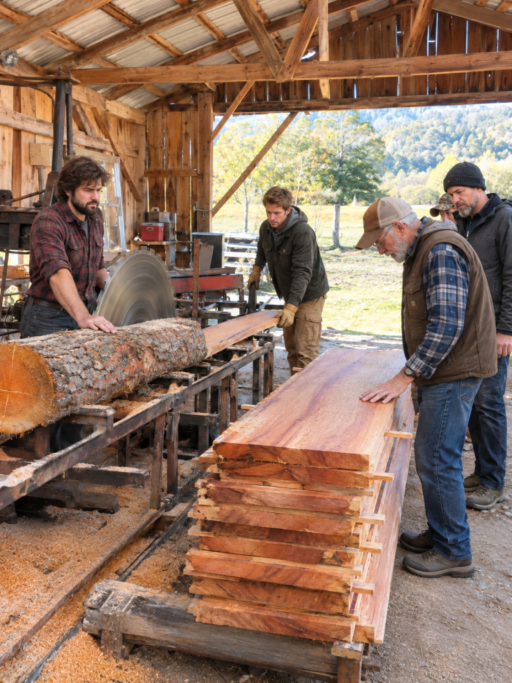
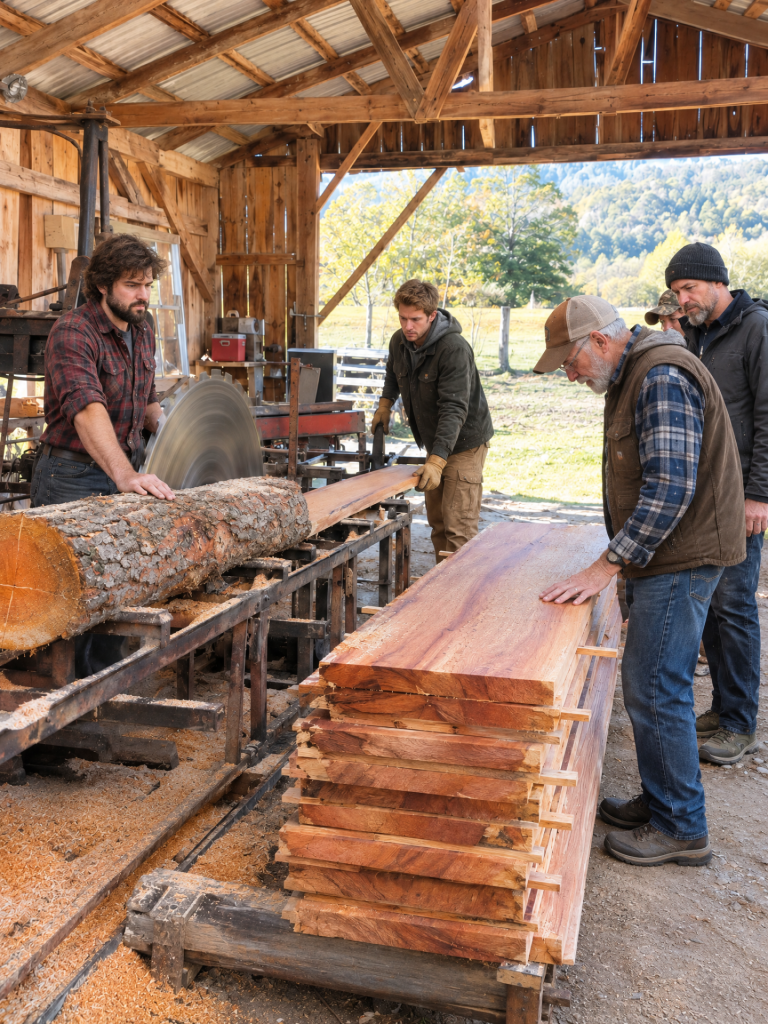
When we reached Levi’s farm, the sun was rising above the surrounding hills. His open-sided sawmill stood near a white farmhouse, with Belgian draft horses grazing nearby.
Levi was waiting beside the saw carriage. He examined the logs carefully, running his hands along their bark and studying their ends before asking Mason to unload them.
He chose the largest log first, the one my grandfather had planted. As the diesel-powered saw began cutting through the timber, I knew we were finally about to learn the truth.