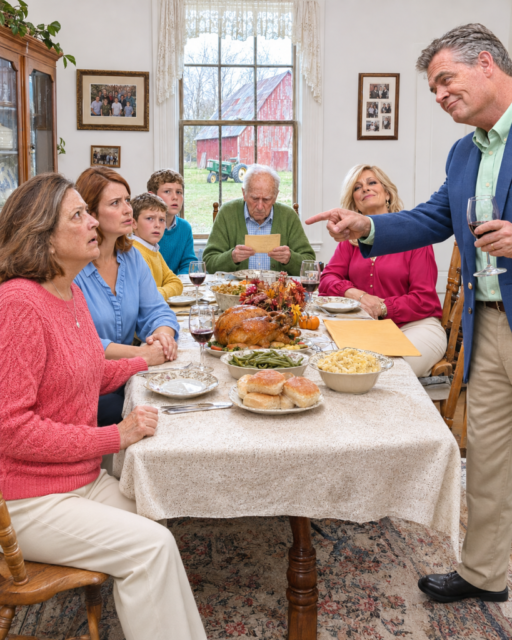
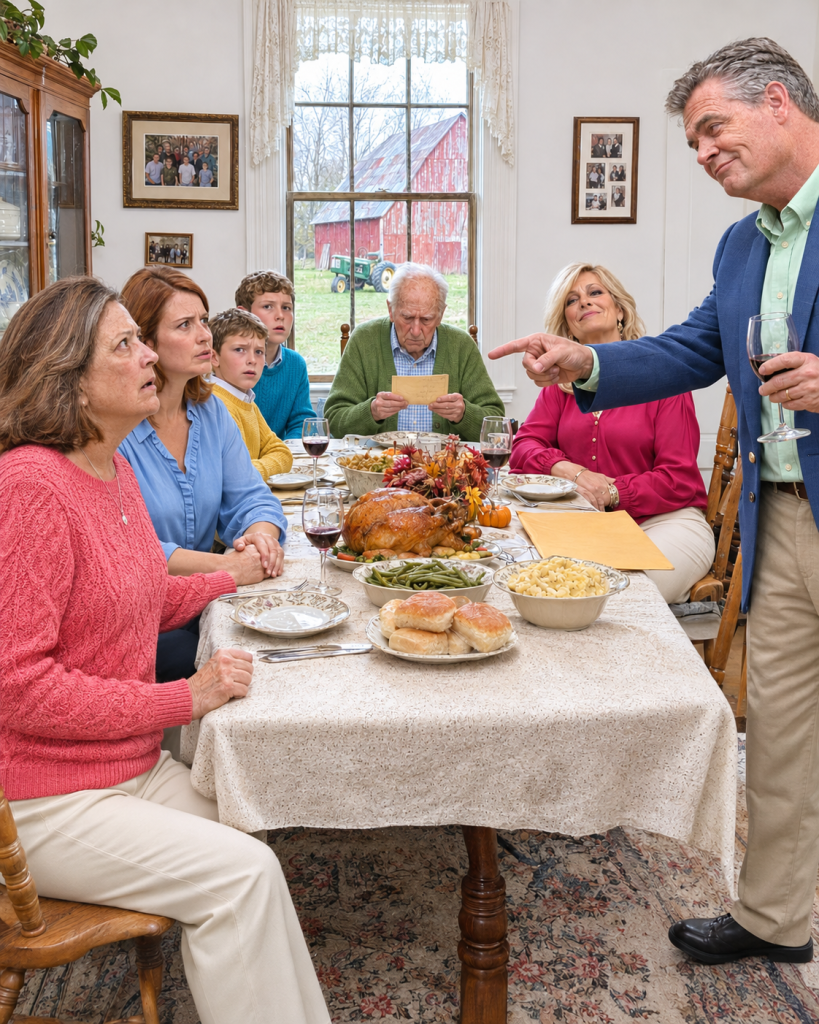

My brother raised his wineglass at Thanksgiving dinner and announced that our father had signed the family farm over to him.
“It’s worth $900,000,” he said proudly. “And Olive, you’ve got until spring to find somewhere else to live.”
My daughter grabbed my hand beneath the table.
Across from me, my ninety-three-year-old father stared at his plate without saying a word.
My brother, Dane, had no idea that the farm he’d just promised to sell had legally belonged to me for thirty-two years.
Our family farm sits outside Brookville, Pennsylvania. I’ve lived there almost my entire life, apart from two years attending business school in Clarion.
For thirty-six years, I worked nights at the county newspaper so I could spend my days helping maintain the property. I kept the financial records, paid the property taxes, repaired fences, and cut hay with the old green tractor my mother used to drive.
My husband passed away years ago. His worn barn coat still hangs beside my back door because I haven’t found the strength to move it.
Daddy lives in the main farmhouse, while I stay in the smaller house across the lane.
Every morning, I walk over to prepare his oatmeal and organize his medications.
“You’re a good girl, Olive,” he tells me.
Dane, meanwhile, moved to the city decades ago.
He visits once a year for Thanksgiving, usually bringing a store-bought pie and leaving before anyone starts washing dishes.
He rarely calls Daddy except on birthdays and Christmas.
This Thanksgiving, Dane arrived with his wife, Charla, and something unusual: a large manila envelope.
I noticed it on the passenger seat when I went outside to welcome them.
Charla immediately wandered toward the back pasture, taking photographs of the pond, the old red barn, and the surrounding fields.
“Just collecting memories,” she explained when she noticed me watching.
I didn’t think much of it then.
At noon, we gathered around Mother’s old dining table. My daughter Laurel sat beside me with her two sons, while Daddy quietly pushed his vegetables around his plate.
He seemed unusually distracted.
“Are you feeling all right, Daddy?”
“I’m fine, Olive. Just fine.”
But he wouldn’t meet my eyes.
Before dessert, Dane stood and tapped his glass with a fork.
“I’ve got some wonderful news.”
Charla smiled as though she’d been waiting for this moment all morning.
“Dad signed the farm over to me last week,” Dane announced. “A developer wants to build houses here, and he’s offering nine hundred thousand dollars.”
Then he turned toward me.
“Sis, you’ve got until spring to move out.”
My face burned.
For a moment, I couldn’t speak.
The little house he wanted emptied contained my mother’s sewing machine, my husband’s belongings, and nearly every memory I’d made as an adult.
And the land he’d promised to a developer wasn’t his to sell.
When Mama died in 1994, her will left the farm to me. Daddy received the legal right to live in the farmhouse for the remainder of his life, but he couldn’t transfer ownership of the property.
Dane hadn’t attended the meeting with Mama’s attorney.
Daddy had asked me not to tell him.
“It would break your brother’s heart,” he’d said. “Let him believe what he wants.”
For thirty-two years, I’d honored that request.
Now Dane was standing at our mother’s table, ordering me out of the home she’d left me.
Laurel leaned toward me.
“Mom, please don’t fight him today. Grandpa will be the one who suffers.”
I almost listened.
Then Charla put down her glass.
“Olive, sweetheart, we’ll give you a few weeks to clear all your junk out of that little house.”
I looked at Daddy.
His hands were trembling, and he still hadn’t raised his head.
I slowly set down my cider.
“Daddy, are you going to tell them, or should I?”
Dane laughed.
“Tell us what?”
For the first time that afternoon, Daddy looked directly at me.
“Your mama said this day would come.”
Then he reached into his shirt pocket and pulled out a small, yellowed envelope.
I recognized my mother’s handwriting immediately.
But I had never seen that letter before.
Daddy held the yellowed envelope in both hands while everyone waited for him to speak.
The paper had been folded so many times that its corners were worn smooth. I recognized Mama’s handwriting, but I couldn’t imagine why Daddy had kept her letter hidden for more than three decades.
Dane lowered his wineglass.
“Dad, what’s that?”
Daddy slowly unfolded the paper and adjusted his glasses.
“Your mother wrote this before she passed,” he answered.
Then he began reading.
“Dane, if your father is reading this at my table, you’ve finally tried to take the farm away from your sister. It was never his to give.”
The room fell silent.
Charla stopped smiling. Laurel tightened her hand around mine, while Dane stared at our father as though he’d misunderstood every word.
“What are you talking about?” Dane demanded.
Daddy continued reading.
Mama had written that she loved both her children, but she wanted us to understand why she’d divided her estate the way she had.
Dane had received financial help for college and assistance buying his first home in the city. I had remained on the farm, working alongside my parents and helping preserve the property.
Mama believed the farm should belong to the person who had dedicated her life to caring for it.
She also hoped neither of us would ever use family loyalty as an excuse to take something from the other.
“Mom actually wrote that?” Dane asked.
“She did,” Daddy replied.
“And you knew all these years?”
Daddy nodded.
I felt a fresh wave of anger.
For thirty-two years, I’d kept Daddy’s secret because he couldn’t bear disappointing his son. Every Christmas, Dane talked about inheriting the farm, and I stayed quiet to preserve the peace.
Now I was discovering that Mama had anticipated this exact confrontation.
Dane turned toward me.
“You knew about this?”
“I knew Mama left me the farm. I didn’t know she’d written you a letter.”
He looked back at Daddy.
“But you signed the transfer papers last week!”
Daddy folded the letter against his chest.
“I signed what you brought me because I’ve never been good at telling you no,” he admitted. “But I knew I couldn’t give you land that wasn’t mine.”
Charla leaned forward.
“Are you saying the sale isn’t valid?”
“The farm belongs to me,” I answered. “Mama left Daddy the right to live here for the rest of his life. She didn’t give him ownership to sell or transfer.”
Dane pushed his chair backward.
“You let me believe this place would be mine!”
Daddy’s expression crumpled.
“I kept thinking I’d find the right time to explain.”
“Thirty-two years wasn’t enough?”
I couldn’t blame Dane for being shocked by the inheritance arrangement. But I couldn’t excuse his decision to sell the farm without speaking to me.
I looked at the envelope he’d brought.
“You said a developer offered nine hundred thousand dollars. Did you tell him you owned the property?”
“I told him Dad agreed to the sale.”
“That’s not the same thing.”
“We had an understanding,” Dane insisted.
Daddy looked down at Mama’s letter.
“I said I’d let you handle things. I should never have signed those papers.”
For a moment, I felt sorry for both of them.
Daddy had spent decades avoiding a difficult conversation, while Dane had built his expectations around a promise nobody had the authority to make.
But their disappointment didn’t erase my rights.
Dane leaned across the table.
“Olive, think about the money. Nine hundred thousand dollars! You could buy a beautiful house anywhere you wanted.”
“And where would Daddy live?”
“We’d figure something out.”