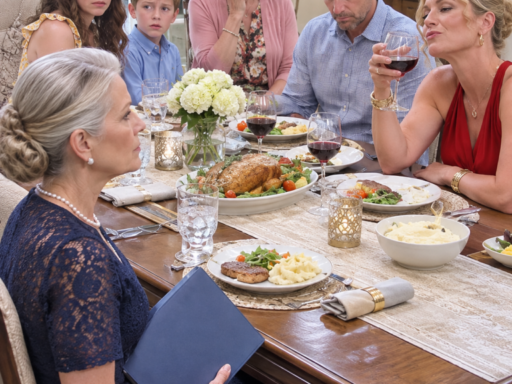
“You need to postpone your wedding, Emily. Megan’s engagement party takes priority, and if you refuse, not a single member of this family will attend your ceremony.”
My father delivered those words with the casual indifference of someone rescheduling a routine appointment. Standing beside the marble kitchen island in the townhouse I shared with my fiancé, Daniel Whitmore, I struggled to comprehend what he was demanding.
“Just move everything back three or four months. Contact your caterers and rearrange the reservations. It’s only a modest gathering anyway.”
Behind me, the dining room table was covered with ivory wedding invitations, sage and dusty rose ribbon samples, carefully organized vendor schedules, and floral invoices. I had spent eleven months planning our wedding, invested nearly $60,000 of my personal savings, and had only thirty-two days remaining before the ceremony.
“Megan finally has an opportunity to enjoy the attention she deserves,” Dad continued. “You need to step aside and stop making everything about yourself.”
My father, Richard Grayson, had spent thirty years working in middle management at a regional logistics company before retiring with a comfortable pension and an exaggerated sense of importance. My mother, Helen, had been a homemaker since 1991, dedicating most of her energy to maintaining our family’s social reputation and ensuring my younger sister received everything she wanted.
“If you refuse, I’ll personally make sure every relative understands how selfish you’ve been. Nobody will attend your wedding. Do I make myself clear?”
At twenty-eight, I should have been accustomed to being treated as an inconvenience, but hearing those words still hurt. Something inside me finally surrendered the hope that my parents might someday consider my happiness as important as Megan’s.
“I understand.”
I disconnected the call and placed my phone on the counter. Across the dining room, Daniel looked up from the cardboard seating arrangement he had been adjusting for the past hour.
Dressed in a faded college sweatshirt and charcoal sweatpants, with reading glasses resting slightly crookedly on his nose, Daniel was the same modest, unassuming man I had fallen in love with three years earlier. When he noticed my trembling hands, he immediately put down his measuring tape and approached me.
“Emily, what’s happened?”
Before I could answer, my phone began vibrating with messages from my family. Their demands were hardly surprising, considering the favoritism that had defined my childhood and followed me into adulthood.
When I graduated summa cum laude with a degree in architectural engineering, my mother canceled her attendance seven minutes before the ceremony because Megan’s boyfriend had broken up with her. I celebrated alone at an Italian restaurant near campus, eating risotto while other graduates enjoyed the company of their families.
When I obtained my architectural license, my parents barely acknowledged the achievement. Yet when Megan changed her hair color from honey blonde to chestnut, Mom organized an elaborate brunch complete with catered food and vintage champagne.
Their attitude toward Daniel had been equally dismissive. Because he drove an eight-year-old hatchback, wore ordinary clothing, and preferred discussing engineering and public parks rather than luxury brands or investments, my father had concluded that he was an insignificant man with little social value.
Meanwhile, Megan had recently become engaged to Julian Ashford, an ambitious junior partner at a commercial litigation firm with impressive social connections. Through Julian, she had secured an unexpected reservation at the prestigious Grand Sterling Country Club, an establishment with a three-year waiting list for major celebrations.
Unfortunately, the available Saturday was the exact date of my wedding. My parents had decided that Megan’s opportunity to impress Julian’s wealthy family mattered more than everything Daniel and I had spent nearly a year preparing.
What they had never bothered to discover, however, was who my quiet fiancé actually was.
The family group chat began filling with messages before I could explain the situation to Daniel. My mother accused me of being stubborn, while my father insisted that supporting Megan’s future was a responsibility every member of our family needed to accept.
“Emily, stop behaving so selfishly. Your sister’s future is at stake.”
Megan’s message was even more insulting than my parents’ demands.
“Julian’s family belongs to real society, Em. You and Daniel can get married at the courthouse any Tuesday. Julian has a legacy to build.”
My mother then demanded written confirmation of my wedding cancellation before midnight, threatening to permanently withdraw the family’s presence and financial support. I almost laughed at the absurdity of her threat because my parents hadn’t contributed a single dollar toward our ballroom, flowers, photographer, or string quartet.
Every expense had come from savings accumulated during eighty-hour workweeks at an architectural firm, where I had earned my position as senior project manager through years of dedication. Nevertheless, my immediate instinct was to apologize and find some way to satisfy everyone.
Daniel gently covered my trembling hands with his before taking the phone from me. His normally relaxed expression had hardened, and there was an unfamiliar seriousness in his eyes.
“Daniel, please don’t make this worse. They’ll turn everyone against us, and I don’t want a war.”
“The war was over before it began, Emily. They just haven’t realized it yet.”
Without composing a lengthy explanation or defending our wedding arrangements, Daniel typed a single message into the family group chat.
“Before you continue disrespecting our wedding, perhaps you should ask Julian what Daniel’s last name represents.”
For twelve seconds, the screen indicated that my mother was typing a response, but the notification suddenly disappeared. Within minutes, the relentless stream of messages had stopped completely.
My family had never understood the significance of Daniel Whitmore because they had never considered him important enough to investigate. When I met him at an urban preservation gala three years earlier, his worn navy blazer and modest leather notebook had led me to believe he was an ordinary architectural professional.
Six weeks later, I discovered that Daniel was the only son of Gerald Whitmore, the man behind Whitmore Enterprises. The corporation owned commercial properties across six states, developed medical complexes, operated European boutique hotels, and controlled a substantial portion of our city’s commercial skyline.
Its hospitality division also owned four prestigious regional golf resorts, including the Grand Sterling Country Club, where Megan intended to celebrate her engagement. Despite his extraordinary background, Daniel preferred working on construction sites, driving his old Japanese hatchback, and discussing engineering rather than displaying his family’s wealth.
My parents had shared eleven dinners with him over three years without once asking meaningful questions about his professional background. They had mistaken his humility for insignificance, and now their assumptions were about to cost them dearly.