
“Perhaps you believed that at first. But what did you think when Tess hit the mailbox? You could have taken over, or you could have followed them. Instead, you sat on the porch.”
Lorraine began crying, admitting that she had spent forty years making do with secondhand vehicles and furniture. She had desperately wanted to keep one valuable possession in perfect condition and hadn’t considered the consequences of her decision.
“I understand everything you’ve gone without,” Dad replied. “But none of that was Owen’s fault.”
He extended his hand, and Lorraine reluctantly retrieved the Buick’s key fob from her purse. Dad placed it inside his shirt pocket and announced that the vehicle would remain unused until he decided what to do with it.
He also insisted that Lorraine acknowledge Tess, whom she had avoided looking at since arriving.
“You drove very well,” Lorraine finally told her.
The words sounded painfully inadequate, and she immediately excused herself. Tess reached for Grandpa’s hand and apologized for destroying his mailbox.
“I’ll replace it, sweetheart. Don’t you ever apologize for what you did today.”
Owen remained hospitalized for five days, gradually recovering from the infection. Tess slept in the recliner beside his bed every night, earning the affectionate nickname “the driver” from the nursing staff.
A hospital social worker subsequently interviewed me after reviewing the deputy’s report. I made it clear that my children would never again remain at the farmhouse unless their grandfather was personally present.
The medical bills arrived in November, including a $1,870 ambulance charge and hospital expenses exceeding $41,000. My insurance covered most of the treatment, leaving me responsible for $4,500.
I arranged a payment plan, but Dad secretly paid the entire outstanding balance after learning about it from Kim. Several weeks later, he visited me and revealed that he had made another significant decision.
Lorraine had spent the previous year persuading him to add her name to the deed of our family farm, part of which had belonged to our relatives since 1906. He had scheduled an appointment with his attorney for October 28 and had nearly agreed to her request.
“I kept the appointment, Marnie. But I changed what I intended to accomplish.”
Instead of transferring ownership to Lorraine, Dad established a trust protecting the family property. She would retain the right to live in the farmhouse for the remainder of her life, with money reserved for her living expenses.
However, ownership of the land would eventually pass to me and subsequently to Tess and Owen.
Dad had ensured that Lorraine understood every provision before signing the documents. When I asked how she had reacted, he quietly shook his head.
“She said she supposed she deserved it.”
During the first week of November, the pearl-white Buick was returned to the dealership in Salina. Surprisingly, Lorraine herself had requested that Dad sell it, admitting that she could no longer bear to sit inside the vehicle.
The dealership purchased it as a used car with only four hundred miles on the odometer, leaving Dad with a loss of approximately $9,000 after settling the loan. Lorraine returned to driving her old Buick with its cracked dashboard.
On the Sunday before Thanksgiving, she appeared unexpectedly at my front door carrying a casserole and an envelope. Inside was a check for $1,870, drawn from the modest savings she had accumulated by selling eggs and altering clothes.
“Lorraine, Dad has already taken care of the ambulance expenses.”
“Then put it away for the children. I don’t want to keep that money.”
She admitted that she had recognized her terrible mistake shortly after watching Tess disappear down the gravel road. Overwhelmed by shame and indecision, she had remained on the porch instead of following them.
“I was wrong, Marnie. I’ve thought about what happened every single night, and I still can’t give you a good explanation.”
I accepted her contribution without pretending that everything had been forgiven. When she asked whether Tess was home, my daughter remained upstairs, listening without coming down.
Lorraine glanced toward the staircase before quietly nodding.
“Please tell her I asked about her.”
We returned to the farm for Thanksgiving because Dad wanted us there and Owen desperately missed his barn cat. Lorraine prepared the entire meal, including a small pumpkin pie especially for Owen.
He happily thanked her, but Tess remained distant throughout the gathering. She was polite whenever Lorraine addressed her, yet she made no effort to initiate conversation, and I respected her decision.
After dinner, Dad invited the children outside to show them something he had been working on. He had replaced the damaged mailbox with a sturdy steel post secured inside a wide concrete foundation.
Before the concrete hardened, he had engraved three things into its surface: TESS, OCTOBER 16, and 9 MI.
My daughter stood quietly beside the mailbox, studying the inscription with her hands tucked inside her coat pockets. Dad remained beside her, allowing the gesture to speak for itself.
“Grandpa, why isn’t my name there?” Owen asked.
“Because you were the cargo, buddy.”
Owen eventually returned to school and proudly showed his two-inch surgical scar to anyone willing to listen. His recovery brought enormous relief to our family, although Tess was still processing everything she had experienced that afternoon.
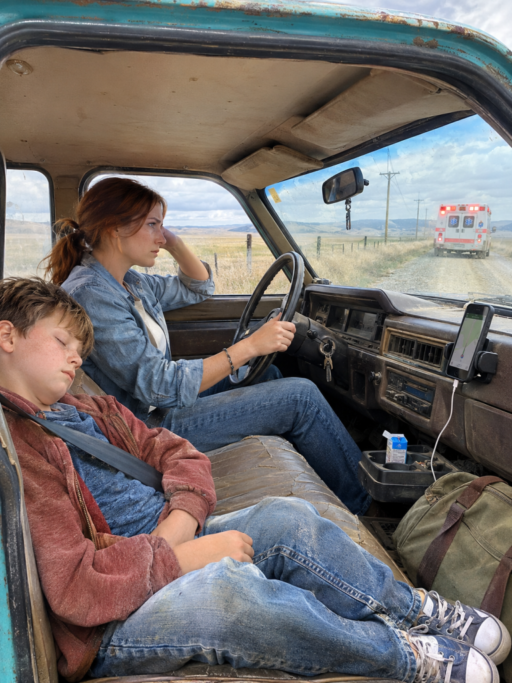
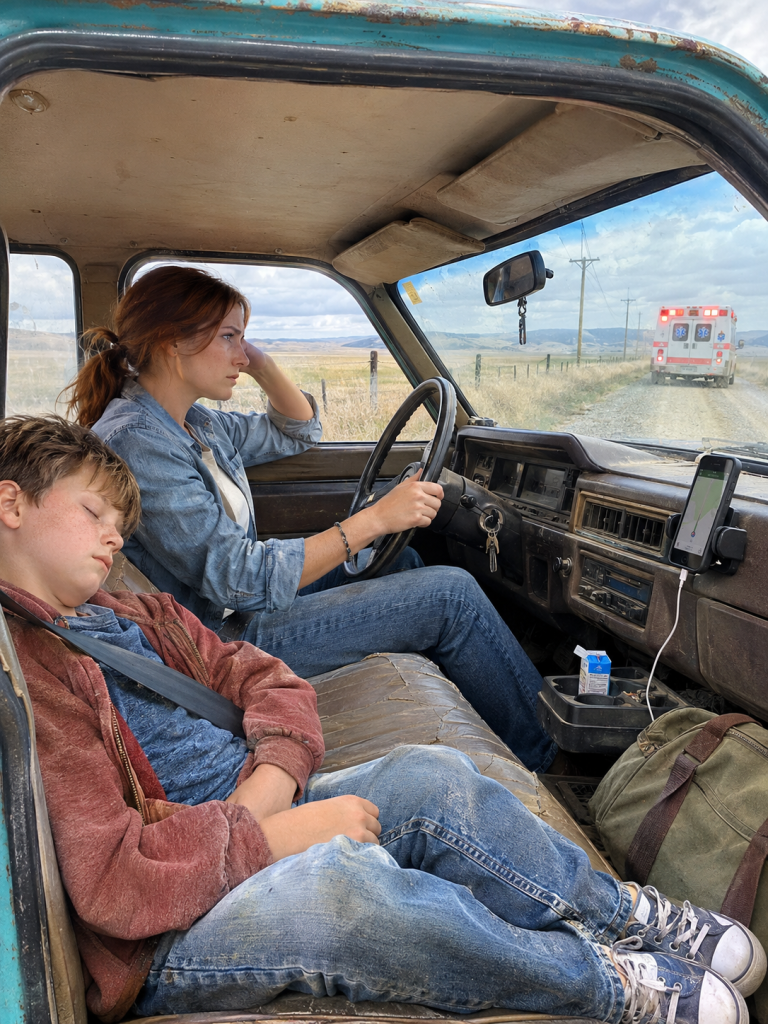
She hadn’t driven since the emergency. Grandpa’s old blue Ford was back beside the hay shed, its bumper bearing a new dent that Dad had deliberately decided not to repair.
He had twice offered to let Tess drive around the pasture again, but she had told him she wasn’t ready. Nobody pressured her to overcome her fear before she felt comfortable doing so.
Last Sunday, while standing beside Dad’s kitchen window, I noticed Tess sitting alone inside the pickup. The engine was off, the driver’s door was closed, and her hands rested quietly in her lap.
She remained there for approximately twenty minutes before climbing out and returning to the farmhouse. When she came inside, she simply asked what we were having for supper.
I didn’t question her or mention the truck. I knew that whatever she needed to overcome, she deserved the time and patience to do it at her own pace.
My daughter had already demonstrated more courage in those nine miles than many people manage to show in an entire lifetime.