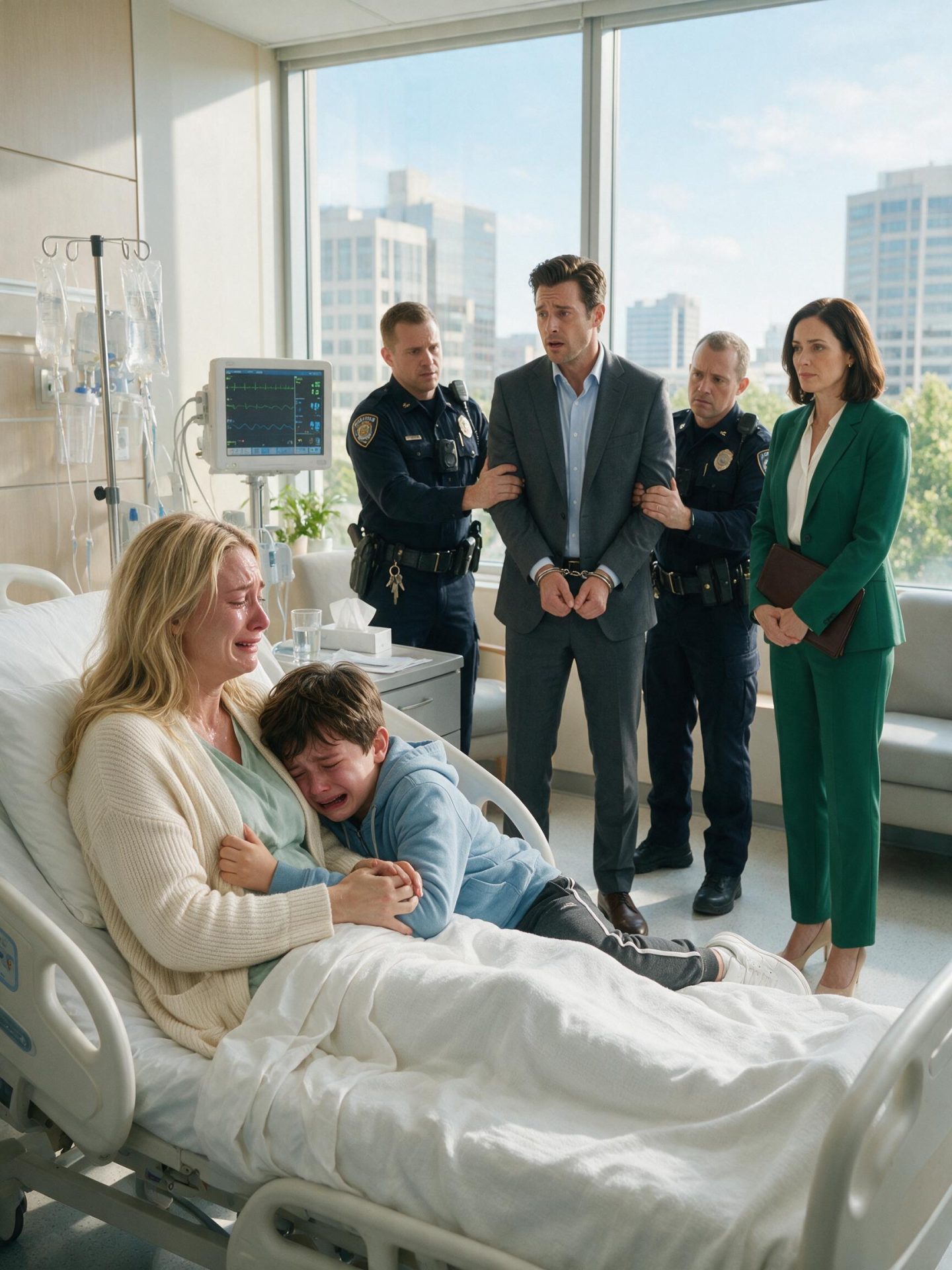

The first words I heard after the crash weren’t spoken by a doctor or a nurse. They came from my husband, standing beside my hospital bed as though he were discussing an ordinary business transaction instead of deciding my future.
“Once they declare her incapacitated, liquidate everything… and then pull the plug.”
Every syllable reached me with terrifying clarity. I wanted to open my eyes, sit up, and tell him I could hear every word, but my body refused to obey. My lungs continued breathing because of the machines surrounding me, yet every muscle remained locked in place, trapping me inside a silent prison where I could think, remember, and understand everything without being able to prove I was still alive.
The doctors at Northwestern Memorial Hospital believed I had never regained consciousness after the crash on the icy highway outside Evanston. Nurses spoke gently whenever they entered my room, physicians carefully explained my condition to visitors, and the media slowly lost interest after the first week, convinced that Victoria Sterling—the criminal defense attorney who had spent years dismantling other people’s lies in court—had become little more than another tragic headline.
They were all wrong. I wasn’t gone. I heard the squeak of medication carts rolling through the hallway, the steady rhythm of monitors beside my bed, the rain tapping softly against the window late at night, and every conversation people mistakenly believed I would never remember. The cruelest part wasn’t the silence surrounding me; it was realizing that everyone spoke more honestly once they believed I could no longer answer.
Every afternoon, however, one voice cut through the darkness and reminded me why I refused to let go. My eight-year-old son Julian arrived carrying the same bright blue backpack from school, dragged a chair beside my bed, gently wrapped his small fingers around my hand, and talked to me exactly as if I were listening.
“Mommy, my teacher said I read better than anyone else today.”
He paused before continuing more quietly.
“Dad forgot to pick me up again, but Mrs. Gable walked me home. Don’t worry… I know how to take care of myself now.”
Those words hurt far more than the injuries from the crash. No eight-year-old should ever believe learning to survive alone is something to be proud of. I wanted to tell him he didn’t have to become an adult before finishing elementary school, that I would come home soon and everything would be all right, but the only answer I could give him was the unbearable silence of a body that refused to move.
Richard’s visits couldn’t have been more different. He never appeared when the room was empty or when only Julian and I were together. Instead, he arrived whenever reporters gathered in the hospital lobby or influential partners from our law firm scheduled visits, carrying enormous bouquets of expensive lilies and wearing impeccably tailored suits that made him look every bit like the devoted husband the public expected him to be.
“My wife is an extraordinary woman,” he would say with perfectly measured grief while nurses offered sympathetic smiles and warm coffee. “I’d give every dollar I own just to see her open her eyes again.”
Listening to those performances became almost unbearable because I knew the man standing beside my bed had never celebrated my success. Throughout our marriage, Richard quietly resented every courtroom victory I won, every major client I brought into the firm, and every compliment I received that reminded him people considered me the better attorney.
Months before the accident, I had begun noticing financial irregularities inside our firm’s escrow accounts. Millions of dollars seemed to disappear before quietly resurfacing elsewhere, digital signatures appeared on documents I never approved, and transfers moved through accounts that served no legitimate legal purpose. Every time I questioned Richard about the discrepancies, he answered with the same patronizing smile that made me feel as though I were imagining problems that didn’t exist.
“Not every issue in life can be solved like one of your courtroom cases, sweetheart.”
At the time, I assumed he simply underestimated my instincts. Looking back, I realize he wasn’t dismissing my suspicions because they were wrong. He was buying himself time before I uncovered something that would destroy everything he had built.
The night everything finally made sense began after Julian fell asleep in the chair beside my bed, still clutching one corner of my blanket. The hospital room was almost completely dark when the door opened quietly, and I immediately recognized Richard’s heavy footsteps, followed seconds later by the unmistakable sound of high heels and the sweet perfume of Vanessa, his executive assistant.
“What if she wakes up?” Vanessa whispered nervously.
Richard laughed under his breath.
“She’s not waking up. Harrison says her brain activity is practically nonexistent.”
“But she’s still breathing.”
He stepped so close that I could feel his breath near my face.
“That’s why we need to move quickly. Once the court approves guardianship, I’ll sell her shares in the firm, the Winnetka house, and her investment portfolio. After that, Harrison will handle the rest.”
Every word stripped away another layer of the lie I had been living. This wasn’t simply about inheritance or control. Richard had already planned my future down to the final machine keeping me alive.
Then he said the sentence that shattered everything I believed about the crash.
“I cut her brake lines once, and nobody suspected a thing. This is going to be even easier.”
Suddenly, every memory returned with brutal clarity. I remembered pressing the brake pedal as my car approached the icy curve outside Evanston. I remembered the sickening realization that nothing happened, the truck rushing toward me, shattered glass exploding across the windshield, and darkness swallowing everything before I could even understand what had gone wrong.
It had never been an accident.
The man crying in front of television cameras had caused it himself.
Rage unlike anything I had ever known surged through me. I wanted to rip every tube from my body, expose Richard in front of the entire hospital, and warn Julian that the person he still called Dad had already decided both of our futures. But my body remained perfectly still, refusing every desperate command my mind sent to it.
Then I felt something warm wrap gently around my left hand. Julian had woken up without Richard noticing, and his tiny fingers closed carefully around mine.
“Mommy…”
His voice trembled with exhausted hope.
“Please wake up.”
Richard never heard him. Vanessa never noticed him. But lying motionless beneath white hospital sheets, listening to my frightened little boy beg me to come back while the man who tried to kill me calmly planned my death, I made myself one silent promise. I would not die in that hospital bed—not before protecting Julian, not before exposing Richard, and not before the truth he believed buried forever finally reached the light.
Richard and Vanessa left only after discussing details that no loving husband should ever have considered. They talked about guardianship paperwork, the timing of insurance payouts, and which board members would support Richard once my shares in the law firm were transferred. Every sentence sounded less like a grieving family member planning for uncertainty and more like an executive finalizing a corporate merger.
“I’ve already spoken to the trustees,” Richard said confidently.
“They’ll approve everything once Harrison signs the updated medical recommendation.”
Vanessa hesitated before asking the question that clearly still bothered her.
“And the boy?”
Richard sighed impatiently.
“Julian will adjust.”
“Children always do.”
“I’ll tell him it’s what his mother would have wanted.”
Those words chilled me more than the machines keeping me alive. My son wasn’t grieving a mother who had died. He was being prepared to accept a version of my death carefully written by the man responsible for it. Richard wasn’t simply trying to erase me from his marriage—he was rewriting me out of my own son’s future.
After they disappeared into the hallway, Julian stayed beside me for a long time without speaking. I could hear him shifting in the chair, wiping away tears he thought no one would notice, before he leaned closer until I could feel his forehead resting gently against the back of my hand.
“Mom…”
“I heard Dad talking.”
His voice was barely louder than a whisper.
“He said you’re never coming home.”
A long silence followed before he spoke again.
“I don’t believe him.”
For the first time since the crash, hope pushed through the fear that had surrounded me for weeks. My body remained completely still, but my heart refused to surrender because somewhere inside that frightened little boy, faith still existed. Even after every adult around him had begun preparing for my funeral, Julian continued talking to me as though he knew I was still listening.
The following morning, I began noticing another pattern inside the intensive care unit. Every nurse carefully documented my condition, every specialist reviewed the same charts, and every physician followed strict hospital procedures—except one man. Dr. Harrison always visited after Richard arrived, never before, and every conversation between them happened just outside my room where they believed no patient could hear.
“Any changes?” Richard asked quietly.
“Nothing meaningful,” Harrison replied.
“We’ll repeat the neurological assessment next week.”
“And the guardianship paperwork?”
“It should move quickly.”
Their voices remained calm, almost routine, but I had spent my entire legal career recognizing when people avoided saying exactly what they meant. They never directly discussed ending my life, never openly mentioned my assets, and never used words that sounded criminal. Instead, they relied on implication, assuming nobody would ever piece the conversations together.
Unfortunately for them…
Listening had always been my greatest strength. Before I ever became one of Chicago’s most successful defense attorneys, I learned that the truth rarely appears in one dramatic confession. It hides inside patterns, repeated behaviors, and small inconsistencies that eventually fit together into a story nobody intended to tell. Lying motionless beneath those hospital blankets, I realized I wasn’t merely surviving anymore.