
By the time I reached my mid-forties, I had learned that living with a disabled child meant keeping paperwork most people would never think twice about. Every permit, inspection report, contractor drawing, survey, and approval related to Emma’s wheelchair ramp stayed organized inside a blue folder because experience had taught me that accessibility often depended on being able to prove it was legitimate.
Emma was fourteen when everything happened. Ever since a spinal injury changed the way she moved through the world, she had relied on a wheelchair, but it had never changed her determination, quick wit, or fierce desire to remain as independent as possible. The ramp leading from our porch to the driveway made that independence possible, allowing her to leave and return home without needing me to push her every step of the way.
Jason moved in next door the following spring. At first, he seemed like nothing more than an overly particular neighbor, trimming his lawn constantly, washing his truck every weekend, and even asking me to move our trash cans a few inches because he thought they ruined the symmetry between our houses.
I agreed without arguing because choosing peace seemed easier than fighting over something so small. Looking back, that simple decision became the first sign Jason misunderstood my patience. He assumed my willingness to avoid conflict meant I would eventually give in to every unreasonable demand he made.
Over the next two years, his complaints became more frequent. He grumbled about delivery drivers, criticized the medical transport van that occasionally picked Emma up, and even commented on the sound of her wheelchair crossing our porch after school. He never spoke harshly to Emma directly, preferring instead to disguise his contempt behind words like appearance, standards, property value, and neighborhood improvement.
Everything escalated after Jason decided to replace his old detached garage. He proudly showed me the contractor’s rendering over the fence one afternoon, assuring me there would be plenty of room between the new building and our property line when I asked how close it would be.
“Plenty of room.”
I believed him because I assumed he had done the proper research before spending that kind of money. Once again, I chose trust over suspicion, never imagining that decision would eventually affect my daughter’s ability to enter her own home.
Construction began during the summer, and before long the oversized garage towered over the side of his property. It sat much closer to our fence than I expected, and after the first heavy rain, water poured into our yard, collecting beside Emma’s wheelchair ramp. When I mentioned it, Jason brushed off my concerns and insisted everything would settle over time.
By autumn, his new garage had become the center of his pride. He often left the door open so everyone passing by could admire the polished floor, custom cabinets, and spotless interior, and as his satisfaction with the building grew, so did his irritation with Emma’s ramp.
He repeatedly complained that the ramp made our home look temporary and claimed it lowered property values because buyers disliked what he called “medical-looking additions.” I reminded him that the ramp wasn’t decorative but essential for my daughter, yet he casually suggested relocating it to the back of the house, where uneven ground made that impossible.
“No.”
That single answer ended the conversation, but not the conflict. Jason walked away without arguing, leaving me with the mistaken impression that he had accepted my decision. In reality, he had simply chosen to wait for a moment when he believed I couldn’t stop him.
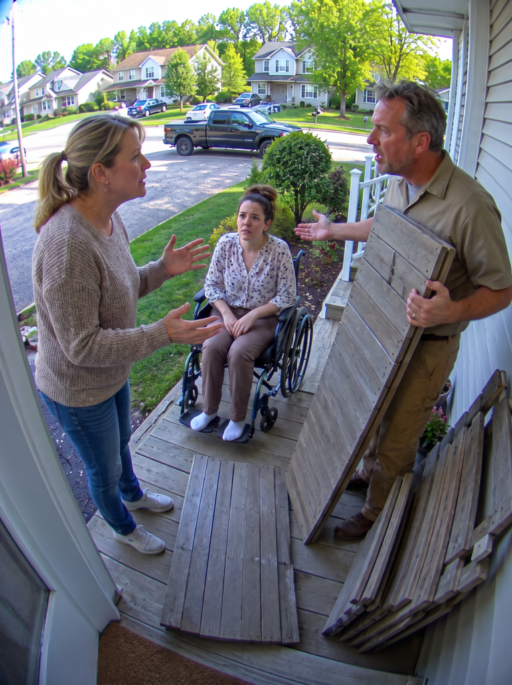
That moment arrived on a cold, damp morning while I was packing Emma’s lunch. I first heard what sounded like wood scraping against brick, followed by the unmistakable snap of metal brackets being pulled loose from the porch. When I reached the front door, several heavy boards had already been stacked against it from the outside, trapping us inside our own home.
Emma rolled into the hallway behind me, staring at the blocked entrance with confusion.
“What is that?”
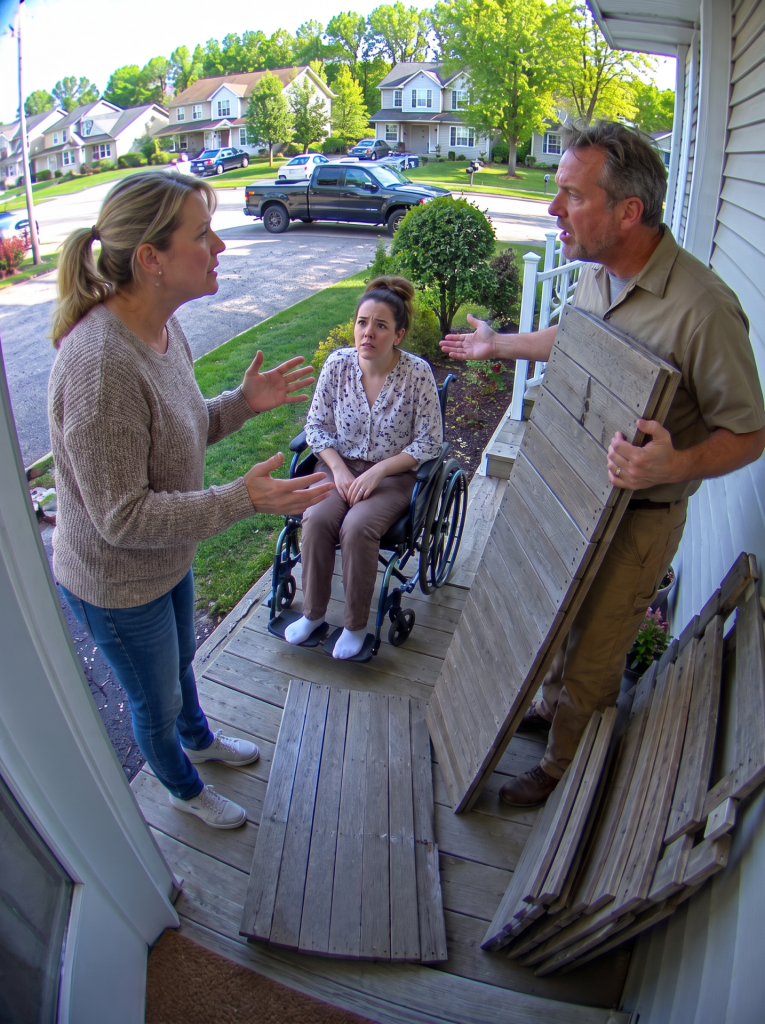
I hurried out through the side door and rounded the house, where the smell of freshly cut pine hit me before I reached the front yard. Jason stood on our porch gripping a pry bar while sections of Emma’s wheelchair ramp lay scattered across the grass, their metal brackets twisted and screws scattered across the concrete.
“Stop.”
Jason slowly turned toward me without showing the slightest hint of surprise. His calm expression made it painfully obvious he had been expecting us to come outside.
“The ramp crosses my side.”
“It does not.”
“It does.”
Emma carefully wheeled herself around the driveway until she reached the front of the house. Looking at the missing ramp and the boards blocking the doorway, she quietly set the brakes on her wheelchair.
“Mom… I can’t get inside.”
Jason heard every word. Without lowering the pry bar, he looked directly at me and answered with complete indifference.
“Move if you don’t like it.”
His words were directed at me, but it was my daughter who paid the price. For one brief moment, anger nearly overwhelmed my judgment, yet before I could react, Emma softly said my name, reminding me that rage wouldn’t solve anything.
Instead, I reached into my pocket and took out my phone.
“Say it again.”
Jason hesitated for the first time.
“You heard me.”
“I want the city to hear you.”
I recorded everything: the dismantled ramp, the boards blocking our front door, the damaged brackets, the scattered screws, the muddy footprints, and the pry bar still clutched in Jason’s hand. Less than an hour later, I had already scanned every document from the blue folder and sent the permits, inspection reports, survey, photographs, and video directly to the city’s building department.
After I contacted the city, I called the contractor who had installed Emma’s wheelchair ramp three years earlier. He arrived before ten o’clock with two workers and enough materials to create a temporary plywood path so Emma could safely enter and leave the house until permanent repairs could be made.
Jason stood in his driveway watching every step they took.
“Don’t step on my property.”
The contractor glanced at the survey marker beside the fence before calmly answering.
“We’re not on your property.”
Jason laughed, convinced that repeating the same accusation would somehow make it true. I had spent enough time around people like him to recognize the confidence of someone who believed certainty mattered more than evidence.
Shortly after noon, the city inspector arrived carrying a measuring wheel, a folding ruler, marking paint, and a tablet loaded with property records. He asked me to explain what had happened, and after giving him a brief summary, I handed over the blue folder containing every permit, inspection report, survey, photograph, and approval connected to Emma’s ramp.
Before he finished reading the first page, Jason confidently walked across the driveway.