
Her hands had stopped shaking.
Then an agent approached us.
“Ms. Hayes, we recovered several electronic devices from the garage. Before you leave, there’s something we’d like you and Sophie to confirm.”
I felt her tense beside me.
“What?”
The agent lowered his voice.
“One of the devices appears to contain a copy of the video that was deleted from Sophie’s phone.”
I looked toward Travis.
He had claimed he deleted the recording because a child needed to learn boundaries.
Apparently, he had kept a copy.
The agent continued.
“And that isn’t the only recording of Sophie we found.”
The agent’s words changed the way Sophie was standing beside me. A moment earlier, she had been watching Travis from a distance with growing confidence, but now her fingers closed around my hand again.
“What do you mean, recordings of Sophie?” I asked.
The agent explained that investigators had recovered a tablet and two external drives from Grant’s detached garage. One contained the video Travis had deleted from Sophie’s phone, while another held several short security clips showing portions of our backyard and side gate.
I felt Sophie press closer.
“Were they watching our house?”
“We’re still determining that.”
I looked toward Travis.
His face told me enough.
The agents separated him from Grant and began asking questions while another investigator took Sophie and me to a quieter area inside Mr. Palmer’s house. A child-interview specialist arrived shortly afterward so Sophie would not have to repeat the same frightening story to multiple adults.
I stayed nearby but did not answer for her.
Sophie explained how Travis had grabbed her wrist, taken her phone, deleted the recording, and told her I might disappear if she talked. When the interviewer asked whether Travis had approached her before that day, Sophie hesitated.
“Sometimes he asked what my mom did for work.”
My attention sharpened.
“What else did he ask?” the interviewer said.
“Whether she traveled a lot and when she was coming home.”
Sophie looked toward me.
“I thought he was just being weird.”
Investigators later found messages between Travis and Grant discussing me weeks before Sophie recorded the exchange. Grant had become suspicious after learning that I worked for a federal agency, even though my public profile showed nothing more interesting than administrative support.
One message from Grant told Travis to determine whether I had unusual work hours or government visitors. Travis responded that I was “just some Army desk woman” and promised he could frighten me if necessary.
That explained the clips.
Travis had repositioned one of Grant’s exterior security cameras so it captured part of my side yard. The recordings showed when I left for work, when Sophie came home from school, and occasionally who visited my house.
The discovery angered me.
What frightened me was that Sophie had unknowingly been living beside adults who had decided her routine was useful information.
Fortunately, investigators found no evidence that Grant had planned to physically harm either of us. His concern had been whether I might recognize what was happening next door and report it.
Then Sophie accidentally recorded exactly what he feared.
The black case in her video contained financial records and encrypted storage devices being transferred to an associate. The envelope Grant handed over contained cash.
Federal investigators had already been examining several companies connected to Grant. Sophie’s footage did not create the case, but the license plate and timestamp helped connect one person investigators had been monitoring to Grant’s property on a date Grant previously claimed they had never met.
Travis had understood enough to know the recording was dangerous.
So he deleted it.
Then he made another mistake.
He sent himself a copy first.
Investigators recovered a message he sent Grant minutes after taking Sophie’s phone.
Kid next door recorded the exchange. I handled it. Saved a copy so you can see what she got.
Grant replied:
Make sure she understands what happens if her mother gets involved.
I read those words twice.
For six days, I had wondered whether Travis invented the threat himself.
He had not.
Grant knew an eleven-year-old had witnessed something potentially damaging, and instead of contacting me, speaking to an attorney, or simply accepting that his own behavior had created the problem, he instructed his son to frighten her.
The case had stopped being abstract.
This was not about shell companies or financial structures Sophie could not understand.
It was about two grown men deciding that a child’s fear was useful.
Grant and two associates were arrested that afternoon on charges connected to the existing financial investigation. Travis was taken into custody separately for witness intimidation, destruction of evidence, unlawful surveillance, and his conduct toward Sophie.
The exact financial case would take months to resolve.
I did not need to understand every transaction.
I only needed to know that Sophie was no longer responsible for carrying any part of it.
Natalie came to my house that evening.
Her mascara had streaked beneath her eyes, and she stood on the porch for several seconds without asking to come inside.
“I didn’t know about the cameras.”
I said nothing.
“I didn’t know about Sophie.”
“You knew Travis took her phone.”
Natalie looked down.
“I knew there had been an argument.”
“He grabbed her hard enough to leave marks.”
Her eyes closed.
“I know that now.”
“No, Natalie. She told me. I told you. You decided it was easier to believe Travis.”
My sister began crying.
I wanted to comfort her because she was my sister.
I also wanted her to understand that tears did not erase choices.
“I kept thinking if I didn’t challenge them, everything would stay calm,” she said. “Grant controlled everything, and Travis became more like him every year.”
“That explains why you were afraid of conflict.”
“I wasn’t afraid.”
I looked at her.
She stopped.
Then she corrected herself.
“I didn’t want to admit I was afraid.”
That I understood.
Natalie told me Travis had spent years deciding who she could see, mocking her whenever she questioned his father, and using money as proof that the Caldwell family always knew better. He had never physically attacked her, but she had slowly learned that disagreement produced humiliation until silence became easier.
“I watched him do it to Sophie,” she whispered. “And I still tried to make it smaller.”
“Yes.”
She looked at me, surprised by the direct answer.
I wasn’t going to rescue my sister from the truth.
“What do I do now?”
“Decide what you want your life to look like.”
“What if I don’t know?”
“Then start with what you know you don’t want.”
She wiped her face.
“I don’t want to go back.”
That was enough for the first night.
Sophie remained cautious for several weeks.
The Caldwell property was secured during the investigation, yet she still checked the fence before going outside. Whenever a dark SUV drove slowly along the street, she came closer to the house.
I never told her there was nothing to fear.
Children know when adults make promises larger than reality.
Instead, I told her what had actually changed.
Travis could not approach her.
The cameras facing our property were gone.
The evidence had been preserved.
Adults whose job was to handle Grant’s case were handling it.
Her only job was to be eleven.
One afternoon, I found her sitting on the back steps with her phone.
She was pointing the camera toward a robin hopping beside the fence.
I stopped inside the doorway.
She noticed me.
“I’m just recording the bird.”
“I know.”
Her expression became uncertain.
“Is it okay?”
The question hurt more than I expected.
“You’re in your own backyard.”
She looked at the phone.
“So I can?”
“Yes.”
“What if somebody doesn’t like being in the background?”
“Then we can talk about privacy and being respectful.”
I sat beside her.
“But nobody gets to grab you, threaten you, or scare you into silence because you accidentally saw something.”
Sophie nodded.
The robin flew away.
She kept recording the empty fence for another few seconds before stopping the video herself.
That distinction mattered.
Months later, Grant pleaded guilty to several federal financial offenses after investigators combined records from his devices with evidence they had gathered long before Sophie entered the picture. The government never publicly identified her role, and I was grateful for that.
Travis’s case was simpler.
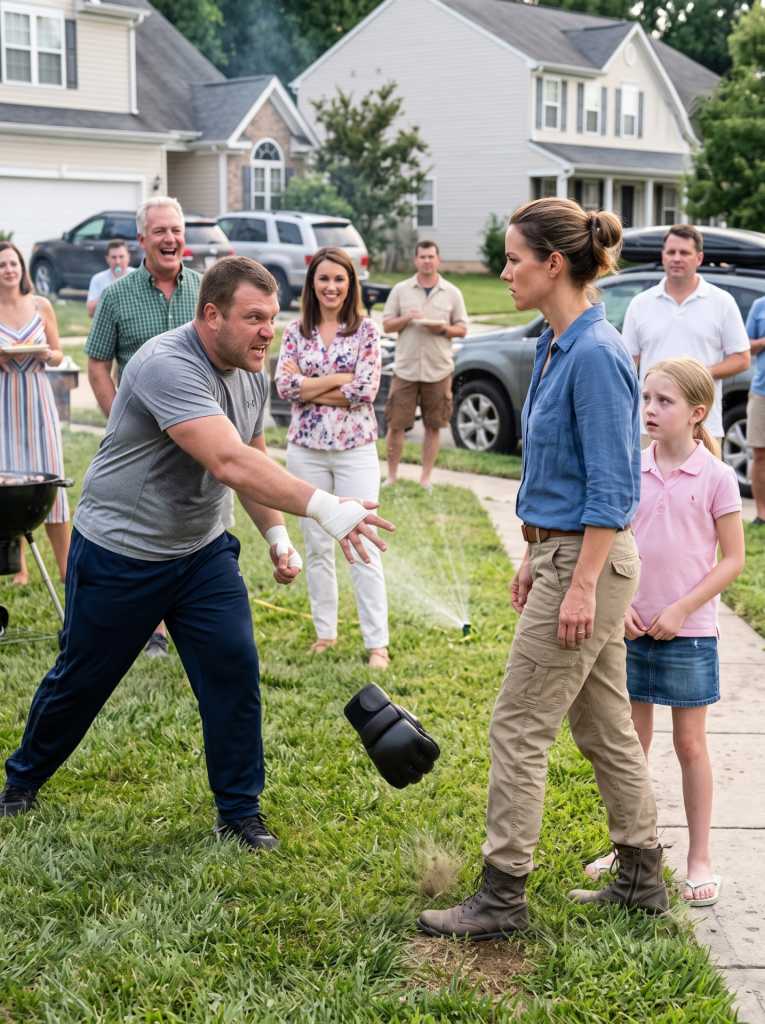
His own messages established that he intentionally deleted evidence and threatened Sophie to prevent her from telling me what she had recorded. The barbecue recording documented his later admission and the threat he made against me in front of witnesses.
He accepted a plea agreement that included criminal penalties, a protective order, and restrictions on contact with Sophie.
Natalie filed for divorce.
She moved into a small apartment twenty minutes away and began rebuilding a life that did not require Grant’s approval or Travis’s permission.
Our relationship did not repair itself overnight.
I did not pretend her failure to protect Sophie had never happened.
But she apologized directly to my daughter without excuses.
“I should have believed you,” Natalie told her.
Sophie looked at her carefully.
“Why didn’t you?”
Natalie could have blamed Travis.
Instead, she answered honestly.
“Because believing you meant admitting things about my husband that I didn’t want to admit.”
Sophie considered that.
“That wasn’t my fault.”
“No.”
Natalie’s voice broke.
“It was never your fault.”
That conversation did more for my sister than anything I could have said.
One night, several months after the barbecue, Sophie asked about the comment Travis had made concerning my job.
We were washing dishes.
“Mom, are you really a records person?”
“Technically.”
She narrowed her eyes.
“That sounds like one of your answers.”
“It is.”
“Were you really an Army mechanic?”
“For part of my career.”
“What was the other part?”
I dried my hands.
There were things I could not tell her.
There were other things I had simply never explained because I wanted our home to belong to the present rather than the places I had left behind.
I took the fireproof case from my study.
Sophie sat at the kitchen table while I opened it.
Inside were decorations, service records, photographs, and a few items connected to fourteen years in the military. I explained enough for her to understand that I had worked in Special Operations and later moved into federal investigative support.
She stared at me.
“So you could have fought Uncle Travis.”
I laughed softly.
“We’re back to that?”
“He was huge.”
“Yes.”
“And he had MMA gloves.”
“I noticed.”
She leaned forward.
“Could you?”
I thought about the answer.
“Probably.”
Her eyes widened.
“But that’s not why you won.”
That surprised me.
“What do you mean?”
“You didn’t do what he wanted.”
I sat across from her.
“No.”
“He wanted you to get angry.”
“Yes.”
“And instead you made him talk.”
I smiled.
“You were paying attention.”
Sophie touched one of the ribbons in the case.
“So being strong is knowing stuff?”
“Sometimes.”
“And not being scared?”
“No.”
She looked up.
“Then what?”
“Being scared and still choosing what keeps people safest.”
She thought about that for a long moment.
Then she closed the case.
The following Labor Day, Mr. Palmer held another barbecue.
Sophie was the first person outside.
She spent most of the afternoon filming neighborhood kids running through the sprinkler and trying to capture slow-motion videos of water balloons exploding against the pavement.
At one point, she turned the camera toward me.
“Mom, say something.”
I was carrying a plate of burned onions Mr. Palmer insisted were perfectly cooked.
“About what?”
“Anything.”
I looked directly into her phone.
“Your neighbor burns onions every year.”
Mr. Palmer shouted from the grill that I had no appreciation for culinary excellence.
Sophie laughed so hard the camera shook.
I watched her run toward her friends with the phone still recording.
She did not look at the Caldwell house.
She did not check the fence.
She did not ask whether filming was allowed.
For months, I had thought justice would be the warrants, the guilty pleas, or watching powerful men discover that money could not erase evidence.
Those things mattered.
But they were not the moment I remembered most.
The moment that stayed with me was much smaller.
It was my eleven-year-old daughter standing in her own yard with a camera in her hand, no longer afraid that seeing something meant she had done something wrong.
Travis had tried to teach Sophie that powerful people decided what truth she was allowed to tell.
Instead, she learned that fear did not make her powerless.
And I learned that all the training I had spent years keeping separate from motherhood had ultimately served its most important purpose without requiring me to throw a single punch.
It helped me make sure my daughter never had to become smaller just to make a dangerous adult feel powerful.