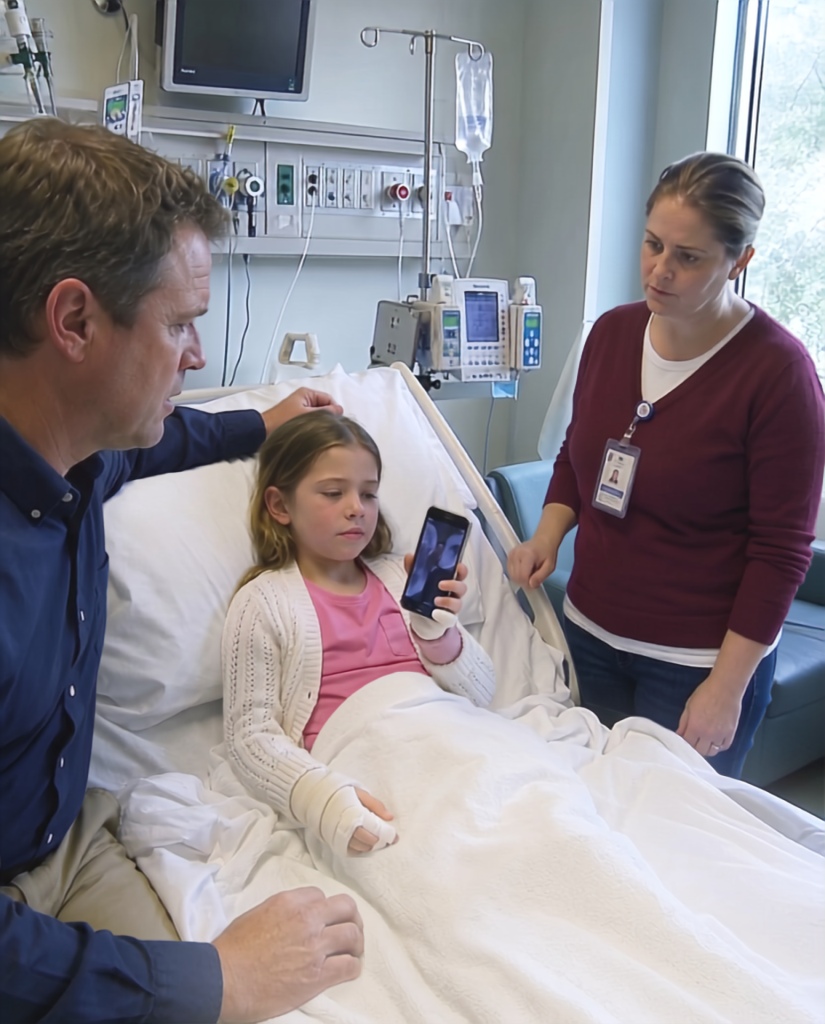

At 2:17 in the morning, my phone rang across a damp training field in Georgia. I was two days away from finishing an eight-month deployment when I looked down and saw the name of the one person who should never have been calling me at that hour.
Anna.
My nine-year-old daughter should have been asleep at her mother’s house in Blackwood Ridge. Instead, when I answered, all I heard for several seconds was uneven breathing and the faint electronic rhythm of a hospital monitor.
“Dad?”
I stepped away from the other soldiers.
“I’m here, sweetheart.”
Her next words were barely louder than a whisper.
“I’m at the hospital.”
Every instinct in me wanted to demand answers, but years in the military had taught me that panic traveled quickly through a phone. If I lost control, Anna would have to carry my fear on top of her own.
“Okay,” I said. “You’re not alone anymore. Tell me what happened.”
She tried to breathe slowly.
“Luke and Reid got mad at me.”
Luke and Reid were her mother’s older brothers. They had spent years behaving as though being born into the Higgins family gave them permission to intimidate anyone who challenged them.
“What did they do?”
Anna became quiet.
“Dad, everything hurts.”
I closed my eyes.
“Where’s your mom?”
Another silence followed.
“She saw me.”
I waited.
Anna’s voice broke.
“Then she closed the curtain.”
For a moment, I could not speak.
Dahlia and I had been divorced for almost three years, but whatever had happened between us, I had always believed there was one line neither of us would cross. We could disappoint each other, argue over custody, and hate every decision the other person made, but Anna was supposed to remain outside that war.
“Sweetheart, listen to me. Are you safe right now?”
“A nurse is here.”
“Good. Stay with her.”
“Do I have to go back to Mom’s house?”
That question hurt more than anything she had already told me.
“No.”
I made the promise before I knew how I would legally keep it.
“You’re not going back there.”
A nurse gently took the phone and identified herself. She confirmed that Anna was stable but had several serious injuries requiring hospitalization and told me the medical team had already contacted the appropriate authorities.
I thanked her and ended the call.
Then I stood beneath the field lights trying to decide what kind of father Anna needed me to become.
The first version was easy to imagine.
I knew the road to the Higgins estate.
I knew where Luke parked his truck.
I knew exactly how men like him responded when someone finally brought consequences to their front door.
But Anna had not called because she needed another angry man.
She had called because she needed her father.
I contacted my command, arranged emergency leave, and began the longest trip home of my life.
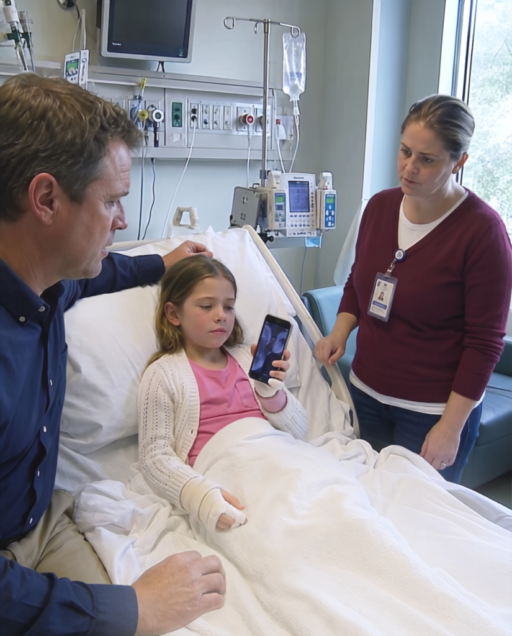
By the following afternoon, I was walking through a hospital corridor in Charleston with a paper cup of coffee I had forgotten to drink. Dr. Megan Foster met me outside Anna’s room and explained that my daughter had multiple fractures and other injuries that were not consistent with an ordinary fall.
“She is going to recover physically,” Dr. Foster said. “But that won’t be the only part of recovery.”
I understood.
Anna was awake when I entered.
She looked impossibly small beneath the blankets and medical supports, and I sat beside her without touching anything until she opened her eyes.
“Dad?”
“Right here.”
I offered two fingers, and she curled hers around them.
For several minutes, neither of us spoke.
Then Anna asked the same question.
“Do I have to go back?”
“No.”
“What if Mom says I do?”
“Then Mom can talk to the court.”
Anna studied my face.
“What if Grandma says you can’t stop them?”
Cheyenne Higgins.
Dahlia’s mother.
“What did Grandma tell you?”
Anna looked toward the door.
“She says Grandpa knows everybody.”
That part was not entirely an exaggeration.
Ellis Higgins owned the largest lumber operation in Blackwood Ridge and employed enough local families that people thought carefully before crossing him. He was also close friends with Police Chief Gordon May, a relationship the Higgins family mentioned whenever they wanted someone to remember how connected they were.
For years, I had considered their influence irritating.
Now it was relevant.
“What happened before you went outside?” I asked.
Anna’s grip tightened.
“I spilled soda on Luke’s boots.”
“Then what?”
“He got mad.”
I did not push further.
Anna had already spoken with medical staff, and I did not want her repeating the same experience for every adult who wanted details.
Instead, I asked Dr. Foster to make sure her statements were documented through the hospital’s normal process. I requested copies of the medical records I was legally entitled to receive and wrote down the exact time Anna had called me.
2:17 a.m.
I started an evidence log that evening.
Hospital intake.
Medical findings.
Anna’s call.
Names of staff.
Nothing dramatic.
Just facts.
On my fourth afternoon at the hospital, Anna was sleeping when my phone rang.
Cheyenne Higgins.
I answered and placed the call on speaker.
“I heard you’re back, little soldier.”
I looked at Anna.
“What do you want, Cheyenne?”
“I want you to stop creating trouble.”
“My daughter is in a hospital.”
“And she’ll recover.”
I said nothing.
Cheyenne continued.
“Luke and Reid made a mistake. You don’t destroy a family over one bad night.”
“They’re adults.”
“They’re my sons.”
“And Anna is nine.”
Her voice hardened.
“You’ve always thought that uniform made you important.”
“This isn’t about me.”
“Everything becomes about you eventually.”
I let her talk.
That was the advantage of silence.
People often filled it with things they should never have said.
“My husband has spent thirty years building relationships in Blackwood Ridge,” Cheyenne continued. “We know the police. We know the courts. Take Anna when she’s discharged and stop trying to turn this into something bigger.”
I looked at my daughter’s sleeping face.
Then Cheyenne made the mistake that changed the call.
“Luke says when you finally come looking for him, he’ll finish what he started.”
I felt something inside me go completely still.
“Is that a threat?”
Cheyenne laughed.
“Call it whatever makes you feel important.”
She hung up.
I saved the recording.
I had put the call on speaker because I wanted a nurse nearby to hear the conversation. I had also recorded it because years of investigative work in the military had taught me that the most important evidence was often created when people believed they were untouchable.
My first impulse was still to drive to Blackwood Ridge.
Instead, I called Colonel Kenneth Cole, my former commanding officer.
He listened to the entire recording.
When it ended, he asked one question.
“Where are you?”
“At the hospital.”
“Stay there.”
“I wasn’t planning to leave.”
“That wasn’t what I asked.”
I understood him.
“No. I’m not going after Luke.”
“Good.”
Cole paused.
“Then start preserving everything.”
“I already have.”
“That girl doesn’t need you proving you’re tougher than her uncles, Ron.”
I looked at Anna.
“I know.”
“She needs you proving what happened.”
That became the plan.
I created duplicate copies of the evidence log and stored them separately. I preserved Cheyenne’s original recording, kept the phone untouched, and contacted a civilian attorney outside Blackwood Ridge so no one connected to the Higgins family could quietly steer the process.
I did not post anything online.
I did not confront Dahlia.
I did not call Luke or Reid.
The Higgins family expected rage because rage was easy to discredit.
I gave them documentation instead.
At 10:43 that night, my phone vibrated on the hospital windowsill.
The number was unfamiliar.
I almost ignored it.
Then I read the message.
My name is Paige. I was upstairs that night.
A second message appeared.
Anna told the truth.
I stood slowly.
Then the third message arrived.
I recorded what happened.
A video file appeared beneath it.
The thumbnail showed the Higgins backyard, the side of Luke’s pickup, and Anna standing near the fence.
In the upstairs window behind her was Dahlia.
Her hand was already touching the curtain.
I stared at the image for several seconds before calling Cole.
“I think we just found the one thing they didn’t know existed.”
“What?”
I looked through the hospital-room door at my sleeping daughter.
“A witness.”
Then I pressed play.
The video began at 8:46 p.m., almost six hours before Anna called me from the hospital. Paige was filming from an upstairs bedroom at the Higgins house, and the picture shook slightly as she aimed her phone through the window toward the backyard.
Anna stood near the fence with a dark stain across one sleeve where she had spilled soda earlier. Luke was pointing toward his boots while Reid stood beside the pickup, and even without hearing every word, I could tell from my daughter’s posture that she was trying to make herself smaller.
Then Luke moved toward her.
I stopped the video.
“Ron,” Cole said through my other phone, “you don’t have to watch this alone.”
“Yes, I do.”
“No, you don’t.”
He was right, but I pressed play anyway because if this recording was going to protect Anna, I needed to understand exactly what it contained.
The camera moved toward the upstairs window across the yard.
Dahlia appeared behind the glass.
Anna looked up.
Even through the grainy recording, I recognized the expression on my daughter’s face.
She expected her mother to help.
For one second, Dahlia stood completely still.
Then she reached forward and pulled the curtain closed.
I paused the video again.
That was the part I had been afraid to see.
Anna’s words from the hospital returned immediately.
She saw me. Then she closed the curtain.
Until that moment, some part of me had still hoped my daughter misunderstood what happened. Maybe Dahlia had gone downstairs to intervene, maybe she had called for help, or maybe there was some explanation that would make her decision less impossible to understand.
The video removed that hope.
I resumed the recording.
Paige’s phone moved away from the window before anything more graphic entered the frame. Her breathing became louder as she backed into the upstairs hallway, apparently realizing someone downstairs had noticed her.
Footsteps hit the stairs.
Paige moved into a bedroom and closed the door.
A few seconds later, the handle turned.
“Paige?”
Luke’s voice was unmistakable.
The handle moved again.
“Open the door.”
Paige did not answer.
Luke’s voice hardened.
“I know you were at the window.”
The recording ended.
For several seconds, Cole and I said nothing.
Then he asked, “Do you still have contact with her?”
I looked at the message thread.
“I think so.”
I typed carefully.
Are you safe right now?
The response did not come immediately.
I waited nearly four minutes.
Then Paige answered.
Yes. I’m not at their house anymore.
I asked whether she still had the original recording on the phone she used that night.
Yes. I never deleted it.
That mattered almost as much as the video itself.
I told Paige not to edit, crop, forward, or post anything. My attorney arranged for her to speak with investigators outside Blackwood Ridge and to turn over the original device through a documented process.
Paige agreed on one condition.
She did not want the Higgins family told where she was staying.
I understood.
The following morning, my attorney met me in the hospital cafeteria.
Her name was Rebecca Shaw, and she practiced family and criminal law two counties away. She had no business ties to Ellis Higgins and no interest in how important his family believed itself to be.
Rebecca watched the video once.
She did not replay it.
“This is significant,” she said.
“Enough to keep Anna away from them?”
“Combined with the medical records and her statements, it gives us a strong basis for emergency protection.”
I placed my phone on the table.
“And this.”
She listened to Cheyenne’s recorded threat.