
For more than twenty years, I allowed my family to believe there was nothing remarkable about me. I never considered it lying, although I repeated that explanation to myself every time a relative mocked my “little government job” or my mother introduced me as the daughter who simply handled paperwork for the Army.
At family gatherings, someone would inevitably ask why I had spent so many years doing the same office work without earning a meaningful promotion. I always smiled because smiling was much easier than trying to explain a life governed by nondisclosure agreements, classified briefings, need-to-know restrictions, and years of carefully practiced silence.
My family interpreted that silence as proof that I had accomplished very little. They imagined me sitting beneath fluorescent lights, processing forms, arranging schedules, and bringing coffee to the people who actually made important decisions.
I let them believe it because the truth wasn’t something I was free to share, but there was another reason too. My family seemed more comfortable with a version of me they could understand, manage, and occasionally ridicule.
So whenever I went home, I wasn’t Major General Sarah Whitmore. I was simply Sarah, a forty-six-year-old woman who drove an aging blue sedan, wore faded jeans to family gatherings, rarely brought anyone home, and supposedly spent her days doing paperwork for the military.
Being underestimated had taught me two things over the years. It could hurt deeply, but it could also be useful, and the useful part had helped keep me alive while the painful part taught me how to remain silent.
That Fourth of July began like every annual cookout my sister Melissa hosted at her two-story home outside Fredericksburg. The backyard was already crowded by noon, filled with relatives, children running through sprinklers, teenagers pretending not to film one another, and enough old family tension to hide beneath several layers of jokes.
The tables were covered with ribs, corn, potato salad, deviled eggs, watermelon, and open coolers packed with ice. I pulled into the driveway at exactly 3:52 p.m., a time I knew because my dash camera recorded everything from the moment I turned onto the street.
Keeping a camera running wasn’t paranoia for me but professional habit. I had spent too many years learning that timestamps remembered things more accurately than people did, especially when witnesses had personal reasons to soften what they had seen.
I parked at the far edge of the driveway, leaving plenty of space for the other vehicles and Melissa’s dessert table beneath the carport. There was nothing illegal or unusual about where I left my car, although that apparently wouldn’t matter later.
My mother spotted me as I carried a fruit salad toward the backyard. She waved from beneath a maple tree and immediately announced my arrival to everyone nearby.
“There’s Sarah,” she called, waving one hand. “Finally.”
“I’m not late,” I said.
“You’re always later than you think you are,” she said.
The comment sounded harmless, which was how nearly everything in my family sounded until someone actually got hurt. I kissed her cheek, gave Melissa the fruit salad, and slipped into the familiar routine of helping wherever I could while quietly enduring whatever jokes came my way.
I prepared a plate for my mother, helped Melissa move food out of the sun, listened to Uncle Ray complain about property taxes, and smiled when Aunt Denise asked whether the Army had finally improved my office situation. She seemed genuinely amused by the idea that my professional ambitions might extend no further than getting a better chair.
“Still in the same chair?” she asked.
“Something like that,” I said.
My cousin Brad overheard the exchange from beside the grill and laughed louder than anyone else. He had spent eight years as a sheriff’s deputy and somehow managed to make those eight years sound longer and more demanding than most military campaigns.
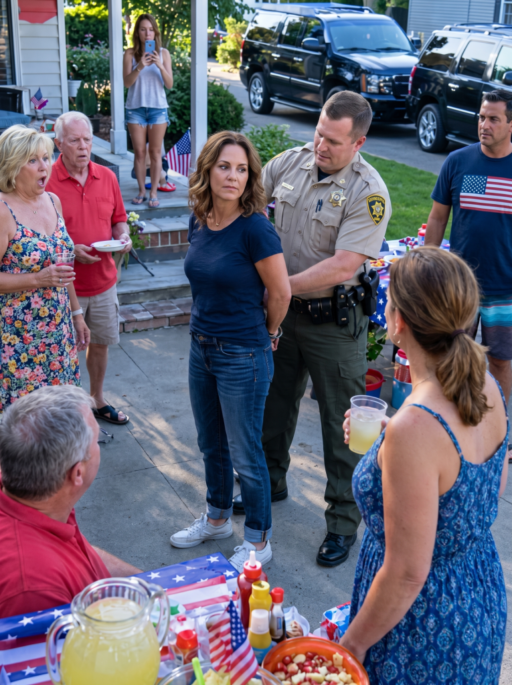
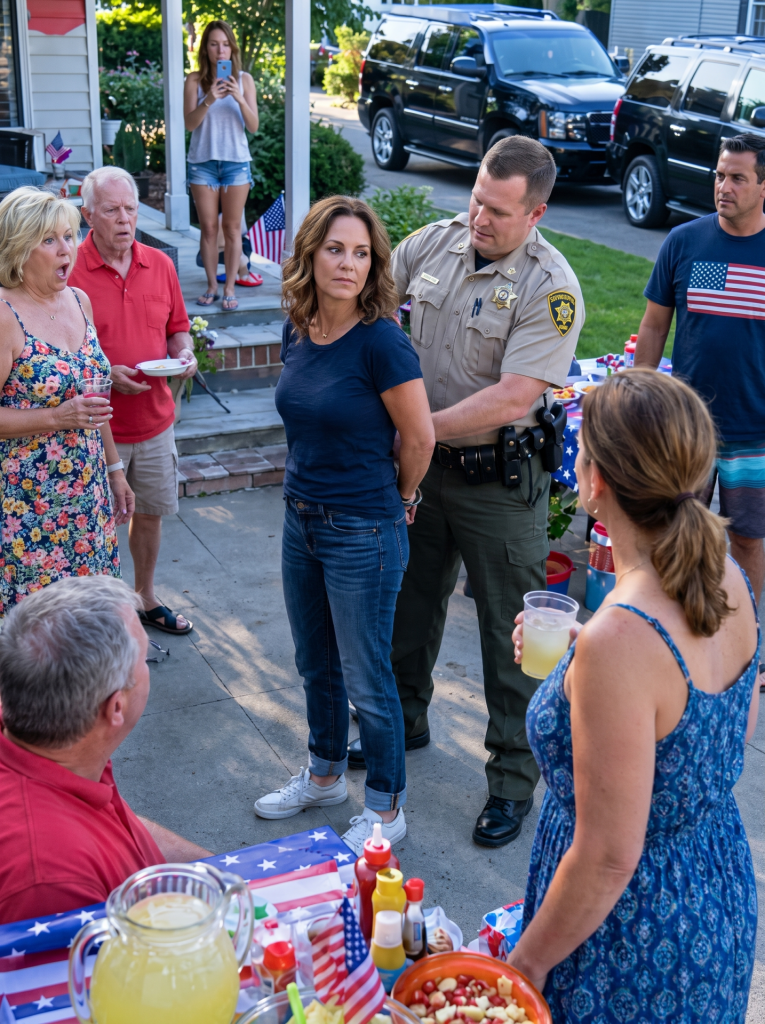
Brad had arrived at the cookout in full uniform even though he was off duty, complete with his pressed shirt, polished badge, duty belt, visible handcuffs, and sidearm. Nobody questioned why he needed any of it at a family barbecue, which was exactly the kind of unquestioned attention he enjoyed.
Even as a child, Brad had liked pushing smaller cousins around before portraying himself as the victim whenever an adult intervened. As he grew older, the behavior changed very little, except that adulthood eventually gave him a badge that made his old instincts look more legitimate.
I had watched him lecture waitresses over trivial signs of disrespect and turn Thanksgiving card games into speeches about the pressure of wearing a vest. Once, he even lectured a twelve-year-old nephew about “compliance” because the boy didn’t immediately surrender a football Brad believed might break a window.
Most relatives laughed whenever Brad behaved that way, not because he was particularly funny but because challenging him required more courage than indulging him. That afternoon, I noticed him watching me before I had even finished my first glass of lemonade.
He stood near the grill with one thumb hooked through his belt, studying me before glancing toward the driveway. I recognized the expression immediately because I had encountered enough men like Brad throughout my career to know when someone was searching for an excuse.
I refused to give him one and instead helped Melissa carry food outside, checked on my mother, and spoke with my nineteen-year-old niece Chloe. She was quiet and observant, the kind of young woman adults often underestimated because they confused paying attention with shyness.
Three years earlier, before leaving for an operation I couldn’t discuss, I had given Chloe a matte black card sealed inside a thin plastic sleeve. It contained only one telephone number, with no logo, title, or explanation.
“Aunt Sarah, is this like a movie?”
I had looked at her long enough for the amusement to disappear from her face.
“No,” I told her. “That is exactly why you take it seriously.”
“What is it?”
“An emergency number.”
“For what kind of emergency?”
“The kind where you cannot trust the person standing closest to you.”
Her eyes had widened slightly.
“Why are you giving it to me?”
“Because you listen before you react.”
Chloe was the only relative I had ever trusted with that number because I knew she could remain useful even when she was frightened. Now, as Brad gradually moved closer to me across the backyard, I noticed that same black card tucked behind the transparent case of her phone.
I deliberately looked away before anyone could notice what had caught my attention. A few minutes later, while I was placing paper plates beside the food table, Brad finally found the excuse he had apparently been searching for.
“Nice parking job, Sarah.”
I glanced toward the driveway even though I already knew there was nothing wrong with my car.
“My car is fine.”
“It’s crowding the truck.”
“It’s not.”
Brad smiled, but there was nothing friendly about it. It was the kind of smile designed for an audience, and several relatives were already listening.
“It’s not crowding the truck if you don’t understand spacing,” he said.
A few people laughed, but I ignored them and refused to give Brad the argument he wanted.
“Move it if you need more space,” I said.
That response irritated him because Brad wasn’t interested in solving a parking problem. He wanted resistance, and when I denied him that, he stepped closer.
“Don’t give me attitude.”
The backyard continued normally for another moment before everyone began sensing the change. Melissa stiffened near the dessert table, Uncle Ray suddenly became interested in his drink, and even my mother turned slightly toward us without saying anything.
“I’m not giving you attitude,” I said.
Brad lowered his voice just enough to make the hostility unmistakable while ensuring everyone nearby could still hear him.
“You government pencil-pushers always think rules don’t apply to you.”
The old family joke had suddenly acquired the weight of his badge. I turned fully toward him but kept my voice calm.
“Brad, this is not the place.”
My calmness seemed to irritate him even more. He stepped directly into my personal space and put one hand around my arm.
I looked down at his hand and gave him every opportunity to reconsider what he was doing. Had he released me then, the incident might have become another unpleasant family memory everyone later dismissed as Brad getting carried away.
Instead, his fingers tightened around my arm.
“You need to learn how to respect authority,” he said.
Something cold and familiar moved through me, but it wasn’t fear. It was recognition because I had spent enough years around dangerous situations to understand exactly what kind of man I was dealing with.
“I strongly suggest you remove your hand,” I said.
Melissa finally spoke from nearby, although her voice already carried the hesitation Brad had learned to exploit.
“Brad, come on.”
He heard that uncertainty and interpreted it exactly as I expected. Men like Brad didn’t require everyone around them to agree with what they were doing; they only needed everyone else to decide that preserving peace mattered more than challenging them.
Without warning, he jerked me toward the picnic table. My hip struck the edge, a paper plate fell into the grass, and my shoulder twisted painfully as he forced my upper body forward against the rough wooden surface.
“Stop resisting!” Brad shouted.
I wasn’t resisting, but the truth was irrelevant to what he wanted his audience to believe. By shouting the accusation first, he was already creating the story he intended to tell afterward.
His knee pressed into my lower back while he pulled my right arm behind me and locked the first cuff around my wrist. The second followed moments later, and he tightened the chain enough for the metal to cut painfully into my skin.
The entire backyard fell silent as Brad pulled me upright. My relatives stared from different corners of the yard, while the teenagers near the fence slowly raised their phones without yet beginning to record.
Brad’s face was flushed with satisfaction as he stood behind me, clearly enjoying the authority he believed he had finally established. He leaned close enough that I could smell beer mixed with mint gum on his breath.
“Who’s the boss now, Sarah?” he said.
Most of my family looked anywhere except at my wrists. I saw every face anyway because years of training had taught me to observe more carefully when circumstances became dangerous.
I could feel the painful angle of my shoulder, Brad’s balance, the position of his radio, the location of his sidearm, and exactly how his weight was distributed. My body already knew the sequence of movements required to put him on the ground before he understood what was happening.
I could have done it in seconds, and part of me wanted to. Instead, I remained still because the moment I used my training against him, Brad would claim I had attacked him and turn his own aggression into an official justification.
I had seen too many men survive worse behavior simply because they wrote the first report. So I controlled my breathing, ignored the pain in my wrists, and searched the backyard for Chloe.
She stood near the porch, half concealed behind the screen door, staring directly at me with a pale face. When our eyes met, I gave her one small, precise nod, exactly the signal I had taught her three years earlier.
For a moment she didn’t move, but then one hand slipped into her pocket. She quietly stepped backward until Brad could no longer see her.
At 4:17 p.m., Chloe made the call. Brad never noticed because he was too busy performing for the rest of the family.
“You think because you work in some federal office, you can talk to me however you want?” he said, loud enough for the whole yard. “You think rules are optional? Maybe today you learn something.”
My wrists burned while Melissa tried once more to intervene.
“Brad, that’s enough.”
He ignored her, confirming that this had stopped being ordinary family bullying. Someone had finally given him a boundary, and instead of respecting it, he treated it like encouragement.
“I’m the law here,” he said.
I turned my head just enough to look at him.
“No,” I said. “You’re a countdown.”
Brad frowned.
“What?”
“I strongly recommend you enjoy that feeling,” I said.
He laughed.
“What feeling?”
“Being in control.”
His grip tightened around my arm.
“It expires in about five minutes.”
Brad laughed harder, but nobody else joined him. My family didn’t understand what I meant yet, although they clearly sensed something in my voice had changed.
A few minutes later, the distant sound of vehicles reached the backyard. Three black SUVs pulled up outside the house in a coordinated line, and for the first time since grabbing me, Brad stopped performing long enough to look away.