
Beneath our daughter’s photograph were two words.
Reserved placement.
I stared at Rebecca because the notation made no sense. Clara had never been placed through Havenbridge, and there had never been any guardianship proceeding involving her because Meredith and I were her biological parents.
“Why would they have Clara’s photograph?”
Rebecca couldn’t answer yet, but she explained that its presence inside the hidden archive meant Havenbridge’s interest in our family might have begun long before Meredith discovered the altered records. Someone had known about Clara when she was a newborn, years before Meredith ever believed Harrison Creed had started watching us.
That possibility frightened me more than Creed’s phone call because it changed the timeline completely. I had assumed Meredith stumbled onto Havenbridge’s secrets and accidentally placed our family in danger, but Clara’s photograph suggested our family might already have been connected to whatever the organization was doing.
I returned to Clara’s hospital room that evening and watched her sleeping beside the battered white rabbit investigators had finally returned after documenting it. For years, that toy had been nothing more than something she loved, yet hidden inside it had been the evidence Meredith risked everything to protect and the key to a room filled with secrets.
Harrison Creed had threatened me because he believed recovering the flash drive could still protect Havenbridge. He didn’t know investigators had already opened the green door, and somewhere inside those rows of untouched records was the answer to the question that now mattered more than anything else.
Why had Havenbridge marked my daughter for a “reserved placement” when she was still a newborn?
The answer to Clara’s photograph came from a set of records stored in the deepest section of the Willow Door archive. Investigators discovered that Havenbridge had maintained two versions of many children’s files: the official records presented to courts and families, and a private set documenting prospective placements, payments, and people the organization considered useful or vulnerable.
Clara’s file belonged to the second group, but the notation beneath her photograph didn’t mean someone had legally arranged to take her from us. Instead, investigators believed Havenbridge had identified our family as a possible target during a period when Meredith and I were experiencing financial and marital difficulties, then quietly gathered information that could later be used to create a manufactured family crisis.
The discovery made me feel sick because ordinary problems had apparently been treated as opportunities. Havenbridge collected information about struggling families, then maintained records that could be manipulated if circumstances ever made a child easier to separate from a parent.
Rebecca showed me additional files containing altered medical histories, fabricated statements about parental instability, and guardianship documents prepared long before any legitimate proceeding had begun. Several folders even contained handwritten notes estimating which prospective families might provide donations after receiving assistance from Havenbridge.
“This wasn’t about helping children,” I said.
Rebecca shook her head. “It was about controlling where they went and who benefited.”
Meredith was devastated when I told her what investigators had discovered about Clara. She remembered a Havenbridge representative approaching us years earlier after Clara’s birth and offering information about family-support programs, but neither of us had considered the conversation important enough to remember until now.
That encounter apparently gave someone enough information to begin a preliminary file on our family. Nothing happened because we never entered the program, but Clara’s photograph remained in the archive until Meredith unknowingly took a job with the same organization years later.
The realization explained why Harrison Creed reacted so aggressively when Meredith began comparing records. She wasn’t merely an employee who had discovered irregular paperwork; she was someone whose own daughter appeared inside the system she was investigating.
Meredith looked toward me from her hospital bed. “He knew I’d eventually find Clara.”
“And that’s why he wanted the drive.”
She nodded slowly. “Once I realized children were being moved using altered records, I started copying everything I could.”
She had hidden the flash drive inside Clara’s rabbit because it was the one object she believed Creed would never consider important. The silver key had come from a former Havenbridge employee who secretly helped her identify Willow Door, but Meredith had been attacked before she could reach the archive herself.
With the original records secured, investigators no longer depended entirely on Meredith’s copies. Search warrants expanded to Havenbridge offices and associated properties, while financial investigators began tracing payments connected to Harrison Creed and several people who had approved questionable placements.
The case took months rather than days, and I quickly learned that discovering evidence was very different from proving what each person had done. Some records reflected legitimate placements, others contained administrative mistakes, and investigators had to separate those cases carefully from files showing deliberate alterations.
Meredith cooperated throughout the process. She gave investigators names, explained Havenbridge’s internal systems, identified employees who might know more, and admitted whenever she couldn’t distinguish something she personally witnessed from something she had only suspected.
That distinction became important when the case reached formal hearings. Creed’s attorneys tried to portray Meredith as a bitter former employee who had stolen confidential records, but the untouched documents recovered behind the green door supported enough of her claims that dismissing her as unreliable became increasingly difficult.
By then, Clara had recovered and Noah had returned to school, although neither child immediately returned to the routines they had before everything happened. Noah became anxious whenever Meredith was late, while Clara carried her white rabbit almost everywhere and repeatedly asked whether anyone could take her away.
“No,” I told her one evening. “Nobody gets to secretly decide where you belong.”
She hugged the rabbit against her chest. “I belong with you and Mom?”
“You belong with people who love you and keep you safe.”
Meredith and I also had to confront what our own choices had done to the children. Havenbridge created the danger, but our divorce had become so hostile that Noah and Clara had learned to treat tension between their parents as normal.
We started family counseling and agreed that whatever happened between Meredith and me would never again be communicated through the children. No more vague explanations, no more using custody schedules to avoid difficult conversations, and no more assuming silence was safer than an uncomfortable truth.
Months later, Noah was asked to speak during a closed hearing about the days he and Clara had been alone. Nobody encouraged him to dramatize what happened, and the interviewer repeatedly reminded him that saying “I don’t remember” was perfectly acceptable.
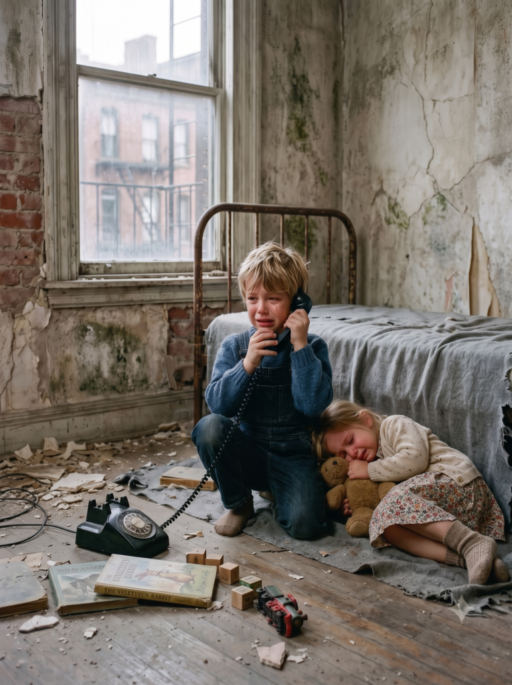
He explained that Meredith had told him to protect Clara and hide the silver key if the man with the shiny shoes returned. Then he described finding an old phone, trying several numbers from memory, and finally reaching me while Clara became too weak to get off the couch.
When he finished, he asked whether he had done something wrong by calling me.
I had to look away.
The interviewer answered before I could. “You did exactly what you were supposed to do when you needed help.”
Noah nodded, and I watched some of the tension leave his shoulders.
The investigation eventually dismantled Havenbridge’s ability to operate under its existing leadership. Harrison Creed and several associates faced criminal proceedings connected to falsified records, financial misconduct, obstruction, and other conduct supported by the evidence recovered from Willow Door.
Authorities also began reviewing older placements individually. Some children remained safely with families who had acted in good faith, while other cases required courts and social-service agencies to examine whether decisions had been influenced by altered information.
There was no single dramatic moment when every wrong was corrected. Some families received answers quickly, others faced long legal processes, and investigators acknowledged that certain records were too incomplete to reconstruct perfectly.
Our family had to accept the same uncomfortable reality. Meredith survived, but survival didn’t automatically repair our marriage, and understanding why she had lied to me didn’t erase the damage those lies caused.
We did not get back together.
Instead, we built something less romantic but far healthier.
We became parents who could finally speak honestly to each other.
A year after Noah’s phone call, Meredith and I attended Clara’s school performance together. We sat in the same row without arguing about seats or schedules, and Noah spent most of the evening complaining that his sister’s class sang the same song too many times.
Afterward, Clara ran toward us carrying the one-eyed rabbit beneath her arm. The stitches across its belly had been repaired, but she refused my offer to replace it with a new toy because she said this one had already found its way home.
On the drive back, Noah asked whether Havenbridge was gone forever. I told him the organization as he knew it could no longer do what it had done, although adults were still working through the records and helping families affected by the investigation.
He thought about that before asking whether I was still angry with Meredith.
I glanced toward her in the passenger seat.
“Sometimes.”
Meredith smiled faintly. “Sometimes I’m angry with your dad too.”
Noah seemed confused. “But you’re friends now.”
“We’re your parents,” I told him. “That means we can disagree and still take care of you together.”
That answer satisfied him.
It satisfied me too.
For a long time, I thought the most important thing I discovered inside Clara’s rabbit was the flash drive. Later, I thought it was the silver key because it opened the green door and exposed the records Havenbridge had tried to hide.
I was wrong about both.
The most important thing was what Noah’s phone call forced all of us to understand.
Our children had spent too long surrounded by adults keeping secrets because they believed secrecy would protect someone. Meredith hid the truth to protect us, I allowed resentment to replace questions, and Havenbridge depended on frightened families remaining isolated from one another.
That ended the afternoon my seven-year-old son found a phone and called me.
One year later, Clara was healthy, Noah no longer worried that I wouldn’t answer, and Meredith was rebuilding a life that belonged to her rather than to Harrison Creed’s threats. Our marriage remained over, but our family was no longer defined by the divorce.
Sometimes the thing that saves a family isn’t putting it back exactly the way it was.
Sometimes it’s finally telling the truth about what went wrong and building something safer from what remains.