
I had spent three years telling myself that my mother-in-law, Lorraine, was simply slow to accept the fact that my daughter came from my first marriage. She never openly said Zia was not family, but she had developed a hundred smaller ways to make a seven-year-old understand that she stood just outside the circle.
Lorraine rarely called Zia her granddaughter. Instead, she used phrases like “Travis’s girl,” “your daughter,” or “that sweet little visitor,” always with enough sweetness in her voice that objecting made me sound unreasonable.
My husband, Travis, noticed it too, but for a long time he believed private conversations with his mother would eventually make a difference. He reminded her that Zia called him Dad, that he considered her his daughter, and that our family did not divide children into categories based on biology.
Lorraine always nodded, apologized just enough to end the conversation, and behaved better for a few weeks. Then another birthday, Sunday dinner, or holiday would arrive, and somehow Zia would once again be seated a little farther away, remembered a little later, or introduced differently from the other grandchildren.
Christmas was the first time Lorraine stopped pretending it was accidental. We arrived at her house shortly after eight that morning, with Zia wearing a gold dress she had chosen herself and carrying a small bag of gifts she had carefully wrapped for her cousins.
Before we walked inside, Travis noticed a scuff on one of her black shoes and crouched to wipe it away with his thumb. He smiled at her and told her she looked beautiful, then quietly said something to me that stayed in my mind for the rest of the day.
“She deserves one Christmas where she feels completely chosen.”
Inside, Lorraine’s house looked perfect. Pine garland framed the doorway, cinnamon rolls cooled beneath foil in the kitchen, and carefully wrapped presents covered the floor beneath a tree decorated almost entirely in silver and white.
Lorraine greeted us warmly enough and kissed Travis on the cheek. She gave me a quick hug, then looked down at Zia and smiled as though she were welcoming the child of a distant acquaintance.
“Well, look who came with you.”
Zia did not seem to notice the wording. She hugged Lorraine, handed her a small gift bag, and said she had picked the ornament inside because it looked like the angel over Grandma’s fireplace.
Lorraine thanked her, placed the bag on a side table without opening it, and called for everyone to sit down. By then, most of Travis’s siblings and their children had already arrived, and the living room quickly filled with voices, coffee cups, torn paper, and children comparing the shapes of their packages.
At exactly 8:47, Lorraine began handing out presents. She called each grandchild by name and made a small ceremony out of every gift, telling one cousin she had searched three stores for his tablet and telling another that the cash inside her envelope was for whatever she wanted.
Zia sat beside me with her hands folded in her lap. She smiled every time one of the other children opened something and even helped a younger cousin remove tape from a box that had been wrapped too tightly.
Then Lorraine looked toward her.
“Oh. Zia.”
The difference in her voice was subtle, but everyone in the room heard it. Lorraine reached behind her chair and brought out a thin drugstore gift bag with a crooked red bow stuck near the handle.
“This is for you, sweetheart. I didn’t want you to feel left out.”
Beside me, Travis became completely still.
Zia accepted the bag with both hands and thanked her. She pulled aside two sheets of tissue paper and removed a small vanilla candle, the kind displayed near the checkout counter in almost any pharmacy.
The candle itself did not bother me. Zia had never been a child who compared price tags, and I did not expect Lorraine to spend the exact same amount on every grandchild.
Then I saw the tag attached to the handle.
To Travis’s Girl.
For several seconds, nobody spoke. One of Travis’s sisters looked down at her coffee, another relative suddenly became interested in helping a child organize wrapping paper, and one of the older cousins glanced at Lorraine before quickly turning away.
Zia read the tag once, then again. She did not cry or complain, but something changed in her expression as she placed the candle carefully beside her chair.
“Thank you, Grandma.”
Lorraine smiled.
“You’re welcome, sweetheart.”
Then she immediately turned toward another grandchild and asked whether he liked his new headphones. The room slowly filled with conversation again, but the silence Lorraine had created remained between Travis and me.
I leaned toward him.
“We should go.”
He kept his eyes on Zia.
“Not yet.”
I stared at him because that was not the answer I expected.
“Why?”
His voice was barely above a whisper.
“I talked to her three weeks ago.”
“About this?”
“About everything.”
Before I could ask what he meant, Zia joined two of her cousins beside the Christmas tree. She laughed when they invited her into their game, but I knew my daughter well enough to recognize the smaller, more careful laugh she used when she was trying to convince adults that she was fine.
The rest of Christmas Day passed beneath the kind of politeness Lorraine had perfected. Nobody challenged her openly, Lorraine behaved as though the gift exchange had contained nothing unusual, and Zia never mentioned the tag again.
That night, after dinner had been cleared and most of the family had gone upstairs, I found Zia sitting on the guest-room bed. Her gold dress was wrinkled from the long day, her shoes were lined neatly beside the wall, and the vanilla candle rested in her lap.
She was turning the gift tag between her fingers.
I sat beside her.
“Did you have a good Christmas?”
She nodded, but she did not look at me. For several seconds, she rubbed her thumb across Lorraine’s handwriting before finally asking the question I had been afraid those three words would place inside her head.
“Mom, am I only Dad’s girl?”
My chest tightened.
“What do you mean, sweetheart?”
“Grandma writes everyone else’s name. She calls them her grandchildren.”
Zia looked toward the candle.
“But she calls me Dad’s girl.”
Before I could answer, I saw Travis standing in the doorway. He had heard everything.
He crossed the room, knelt in front of Zia, and gently took the tag from her hand.
“You are my daughter.”
She searched his face.
“But you didn’t make me.”
“No, I didn’t.”
He smiled softly.
“But being your dad isn’t something that happened to me. It’s something I choose every single day.”
Zia’s eyes began filling with tears.
“Does Grandma get to choose if I’m family?”
Travis’s expression changed.
“No.”
His answer came without hesitation.
“She gets to choose how she treats you. She does not get to choose whether you belong to me.”
For a few seconds, Zia simply stared at him. Then she leaned forward and wrapped her arms around his neck, and Travis held her so tightly that I had to look away for a moment.
When they separated, he reached toward Zia’s overnight bag. He opened one of the side pockets and removed a small red velvet box that I had never seen before.
I frowned.
“What is that?”
Travis sat beside us.
“Something I hoped we wouldn’t need.”
He placed the box in Zia’s hands but stopped her when she tried to lift the lid.
“Don’t open it.”
She looked confused.
“Is it for Grandma?”
“If she makes you feel like you don’t belong again tomorrow, you can give it to her.”
I turned toward him.
“You knew something else might happen?”
“I knew my mother.”
His voice held no anger, only disappointment.
“And three weeks ago, I told her exactly what would happen if she deliberately excluded Zia again.”
Zia turned the velvet box over carefully.
“Will Grandma be mad?”
“Probably.”
Her next question came much more quietly.
“If I give this to her, will you still be my dad?”
For half a second, Travis closed his eyes.
Then he put both hands around hers.
“Nothing you do tomorrow can change that.”
Zia nodded and slipped the red box into her little purse. Nothing else happened that night, and Lorraine went to bed believing the uncomfortable moment with the candle had already been forgotten.
The following morning, she hosted brunch.
When I entered the dining room, white plates had been arranged around the table, silver napkin rings were back in place, and Lorraine had written a place card for every person in the family. I found my name, then Travis’s, then each aunt, uncle, cousin, and grandchild.
Everyone had a name except Zia.
Her place card contained a single word.
Guest.
My hand moved toward it immediately, but Travis gently caught my wrist.
I looked at him.
He was not watching his mother.
He was watching Zia.
Our daughter had already seen the card.
For several seconds, she stood completely still. Then she reached into her little purse, wrapped both hands around the red velvet box, and walked toward Lorraine.
“Grandma?”
Lorraine turned with the polished smile she used whenever she expected everyone around her to remain polite.
“Yes, sweetheart?”
Zia held out the box.
“Dad told me to give this to you if you made me feel invisible again.”
The room went silent.
Lorraine glanced at Travis.
“Well, that sounds unnecessarily dramatic.”
Travis stood behind Zia.
“Open it, Mom.”
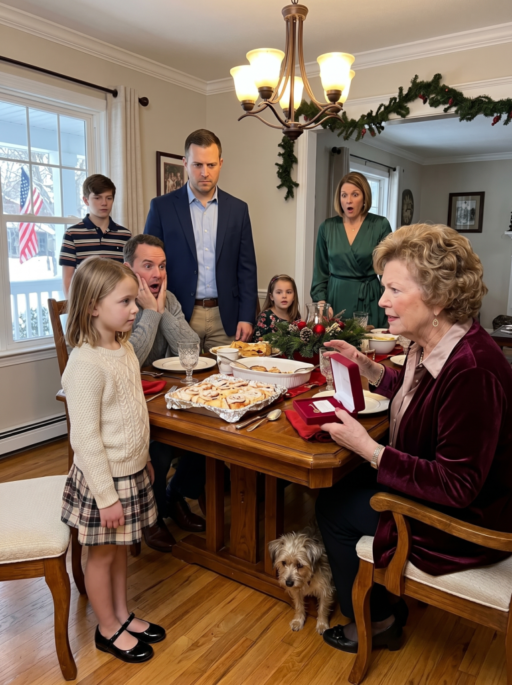
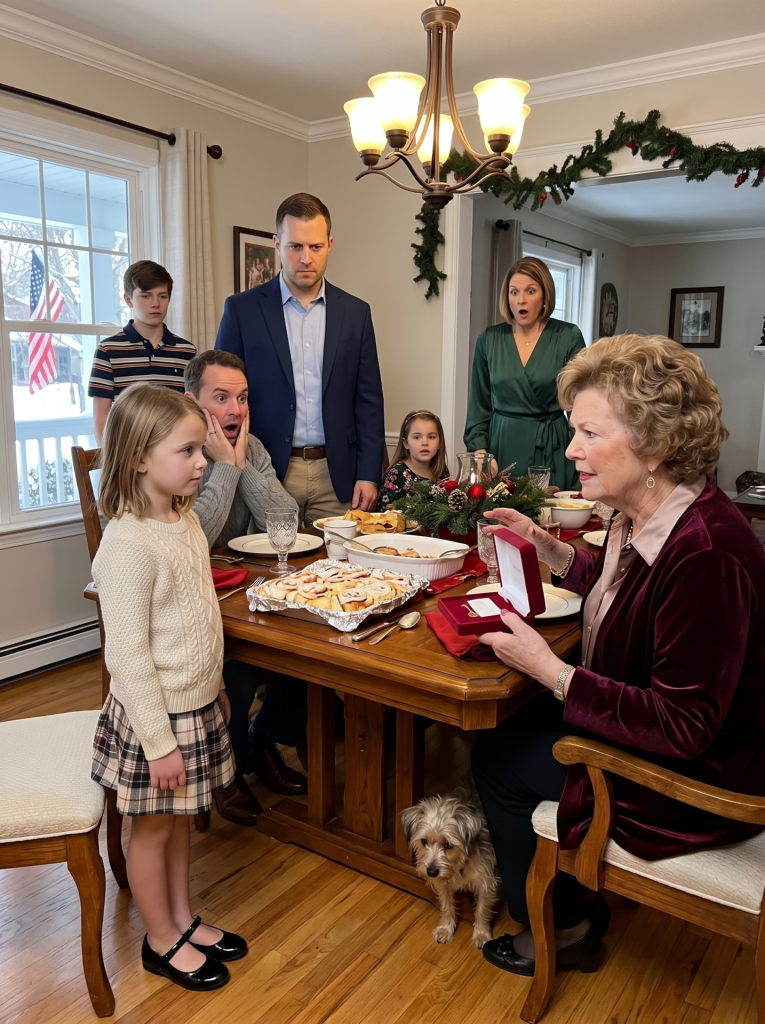
Lorraine took the velvet box and lifted the lid.
Inside sat one small brass key beside a folded white card.
The moment Lorraine saw the key, every trace of confidence disappeared from her face.
Lorraine stared into the red velvet box as though the small brass key had changed the temperature of the entire room. Her fingers tightened around the edges, and when she lifted the folded white card, the confident expression she had worn all morning was gone.
“What have you done?”
Travis stepped forward but kept his voice calm.
“What I told you I would do.”
Lorraine looked from him to Zia, then back to the key in her hand. Several relatives around the table were visibly confused, because to everyone else it looked like an ordinary house key.
“You wouldn’t.”
“I already did.”
Lorraine’s voice suddenly rose.