
The smell reached the hallway before the stretcher even crossed the emergency-room doors. It was a sickening mixture of sweetness, metal, and decay that cut straight through the usual scent of disinfectant, and everyone near the nurses’ station immediately knew this was not an ordinary pediatric emergency.
My name is Dr. Sarah Jenkins, and after eight years in emergency medicine, I had learned that the most dangerous cases were not always accompanied by screaming relatives or obvious trauma. Sometimes a critically ill child arrived beside an adult who spoke so calmly that, for a dangerous moment, everyone was tempted to believe nothing serious had happened.
Marcus, one of our nurses, hurried toward me with his hand pressed over his mask. The eight-year-old boy who had just arrived had a temperature of 103.8, a heart rate near 140, dangerously falling blood pressure, and was barely alert enough to respond when the staff spoke to him.
“His mother says it’s a mild flu.”
Marcus glanced toward Trauma Room 2 before lowering his voice.
“But you need to see his arm.”
The moment I entered, the odor became almost unbearable. The boy looked smaller than eight, with cracked lips, hollow cheeks, and pale, waxy skin that immediately suggested his body had been fighting something serious for much longer than a few hours.
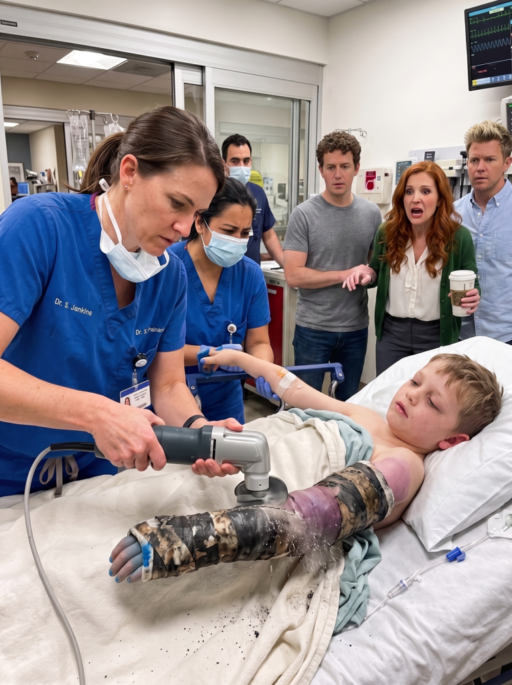
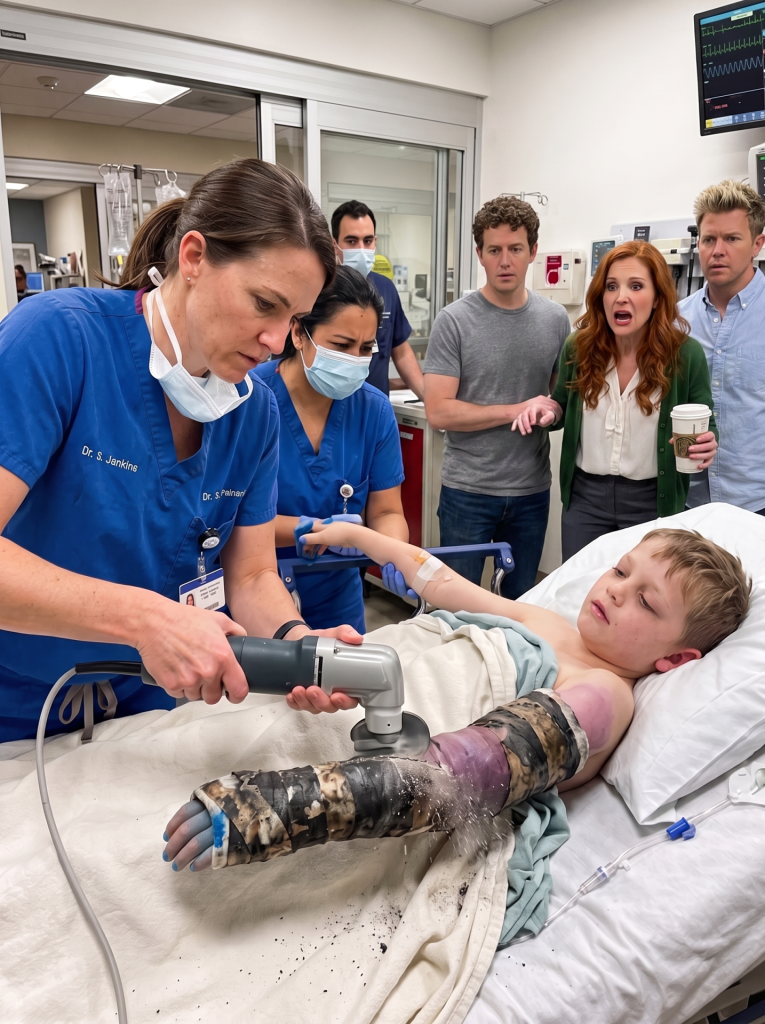
His right arm was trapped inside a fiberglass cast running from his knuckles to above his elbow. The cast was filthy and covered with dark stains, while the material near his hand had tightened around badly swollen skin and his exposed fingertips had already turned blue.
I gently pressed one of his fingertips to test the circulation.
The color did not return.
“How long has this cast been on?”
His mother, Martha Harris, stood in the corner holding a Starbucks cup as though she were waiting through an inconvenient appointment. Dressed in a cream sweater and pearls with perfectly maintained nails and a smooth blonde bob, she looked strangely untouched by the medical crisis unfolding only feet away.
“Oh, about a month.”
She gave a casual shrug.
“He’s clumsy and always falling out of trees in the backyard.”
“We only came because he felt warm this morning. It’s probably some seasonal bug.”
Nothing I was seeing matched her explanation. His vital signs suggested septic shock, and the discoloration in his fingers told me that whatever was happening beneath the cast had already begun interfering with circulation.
“Mrs. Harris, your son is critically ill.”
I kept my voice controlled, but there was no room for negotiation.
“That cast needs to come off immediately.”
“He may lose his hand, and if this infection has spread the way I suspect, he could lose his life.”
Instead of reacting with fear, Martha became irritated. She insisted that his orthopedic surgeon had ordered the cast to remain untouched for another two weeks.
“No.”
“Give him antibiotics and we’ll leave.”
Clara, one of our most experienced nurses, had already put on a second mask and rubbed peppermint oil beneath her nose because the odor was becoming overwhelming. Marcus began preparing pediatric IV equipment while we activated the sepsis protocol, and I felt an old memory returning that I had spent years trying not to repeat.
Three years earlier, I had treated another child whose caregiver offered polished explanations for injuries that didn’t quite make sense. I had documented my concerns but allowed myself to accept those explanations too quickly, and when that child later returned in worse condition, I promised myself I would never again ignore what the evidence in front of me was saying.
“Clara, call security.”
I turned toward the supply area.
“Then bring me the cast saw.”
Martha reacted instantly. She rushed toward the stretcher, shouting before Clara moved between her and the boy.
“You can’t touch him!”
“I’ll sue this hospital!”
Two security guards entered and pulled Martha away from the bed. She struggled against them until she saw Clara place the cast saw beside her son’s arm, and then something remarkable happened.
Her anger disappeared.
“Don’t open it.”
Her voice had become almost a whisper.
I stared directly at her.
“Why?”
Martha kept her eyes fixed on the cast.
“Please.”
“Don’t open it.”
That reaction told me something her earlier explanations hadn’t. Martha wasn’t simply unaware that something might be wrong beneath her son’s cast because, whatever the reason, she clearly knew there was something inside that she desperately did not want us to discover.
Marcus continued administering fluids and antibiotics while Clara stabilized the boy’s arm. I leaned toward him and gently explained that my name was Sarah and that I needed to remove the cast because his arm was very sick.
His lips moved, but he was too weak to answer.
I switched on the saw.
As I carefully cut through the fiberglass, Martha repeatedly demanded that I stop from across the room. The first section was difficult to separate, but once it finally opened, the odor became dramatically stronger and even Marcus turned away for a moment behind his mask.
The padding underneath was soaked, compressed, and darkened from moisture and contamination that had apparently been trapped there for an extended period. When Clara carefully lifted one side away, several pale larvae dropped from the ruined padding onto the sterile floor.
For a moment, even experienced medical staff froze.
Then training took over.
The boy’s arm was severely swollen and extensively infected, with damage beneath skin that had been sealed inside the cast without appropriate treatment. Whatever had happened there had clearly been developing long before that morning.
“Get surgery on the phone.”
Marcus moved immediately while Clara helped me remove the remaining contaminated material. Across the room, Martha suddenly began offering explanations, claiming her son constantly played outside, got dirty, and might have pushed something underneath the cast himself.
“He never said it hurt that badly.”
I stopped and looked at her.
Only minutes earlier, she had insisted there was nothing wrong with his arm. Now she was defending herself against complaints of pain that nobody in the room had mentioned.
“When did he tell you his arm hurt?”
Martha opened her mouth but hesitated.
“I mean, obviously a broken arm hurts.”
“That isn’t what I asked.”
Before I could press her further, the monitor alarmed as the boy’s blood pressure began falling again. Whatever Martha was hiding would have to wait because keeping her son alive mattered more than getting answers from her.
For the next several minutes, the room filled with urgent medical activity as fluids, antibiotics, blood tests, consultations, and emergency interventions became our only priority. When the transfer team finally prepared him for surgical evaluation, the boy opened his eyes and looked directly at me.
“Am I bad?”
I leaned closer, uncertain whether I had heard him correctly.
“What?”
His voice was barely audible.
“Because I got it dirty.”
A cold feeling moved through me.
“No.”
I answered without hesitation.
“You are not bad.”
He continued watching me cautiously, almost as though reassurance normally came with consequences.
“You’re sick.”
“And we’re going to take care of you.”
His eyes slowly closed, but Martha immediately seized on what he had said.
“See?”
“He admitted it.”
“He got it dirty.”
Clara looked furious, but instead of arguing, she carefully sealed the removed cast and contaminated materials inside the proper evidence container.
“We’re preserving everything that matters.”
Martha’s expression tightened.
Once the surgical team took the boy, I opened his medical record and examined the original instructions from his fracture treatment. They clearly warned that worsening swelling, pain, odor, wet padding, fever, or changes in finger color required immediate reassessment, and the chart also showed attempts to arrange follow-up care.
There was nothing supporting Martha’s claim that she had simply been instructed to leave the cast untouched regardless of what happened. When I returned to Trauma Room 2, she was sitting alone, her abandoned coffee on the floor and much of her earlier confidence gone.
“You checked his chart.”
“Yes.”
“I want a lawyer.”
“You can speak to whoever you choose.”
I remained standing in front of her.
“My responsibility is your son’s medical care and accurately documenting the condition in which he arrived.”
Martha stared at me bitterly.
“You’re making me sound like a monster.”
“I haven’t called you anything.”
I kept my tone completely even.
“Your son arrived in septic shock with a severely neglected cast, impaired circulation in his fingers, a high fever, and an infection serious enough that surgeons are now determining what tissue can be saved.”
I paused before adding the detail she couldn’t explain away.