
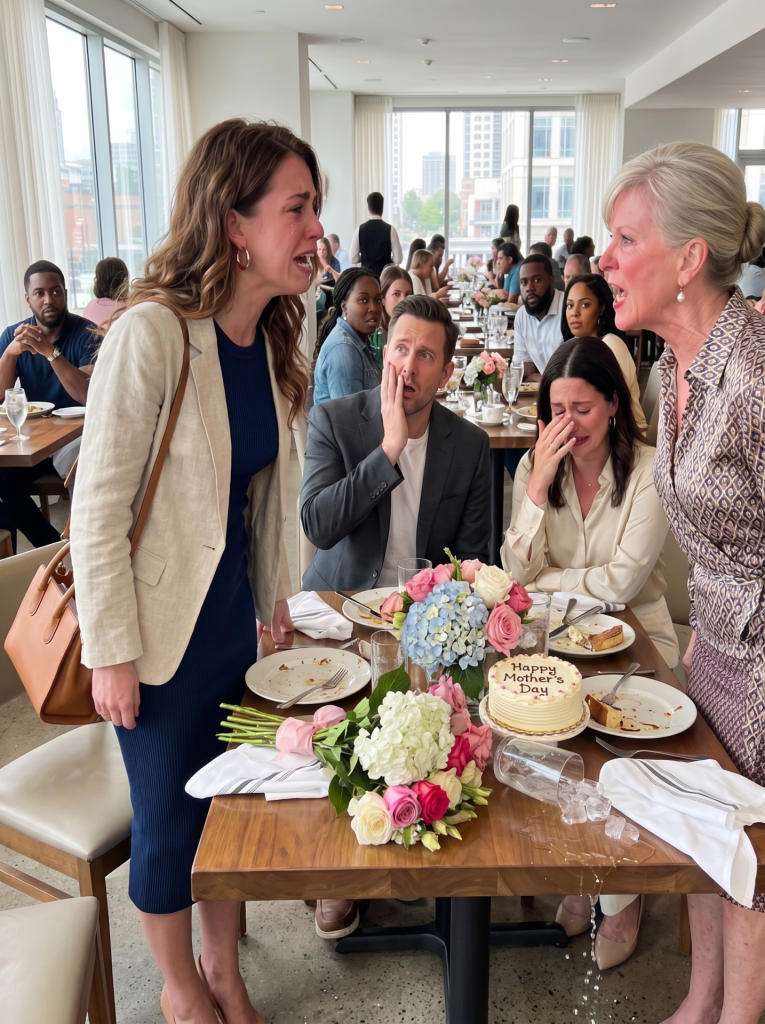

On Mother’s Day, my mother looked directly at me across a table covered with flowers, untouched cheesecake, and the expensive brunch I had paid for. Then Diane Whitmore said something so cruel that for several seconds, I couldn’t even process that the words had come from my own mother.
“I wish you’d never been my daughter.”
My older brother, Ryan, immediately dropped his eyes toward his plate, while his wife, Melissa, suddenly became fascinated with her napkin. Neither of them defended me, and their silence told me this was going to be another family moment where I was expected to absorb the damage quietly.
“You heard me, Emily. Ever since you married Daniel, everything has become about your career, your house, your life. You barely remember this family exists.”
I was thirty-four and working as a regional operations manager in Charlotte, North Carolina, regularly putting in sixty-hour weeks. Since my father died, I had helped cover Mom’s mortgage, paid Ryan’s legal expenses during his divorce, and even driven four hours through freezing rain the previous Christmas because Mom said she couldn’t tolerate spending the holiday in an empty house.
Apparently, none of those things qualified as putting family first.
“What exactly would have made me a good daughter?”
“Someone who puts family first.”
Ryan finally raised his head, although his concern wasn’t directed toward what Mom had just said to me. As usual, he seemed more interested in preventing an uncomfortable confrontation than acknowledging who had caused it.
“Emily, maybe this isn’t the time.”
I gave a short laugh because that was how things always worked in our family. Whenever somebody hurt me, there was somehow never an appropriate moment to discuss it.
Mom pushed her chair away from the table and stared at me with the familiar expression she wore whenever she wanted gratitude to become an obligation.
“I sacrificed everything for you.”
“And I’ve spent half my adult life paying you back for sacrifices I never asked you to keep using against me.”
Her expression hardened immediately. Instead of reconsidering what she had said, she delivered the sentence that finally destroyed whatever remained of my willingness to keep playing my assigned role.
“If I could do it again, I wouldn’t have had a daughter at all.”
I reached for my purse. Daniel gently touched my wrist, but I shook my head because I didn’t want him intervening, and for once, I didn’t want to argue either.
“Em.”
There were no tears and no shouting. I simply stood and looked at the woman who had spent years reminding me that family was supposed to come before everything else.
“Then live as if you never had one.”
Mom blinked at me as though she hadn’t expected her words to have consequences.
“What?”
“You wish I’d never been your daughter. Fine. Starting today, you don’t have one.”
Ryan scoffed, apparently convinced this was another argument that would disappear once I calmed down and resumed fixing everyone’s problems.
“Don’t be dramatic.”
I looked directly at him.
“You’ll understand tomorrow.”
Daniel followed me outside without trying to change my mind. I climbed into my black SUV and drove away while Mom watched from behind the restaurant window, probably believing I would eventually feel guilty and call her first.
That night, I blocked her number, then Ryan’s, and finally Melissa’s. For the first time in months, I went to sleep without wondering which family problem would become my responsibility next.
At exactly 6:17 the following morning, my phone began vibrating across the nightstand. One call became several, and within minutes Daniel was staring at his own screen with an expression that told me the consequences had already begun.
“Emily.”
“What?”
He turned his phone toward me. There were twenty-three missed calls, three voicemails, and two increasingly frantic messages from Ryan.
“Call me NOW. Mom’s bank says her mortgage payment failed. So did the insurance. What did you do?”
Before I could respond, another message appeared.
“Emily, this isn’t funny. Mom could lose the house.”
I slowly sat upright and stared at the screen. For years, my family had insisted that my value had nothing to do with the money, time, and security I constantly provided, but less than twenty-four hours after I walked away, nobody seemed concerned about losing me.
They were terrified of losing what I paid for.
And for the first time in years, I smiled without feeling guilty.
What Ryan didn’t understand was that none of Mom’s payments had actually “failed.” I had simply stopped using my own money to cover expenses that had never been my responsibility in the first place.
For four years after Dad died, Mom told relatives that she survived on his modest pension and her Social Security benefits. That was technically true, but she conveniently left out the fact that I had been quietly covering the enormous gap between what she earned and the lifestyle she continued to maintain.
Every month, $1,460 came directly from my account for her mortgage, while another $310 covered homeowner’s insurance and an escrow shortage. I also paid for her phone plan, car insurance, and supplemental health coverage, bringing the total to nearly $2,400 every month.
Ryan knew I helped Mom financially, although he preferred never knowing exactly how much. As long as the bills disappeared without touching his bank account, ignorance was apparently comfortable.
At 7:05 that morning, my phone rang from an unfamiliar number. The moment I answered, I realized Ryan had borrowed somebody else’s phone to get around the block.
“Emily?”
“You blocked me?”
“Yes.”
“What the hell is wrong with you?”
I walked downstairs while Daniel started making coffee in the kitchen.
“Good morning to you too.”
Ryan wasn’t interested in pleasantries.
“Mom is losing her mind. Her mortgage account says the automatic payment was removed.”
“It was.”
“You removed it?”
“Yes.”
“Why?”
I stopped beside the kitchen island.
“Because she doesn’t have a daughter anymore.”
Silence followed, and suddenly Ryan’s anger softened into the familiar tone he used whenever he needed me to solve something.
“Come on. She was angry.”
“She was specific.”
“She didn’t mean it.”
“That’s convenient.”
His patience disappeared again when he realized I wasn’t immediately surrendering.
“You can’t punish her financially because of one sentence.”