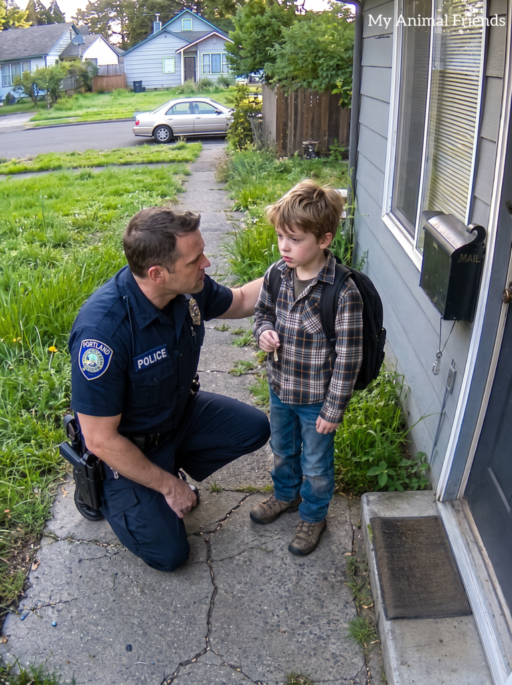

Marcus didn’t cry while telling me any of this. He seemed to have moved beyond expecting adults to believe him, which explained why he had finally changed his approach completely.
Instead of asking someone to trust his description, he had decided to bring an adult directly into the house. At seven years old, Marcus had already learned that people could dismiss words and explain away complaints, but it was much harder to deny something standing directly in front of them.
That was the real meaning behind his simple request.
“Walk me home…”
“…and see it for yourself.”
I quietly contacted dispatch and requested my supervisor along with Adult Protective Services. What had begun as an unusual conversation outside an elementary school had now become a welfare investigation.
While we waited for help, I asked Marcus how long the house had been this way.
“It was already like this when I was little.”
Then he pointed toward a corner where stacks of boxes climbed almost to the ceiling.
“There used to be space there.”
“What was there?”
“My homework desk.”
A sad little smile crossed his face.
“I don’t remember when it disappeared.”
I looked at the mountain of belongings where a second-grader’s desk had once stood. Marcus hadn’t suddenly decided that afternoon that something was wrong with his home.
He had simply reached the point where he could no longer wait for the adults around him to notice.
And now that someone finally had, there was no pretending everything was normal anymore.
Within twenty minutes, my supervisor, Sergeant Dwight Kaminski, arrived at the house. The moment he saw the narrow pathways and mountains of belongings for himself, he understood why I had requested assistance, and Adult Protective Services was brought in to evaluate both Marcus and the conditions inside the home.
The following morning, social workers documented every room and carefully assessed Marcus’s grandmother, Loretta. She was mentally alert and fully cooperative, openly admitting that she had known for years that her collecting had become dangerous but had reached a point where she couldn’t stop herself or convince her son that the family needed professional help.
Later that evening, Marcus’s father, Gary, returned from work without knowing what had happened. He walked through the front door, saw the investigators and social workers standing among the enormous piles he had passed every day, then quietly went back outside and sat on the front steps with his face buried in his hands.
Gary wasn’t deliberately trying to harm his son. He had simply spent so many years watching the clutter accumulate little by little that each newly unusable room had become easier to accept, until denial felt less overwhelming than confronting the problem.
Because the house was no longer considered safe for a child, Marcus temporarily moved in with his Aunt Paulette while professionals began clearing the property. Over the next four days, a specialized cleanup team removed eleven tons of accumulated belongings, gradually uncovering floors, reopening windows, and restoring hallways that had disappeared beneath years of possessions.
Adult Protective Services also worked with Loretta rather than simply treating her as someone who had failed her family. She agreed to counseling and professional treatment for hoarding disorder, while the family began learning that her condition couldn’t be solved by repeatedly telling her to clean the house; it required sustained treatment, boundaries, and support.
Several weeks later, I returned to Evergreen Elementary during afternoon dismissal. Children were racing toward their parents and talking about homework exactly as they had been on the afternoon Marcus first approached me, and I stopped by his classroom to ask Mrs. Calloway how he was doing.
“He’s doing much better.”
She pointed toward the third desk beside the window.
“It was empty for a while.”
“But he’ll be back next week.”
Before temporarily moving in with his aunt, Marcus had already started participating more in class. He was raising his hand again, joining group activities, and slowly behaving like the second-grader he should have been all along instead of carrying responsibilities that belonged to the adults around him.
When I walked back outside, I found myself thinking about something Marcus had said during our walk home.
“Everyone I know thinks this is just how families are.”
That sentence stayed with me because nearly every adult Marcus had approached had found some way to minimize what he was describing. His teacher thought the family simply needed to clean, his aunt believed Loretta had always been that way, and his father had lived around the problem for so long that he had stopped recognizing how serious it had become.
Marcus eventually realized that asking people to believe him wasn’t working. So instead of trying to explain the house again, he found one adult he thought might listen and created something much harder to dismiss.
He created a witness.
That was why he hadn’t asked me to investigate his family or immediately rescue him. He had simply asked me to walk beside him, enter his world, and look at what everyone else had learned to ignore.
The more I thought about his decision, the more remarkable it became. Investigators spend years learning that direct observation can reveal what explanations hide, yet somehow a seven-year-old boy had instinctively understood that people could argue with his words but would have a much harder time denying what they saw with their own eyes.
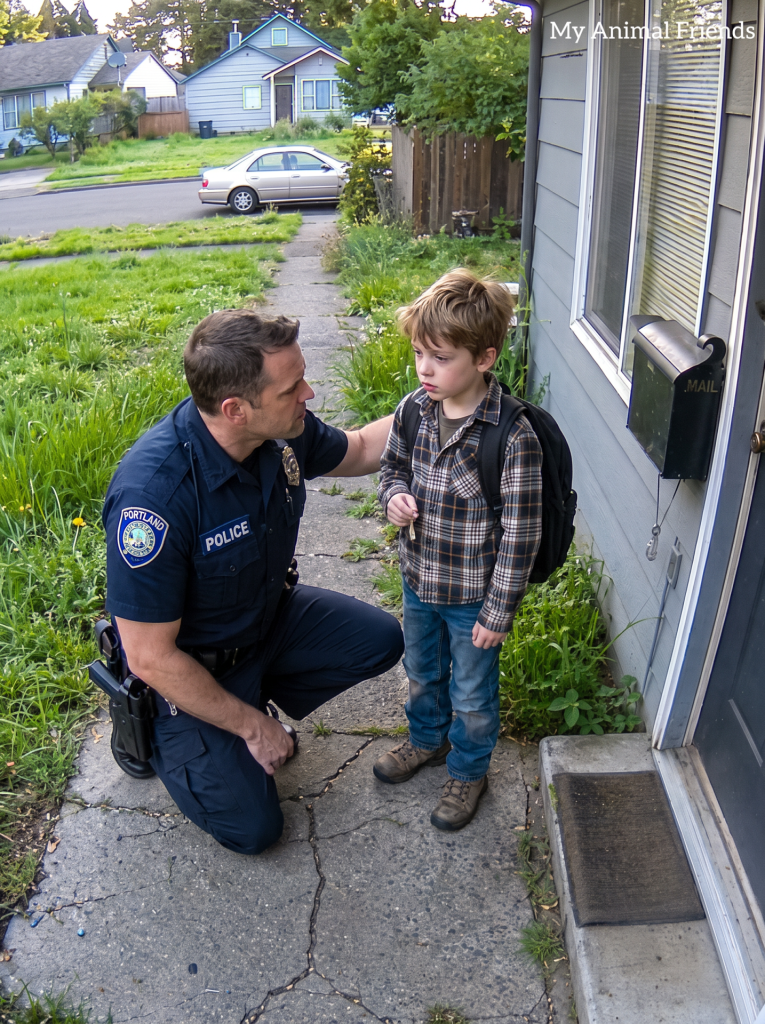
I’ve handled many cases since that afternoon, including incidents far more dramatic than an overcrowded house. Yet when people ask which one stayed with me, I still think about the quiet little boy with the oversized backpack who patiently waited outside his elementary school until he found one adult willing to walk home with him.
Sometimes children aren’t asking an adult to immediately solve everything wrong in their lives. Sometimes they simply need someone willing to enter their world, look closely at what everyone else has dismissed, and finally tell them what they’ve been waiting to hear.
“I see it.”
“And I believe you.’