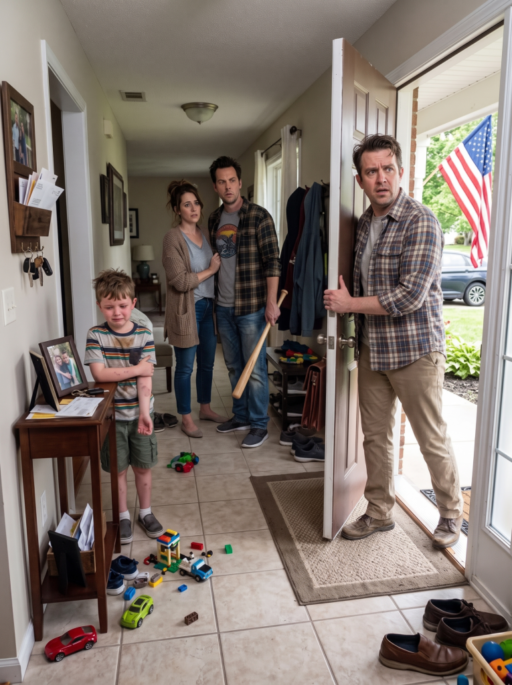
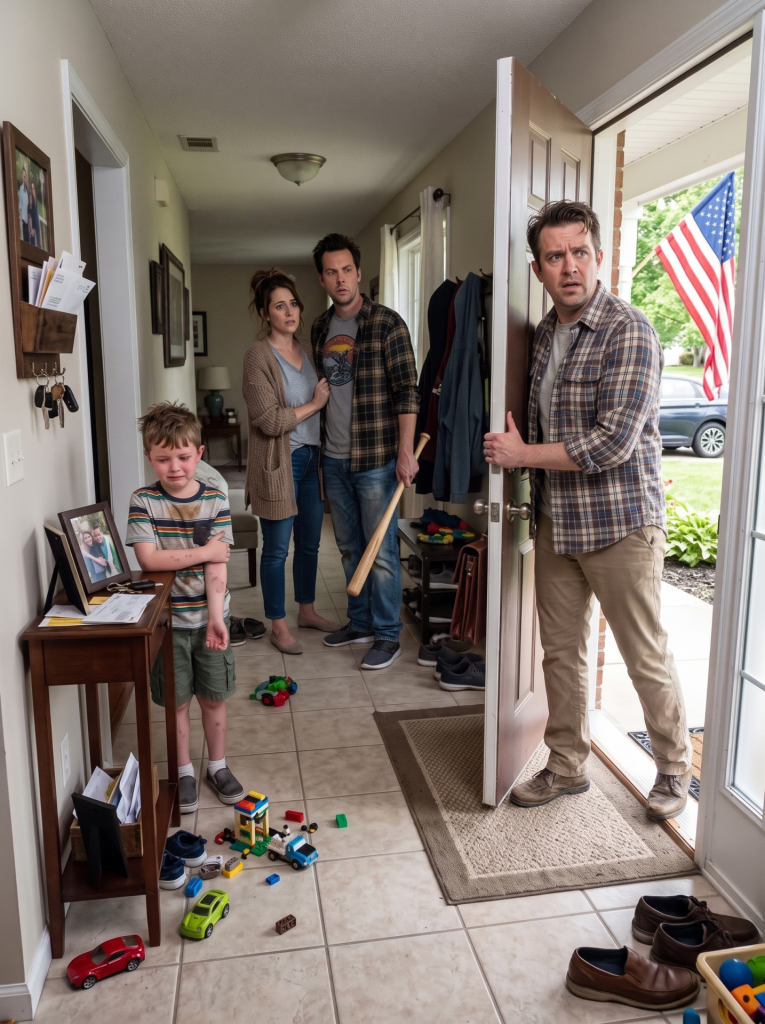

“What made you go inside?”
Derek looked toward Noah.
“He called for help.”
That was all he said, because nothing else needed explaining.
At the hospital, Noah lay in a bed with a small blue sling supporting his left arm. The X-rays confirmed a fracture near his wrist that would require several weeks to heal, and although the doctors assured me there should be no permanent damage, it was difficult to accept that someone entrusted to care for my four-year-old son had caused him that much pain.
I stayed beside him throughout the night and barely moved from my chair. Every few minutes, Noah opened his eyes to make sure I was still there, and each time he looked toward me, he found me exactly where I had promised to be.
Around three in the morning, he finally spoke.
“Daddy?”
“Yeah, buddy?”
“Are you mad at me?”
The question hurt in a way I wasn’t prepared for. I gently touched his hair and wondered how a four-year-old could possibly believe that asking his father for help was something deserving punishment.
“No. Why would I be mad at you?”
“Because I called you.”
“Noah, calling me was the bravest thing you could have done.”
“But Mommy said…”
“What did Mommy say?”
“She said grown-ups get busy.”
I swallowed hard because I suddenly understood why Noah had hesitated before making those calls. Somewhere along the way, he had learned to worry that needing an adult might make him a burden.
“Sometimes they do. But you are never too much trouble for me.”
“You came fast.”
“Of course I did. You called. That means I come.”
Those words stayed with both of us long after that night. Noah needed to know there would never be a meeting, deadline, argument, or inconvenience important enough to make me ignore him when he genuinely needed help.
The investigation progressed quickly afterward. Detectives interviewed me, Derek, Lena, nearby neighbors, and the medical staff, while investigators collected the baseball bat from the living room and carefully documented the evidence inside the house.
This time, the truth didn’t depend on one adult’s version against another. Noah’s fractured arm, his emergency call, Derek’s account, the timeline, and Noah’s own statement all supported the same sequence of events, and Travis was charged with child abuse and assault-related offenses.
A week later, Lena and I sat across from each other inside a family services office. It was our first private conversation since that afternoon, and she looked exhausted and devastated rather than defensive.
“I should have listened to you.”
“I tried telling you.”
“I know. I kept thinking you were just being difficult.”
“You thought I was jealous.”
Lena nodded.
“I thought you hated Travis because he was replacing you.”
“I never cared about replacing me. I cared about Noah.”
That answer broke whatever composure she had left. For once, our conversation wasn’t about which divorced parent had been right; it was about the little boy who had been frightened inside a home where he should have felt protected.
Lena eventually explained that Travis hadn’t behaved that way when their relationship began. He had initially been charming, brought Noah presents, played games with him, helped prepare dinner, and presented himself as someone eager to become part of their family.
Gradually, however, his behavior changed. He became irritated whenever Noah cried, complained that Lena was too soft with discipline, and increasingly treated his anger as authority while accusing her of failing to support him whenever she challenged him.
“I thought I finally found someone who could be a family with us.”
“I was wrong.”
I had complicated feelings listening to her because two truths existed at once. Lena had ignored warning signs that placed Noah in danger, but she was also his mother, and if we wanted our son to recover, anger alone wasn’t going to rebuild what had been damaged.
The court eventually issued a protective order preventing Travis from contacting Noah. His attorneys attempted to characterize what happened as accidental, but the recorded emergency call, witness statements, medical evidence, and Noah’s consistent account made that explanation increasingly difficult to sustain.
Noah never embellished what happened or changed his story. He simply described what he remembered, and later, the detective assigned to the case told me something I never forgot.
“Children often don’t know how to explain what happened.”
“But they know when something isn’t right.”
Physically, Noah’s arm healed exactly as the doctors expected, but emotionally, recovery took considerably longer. For a while, he hated being alone, needed doors left open, wanted someone nearby whenever adults were talking, and sometimes froze when he heard a raised voice.
So we changed our lives instead of pretending his fear should simply disappear. I rearranged my work schedule, Derek became a regular presence, and Lena began attending therapy with Noah while working patiently to rebuild the trust that had been damaged.
Healing didn’t mean convincing Noah that everything was normal again, because it wasn’t. It meant giving him enough honesty, consistency, and safety to understand that what happened wasn’t something he had to carry alone.
On the anniversary of those two phone calls, I took Noah to the park where we used to practice riding his bicycle. His arm had completely healed by then, and he ran ahead wearing his favorite dinosaur jacket before suddenly turning around.
“Daddy!”
“What?”
“Remember when I called you?”
“Yeah.”
“You came.”
“I did.”
He thought about that for a moment.
“Because I’m your kid?”
I walked over, crouched beside him, and pulled him into my arms.
“Exactly. Nothing changes that.”
Years later, people still ask how I somehow knew Noah was in danger that afternoon. They expect an answer about parental intuition or some mysterious instinct, but the truth has always been much simpler.
My son called me twice, and the second time, I answered.
People often imagine courage as something dramatic, but that day taught me it can take much quieter forms. Sometimes courage is a frightened four-year-old picking up a phone, an uncle entering a house because his nephew needs him, or a parent deciding that when a child says something is wrong, believing them comes first.
Noah was small, frightened, and too young to explain everything perfectly. But he knew the one thing that mattered most.
He knew who would come when he called.
And that was enough.