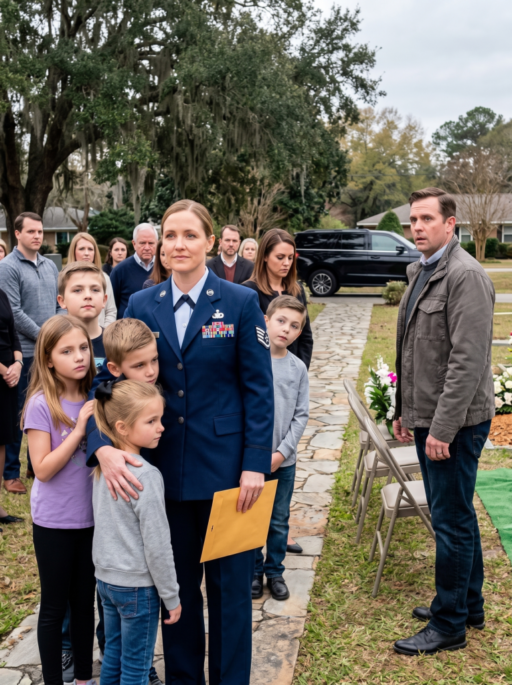
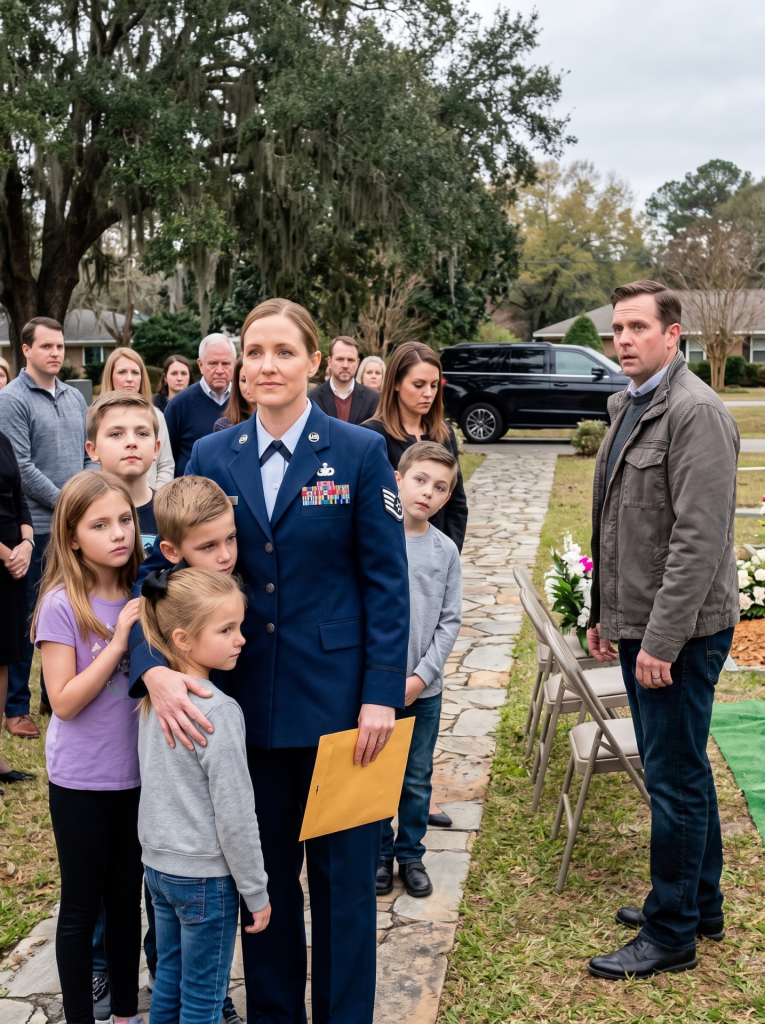
I arrived at my ex-husband’s family funeral with our five children beside me, and the murmurs began before we reached the gravesite. But when he finally looked at them and recognized his own features in every face, the woman who helped break our marriage went white—and I knew the truth she had hidden was about to unravel in front of everyone.

The first page was the paternity report.

He read the heading.

Then the names.

Then the conclusion.

His eyes lifted slowly toward me.

“All five?”

“Yes.”

Grant looked at the children again.

For the first time, the shock on his face was not about whether they were his.

It was about how much of their lives had already happened without him.

Then he turned to the second document.

The old hotel folio.

Vanessa took one involuntary step backward.

Grant noticed.

So did I.

He looked at the page.

Then at Vanessa.

And finally, after ten years, he asked the question he should have asked before ending our marriage.

“What exactly did you know?”

Grant stood beside his father’s grave holding the hotel folio in one hand and the paternity report in the other. For several seconds, he said nothing, but his attention had already shifted away from me and toward Vanessa.

“What exactly did you know?”

Vanessa looked at me before answering him, and Grant noticed immediately. Instead of denying anything, she seemed to be checking my face first, as though she needed to know how much I was prepared to reveal.

“I knew what Savannah told everyone back then,” she said.

Grant’s expression hardened. “That isn’t what I asked.”

Vanessa crossed her arms and reminded him that they were standing at a funeral, but Grant did not look away from her. He lowered his eyes to the papers again and asked whether she had known the hotel was being used for a military training event.

Vanessa hesitated before admitting that she knew there had been some kind of training. Then she quickly added that I had still been seen at the hotel with another man, as if that single detail could restore the certainty she had carried for ten years.
I stepped in before the old version of the story could take over again. The hotel rooms had been reserved as part of a military group booking, and the man photographed beside me had been one of several service members attending the same scheduled event.

Grant looked down at the folio and read it more carefully than he ever had during our marriage. Ten years earlier, he had glanced at documents while already convinced they were excuses; now he traced dates, reservation details, and names as though he understood how much depended on what he had refused to examine before.

The next document was a notarized statement from Captain Aaron Price, the officer Vanessa had identified as the man she believed I was involved with. It explained the training schedule, listed other personnel who had attended, and confirmed that several of us left the building together after the final briefing.

Grant read the entire statement while Vanessa shifted beside him. When she suggested I could have arranged the document later, I pointed to the notarization date from ten years earlier, and for the first time she had nothing immediate to say.

Grant looked at her again. “Did you know this existed?”

“No.”

Her answer came too quickly.

I reached into the envelope and pulled out the last page I had preserved from that period. It was not a dramatic confession or secret recording, just an email Vanessa had sent me three days before the divorce papers were filed.

The subject line read: Let him go.

Vanessa recognized it before Grant even unfolded the page. Her expression changed, and I watched Grant notice that reaction before he read a single sentence.

In the email, Vanessa told me Grant was finally seeing what everyone else had already noticed. She said continuing to defend myself would only humiliate me further, and then she wrote the sentence I had never forgotten.

He already believes me, Savannah. Stop making this harder than it needs to be.

Grant read the line twice and slowly lifted his eyes toward her. Vanessa immediately claimed she had only been trying to stop the constant fighting between us, but Grant asked why ending the fighting had required pushing his wife to stop defending herself.

Vanessa’s polished calm finally started to crack. She said our marriage was already falling apart and reminded Grant that he had complained to her for months about my schedule, the distance between us, and how exhausted he felt.

Grant shook his head. He admitted he had talked about our problems, but he had never asked Vanessa to decide that our marriage was beyond saving.

“You said you didn’t know how much longer you could live like that,” Vanessa said.

“I said we were struggling.”

Grant’s voice remained controlled, but the anger underneath it was obvious. “That is not the same thing as asking you to convince me my wife was cheating.”

Vanessa looked away, and for the first time I saw something other than confidence in her face. Beneath everything she had said about protecting Grant, there was resentment toward me and an old belief that she understood him better than I ever had.

Grant turned back toward me. “Why didn’t you show me this email?”

“I tried to reach you.”

His expression tightened because he remembered how little access I had to him during those final weeks. I reminded him that after the separation, most communication happened through attorneys and that he had stopped accepting my calls before the divorce was even finalized.

“You still could have sent it.”

“I sent you messages.”

Grant frowned. “I never blocked you.”

That answer caught me off guard.

For ten years, I had assumed Grant had deliberately shut every door. The confusion on his face made me think about something I had not questioned in a very long time.

I looked toward Vanessa.

Grant followed my eyes. “What?”

I thought about the night I discovered I was pregnant and called Grant because I believed he deserved to know. Vanessa answered his phone and told me Grant wanted no more emotional manipulation.

The next morning, I sent Grant a message saying I needed to speak to him about the pregnancy. The reply told me there was nothing left for us to discuss except the divorce.

I had carried that message for a decade as proof that Grant had knowingly rejected the pregnancy. Standing beside his father’s grave, I suddenly needed to know whether that assumption was true.

“Did you ever receive a message from me saying I was pregnant?”

Grant’s face went blank.

“What?”

“I contacted you after we separated. Did you ever receive a message telling you I needed to talk about a pregnancy?”

He stared at the five children standing beside me before looking back at my face. Then he shook his head.

“No.”

Vanessa took one small step backward.

Grant saw it.

I told him that Vanessa had answered his phone the night I called. I also repeated what she had said to me, word for word: that Grant wanted no more emotional manipulation.

Grant immediately looked at her.

“I never told you to say that.”

My stomach tightened.

I looked at Vanessa. “Did you delete the message?”

She shook her head quickly.

Grant stepped closer. “Vanessa.”

She tried to tell him this was not the place for another confrontation, but he did not let her redirect the conversation. He asked again whether she had deleted my message and whether she had ever responded to me using his phone.

Vanessa’s eyes filled with tears.

“I thought it would be better.”

Grant stared at her.

“For who?”

She swallowed. “For everyone.”

I felt anger settle into something colder and steadier. “You knew I was pregnant.”

“I didn’t know there were five.”

“But you knew there was a baby.”

Vanessa looked at me and said she had believed the child might belong to the man from the hotel. That explanation revealed something more important than any confession could have: she had not discovered proof of betrayal, she had simply decided the accusation had to be true and treated every later fact as confirmation.

Grant looked devastated.

“Did you send the reply telling her there was nothing left to discuss?”

Vanessa did not answer immediately.

Then she nodded.

“Yes.”

Grant looked down at the ground.

I remembered reading that message alone ten years earlier and accepting it as the final proof that the father of my unborn children wanted nothing to do with them. Learning Vanessa had written it should have felt like victory, but all I felt was the weight of how easily one lie had become ten missing years.

Grant looked at me again. “How far along were you?”

“About nine weeks when I found out.”

He glanced toward Ethan, Noah, Luke, Rose, and Emma. “Did you know there were five when you tried to contact me?”

“Not yet.”

He swallowed hard.

“Did you ever try again after that?”

I answered honestly.

“No.”

Pain crossed his face, but I did not protect him from it. He had been deceived about the pregnancy, but Vanessa had only been able to step into that space because Grant had already stopped listening to me before she ever touched his phone.

“You could have tried again,” he said quietly.

“I had already tried to tell you the truth about the hotel.”

Grant lowered his eyes.

“You didn’t believe me then, so when I thought you had rejected the pregnancy too, I stopped begging to be heard.”

For a long moment, nobody spoke.

Then Vanessa started crying.

“I loved you.”

Grant looked at her without softening.

“You let me believe Savannah cheated.”

“I thought she was going to leave you eventually.”

“That was not your decision.”

Vanessa insisted she had only wanted to protect him from being hurt again. Grant shook his head and told her she had not protected him at all; she had made herself necessary by making sure the person he should have been speaking to could no longer reach him.

Vanessa had no answer for that.

Grant finally asked her to leave.

She stared at him in disbelief and reminded him that they were at his father’s funeral, but Grant said the funeral was exactly why he would not allow her to insult the children and continue controlling the story.

Vanessa looked at me one last time before walking away. There was no applause, no dramatic celebration, and no satisfaction in watching her go, because the damage she helped cause had already taken ten years from people who could never get those years back.

Grant remained standing in front of us with the documents still in his hands.

“What happens now?”

I looked toward William’s grave.

“Right now, we bury your father.”

Grant nodded.

That was all I was willing to give him.

The funeral continued under an uncomfortable silence, and my children stayed close beside me as William Whitmore was laid to rest. Rose cried even though she had never met him, while Ethan kept his eyes lowered and Noah and Luke stood shoulder to shoulder beside Emma.

After the service, each child placed a small white flower near William’s headstone. Watching five grandchildren say goodbye to a man who never knew they existed came closer to breaking me than anything Vanessa had said.

I thought about the Christmas card William sent years earlier.

I hope wherever life has taken you, it has been kinder than we were.

I finally understood why I had kept it for so long. William had been the only Whitmore who apologized without asking me to make him feel better afterward.

When we started walking back toward the SUV, Grant was waiting several yards away. He did not approach the children directly, and for the first time that day, he seemed to understand that biology did not automatically give him permission to step into their space.

“Savannah, can we talk?”

“Not here.”

He nodded.

“Then later.”

I studied him for a moment. “What exactly do you want?”

Grant looked toward the children.

“I don’t know.”

It was the first answer he gave that day that I completely believed.

There was no simple solution waiting for us.

He could not call himself their father and expect ten missing years to disappear. He could not apologize his way into birthdays, school mornings, illnesses, or all the ordinary memories he had never shared.

“If you want the chance to know them, you start slowly.”

Grant nodded.

“No promises.”

“I understand.”

“You don’t tell them what they should call you, and you don’t tell them what they should feel.”

“I understand.”

Then I gave him the boundary I needed him to hear most clearly.

“And you do not blame Vanessa for everything.”

Grant looked hurt.

“She lied to me.”

“Yes.”

I stepped slightly closer.

“But you stopped listening to me before she ever deleted that message.”

He swallowed.

“I know.”

He did not defend himself.

That mattered more than another apology.

I turned toward the SUV, but Ethan stopped me.

“Mom?”

I looked back.

My oldest son was staring at Grant.

“Is he really our dad?”

I walked back and rested one hand against Ethan’s shoulder.

“He is your biological father.”

Ethan looked at Grant again.

“Does that mean we have to know him?”

“No.”

Grant’s face changed, but he did not object.

Then he surprised me.

“You don’t owe me anything.”

Ethan watched him carefully.

Grant continued. “If any of you ever want to ask me something, I’ll answer honestly.”

My son did not smile or step closer.

He only nodded.

“Okay.”

It was almost nothing.

But after ten years built around lies, almost nothing was enough for one day.

As I led my children toward the SUV, I understood that proving what happened in the past had been the easy part. The harder question was whether five children who had grown up without Grant wanted him anywhere in their future, and whether Grant was capable of accepting that the choice belonged to them now.

Grant called me three days after the funeral.

I almost let it go to voicemail.

For ten years, I had imagined what I might say if he ever contacted me again, but when his name appeared on my screen, none of those old speeches felt useful.

I answered.

“Savannah.”

His voice sounded different from the man I remembered.

Less certain.

“I wanted to ask if we could meet.”

I did not answer immediately.

Then I asked:

“About the children or about us?”

There was a pause.

“The children.”

That was the right answer.

We met two days later at a quiet coffee shop halfway between the hotel where the kids and I were staying and the Whitmore property.

Grant arrived early.

He had a folder with him, but this time he did not place it on the table like evidence.

He simply sat down across from me.

“I owe you an apology.”

I looked at him.

“You owe the children more than you owe me.”

He nodded.

“I know.”

That mattered.

Ten years earlier, Grant always needed to explain himself before he could admit he was wrong.

Now he seemed to understand that explanations would not change the outcome.

“I should have listened to you.”

“Yes.”

“I should have asked questions.”

“Yes.”

“I should never have let Vanessa become the person I trusted more than my wife.”

I held his gaze.

“No.”

He looked down.

For a moment, I could see how much he wanted me to make the conversation easier.

I did not.

Grant eventually told me what had happened after I left Georgia.

Vanessa stayed close.

At first, she supported him through the divorce.

Then they began dating.

The relationship lasted several years but never became what she had apparently imagined.

Grant said William never fully approved.

His father kept asking whether Grant had ever verified what happened with me.

Grant always answered the same way.

“There was nothing left to verify.”

Hearing that hurt in a way I did not expect.

William had tried.

Even after I disappeared from the family, he had apparently continued asking the question everyone else wanted buried.

Grant looked at me.

“My dad never believed I handled it right.”

I thought about the Christmas card.

“He was right.”

Grant nodded.

“Yes.”

There was no argument.

Then he asked about the children.

Not whether they liked sports.

Not whether Ethan wanted to meet him.

Not whether I thought they might someday call him Dad.

He asked what they were like.

That was the first question that made me hesitate.

Because describing them meant opening a door.

Still, I answered.

Ethan was responsible to a fault.

Noah talked too much when he was nervous.

Luke could take apart almost anything in the house and occasionally even put it back together.

Rose loved animals and hated losing board games.

Emma remembered every promise anyone made.

Grant smiled at that.