
The morning of my engagement party was unnaturally quiet, and that was the first thing that frightened me. Lily was four years old, and silence had never been part of her personality; most mornings she wandered through the house dragging her stuffed rabbit behind her, inventing songs about pancakes and dinosaurs while talking to everything from the toaster to the houseplants.
That Saturday, there was nothing. When I entered her bedroom, her bed was empty, her purple blanket had been pushed aside, and her stuffed rabbit was lying on the floor while the yellow dress she had chosen for her birthday still hung untouched from the closet door.
“Sunshine girls wear sunshine.”
That was what Lily had told Marcus when she picked out the dress, and he had bought it immediately. Marcus had entered our lives two years earlier and never once treated Lily like an inconvenience; before proposing to me, he had even asked her whether she was willing to share him.
She had agreed under one condition.
“You still have to push me on the swings.”
Marcus had promised he would.
We were staying at my parents’ house because my mother had insisted on hosting our engagement party. She claimed she wanted a fresh start, and although my family had spent years treating Lily differently from my sister Vanessa’s daughter, Emma, I had foolishly hoped my engagement might finally convince them that Lily and I weren’t temporary embarrassments they could eventually erase.
When I became pregnant at eighteen, my parents treated it like a permanent stain on my future. My father called Lily “one bad decision that keeps billing us,” while Vanessa once told me that becoming a young mother had made me difficult to celebrate.
Then Emma was born, and suddenly my family discovered tenderness. Emma received embroidered blankets, framed photographs, birthday countdowns, and praise for ordinary accomplishments, while Lily was constantly corrected for laughing too loudly, touching things, or failing to behave as perfectly as her cousin.
I hated the difference, but I kept hoping they would change.
At 7:18 that morning, hope disappeared.
I searched Lily’s bedroom, the bathroom, the laundry room, and her favorite reading nook before rushing downstairs. My mother stood at the kitchen island wearing pearls and a pale blue blouse, calmly chopping celery as though nothing unusual was happening.
“Have you seen Lily?”
“She probably wandered somewhere.”
The answer immediately bothered me because Lily didn’t wander without telling someone where she was going. Marcus came downstairs moments later, took one look at my face, and immediately joined the search without wasting time trying to convince me that I was overreacting.
When I returned to the dining room, I finally noticed the decorations. Pink balloons covered the ceiling, cupcakes had been arranged beneath a glittering tiara, and a banner stretched across the wall announcing a celebration that made absolutely no sense.
HAPPY BIRTHDAY, EMMA.
Emma’s birthday was three weeks away.
Lily’s birthday was that day.
“What is this?”
Vanessa stood beneath the banner drinking coffee.
“A birthday setup.”
“For Emma?” Marcus asked.
My mother calmly wiped her hands.
“I must have mixed up the dates.”
It was an impossible lie. We had planned the engagement party around Lily’s birthday for months, my mother had written Lily’s name on the checklist attached to the refrigerator, and Vanessa herself had texted the previous evening reminding us to buy Lily’s candles.
My father sat nearby with a newspaper folded across his lap. He hadn’t helped us search, hadn’t asked where Lily was, and seemed more irritated by my panic than concerned about his missing granddaughter.
“Where is my daughter?”
Vanessa took another sip of coffee.
“Some kids are just easier to celebrate.”
Her answer brought back something Lily had asked me the night before. Vanessa had suggested letting Emma open a present “for practice,” and Lily later went upstairs crying before asking me a question I had answered with absolute certainty.
“Can birthdays be taken away?”
I had told her no.
Now I looked at the pink balloons and Emma’s birthday banner and realized my family had apparently tried to prove me wrong.
“What did you do?”
My mother’s expression tightened.
“Do not be dramatic.”
Marcus stepped beside me.
“Where is Lily?”
Vanessa leaned against the dining chair and gave a small laugh.
“Maybe check the waste.”
For a moment, I didn’t understand what she meant. Then I remembered the two commercial dumpsters behind my parents’ garage.
I ran outside with Marcus directly behind me.
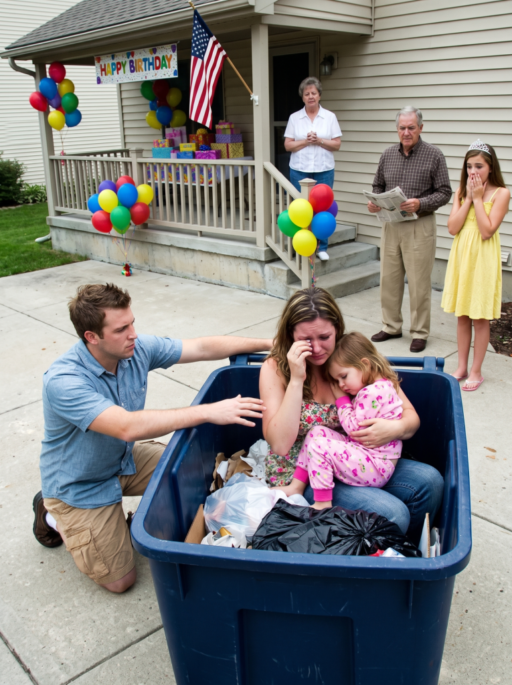
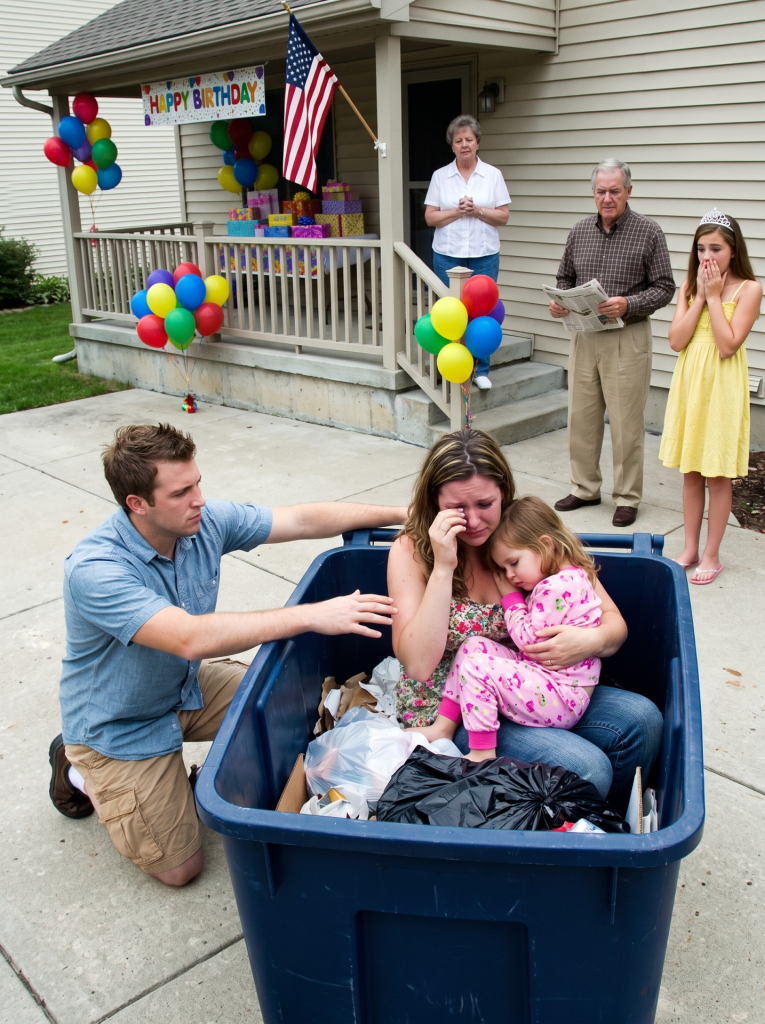
The first dumpster contained nothing but cardboard, garbage bags, and discarded food. Marcus reached the second one before I did and forced open the heavy lid while I screamed Lily’s name.
At first, I saw only torn wrapping paper and black garbage bags.
Then I saw a tiny wrist.
Around it was the silver bracelet I had fastened onto Lily the night before.
I climbed inside and began tearing through the garbage until I found her curled beneath it, missing one shoe and frighteningly still. My hands shook so badly that I couldn’t find a pulse at first, but Marcus climbed in beside me and forced me to try again.
“Try again.”
I pressed my fingers beneath her jaw.
There it was.
Weak, but real.
I lifted Lily out while Marcus helped me over the edge, and when we reached the gravel, I saw my parents and Vanessa standing on the porch watching us. None of them looked surprised enough.
“You knew.”
My father answered first.
“She must have wandered out there.”
Marcus stared at him.
“She was unconscious.”
Then my mother said something that changed everything.
“She was upset. She wouldn’t stop crying. We gave her a little Benadryl so she’d settle down.”
I tightened my arms around Lily.
“You gave my four-year-old medicine without asking me?”
“It was not like that,” Vanessa said.
Marcus immediately called 911 while I photographed the dumpster, Lily’s missing shoe, the torn garbage bags, and the bracelet around her wrist. When Vanessa stepped toward me and tried to take my phone, Marcus moved between us before she could touch it.
The ambulance arrived minutes later, followed by two police cars. While paramedics treated Lily, an officer wearing gloves searched through the garbage and lifted a torn black bag near where we had found her.
Something rolled out beside the paper plates. A small orange prescription bottle. The name printed on the label wasn’t Lily’s. It was Vanessa’s.
“I didn’t,” Vanessa said immediately.
Nobody had accused her yet.
My father stared at Vanessa, then at my mother, and for the first time that morning, the three people who had always defended one another suddenly looked less like a family and more like suspects deciding who would take the blame.
The officer opened his notebook.
“Who put the child in the dumpster?”
And suddenly, nobody had an answer.
The paramedics worked on Lily while my family remained on the porch, suddenly far less interested in explaining themselves. They asked how long she had been outside, what medication she had been given, how much she might have taken, and who had administered it, but my mother kept insisting that everyone was making the situation sound worse than it was.
“This is being blown out of proportion.”
One of the paramedics barely acknowledged her and continued treating Lily. That frightened my mother more than an argument would have, because for once she couldn’t control the conversation or redefine what had happened before anyone else saw it.
The police arrived moments later, and one officer began speaking with Marcus while another approached the dumpsters wearing gloves. My mother followed him partway down the porch steps, apparently still convinced she could transform what they had done into an embarrassing family dispute.
“This is a family misunderstanding.”
“Ma’am, please stay back.”
When the officer found the orange prescription bottle among the garbage, everything changed. Vanessa’s name was printed on the label, and her immediate reaction only made the discovery more suspicious.
“I didn’t.”
Nobody had accused her yet. My father looked from Vanessa to my mother while both women watched him in return, and for the first time in my life, the three of them didn’t look united; they looked like people silently calculating which person would be blamed first.
“Who put the child in the dumpster?”
My mother sat heavily on the porch step, while Vanessa began crying. The tears didn’t look like grief for Lily; they looked like fear of what was about to happen to her.
The ambulance doors closed before I heard an answer. I climbed inside with Lily while Marcus remained behind to speak with the police, promising that he would follow us as soon as he could.
“I’ll follow.”
At the hospital, Lily was taken into treatment immediately. Doctors asked me the same questions the paramedics had asked, and I answered mechanically because concentrating on facts was the only thing preventing me from collapsing.
Lily was four years old. She had been missing that morning, found unconscious inside a dumpster, and might have been given diphenhydramine in an unknown amount at an unknown time; several members of my family had been present, but none had given me a believable explanation.
Marcus arrived twenty-one minutes later carrying Lily’s stuffed rabbit inside a plastic bag. Before leaving my parents’ house, he had already given his statement and backed up every photograph we had taken by sending copies to our email accounts and cloud storage.
“Just in case.”
I understood exactly what he meant. My family had spent years rewriting every cruel remark after the fact, but photographs, timestamps, messages, medical records, and emergency calls were much harder to manipulate.
We sat together beneath the hospital’s harsh lights while ordinary life continued around us. People bought drinks from vending machines, nurses called names, and a little boy nearby complained that he wanted juice, while Marcus and I waited to learn whether my daughter would be all right.
At 10:12 that morning, a police officer arrived to take my formal statement. I told him about Emma’s birthday decorations, the shared messages proving everyone knew it was Lily’s birthday, my mother’s admission about giving Lily medication, Vanessa’s attempt to take my phone, and the prescription bottle recovered from the dumpster.
Then he asked a question that was much harder to answer.
“Has your family ever threatened Lily before?”
My first instinct was to say no because they had never openly announced that they intended to hurt her. Their cruelty had always been quieter: eye rolls when she laughed, accusations that she was dramatic when she cried, comparisons with Emma, and reminders that I should be grateful they allowed me to bring her to family gatherings.
For four years, I had treated those things as favoritism rather than warnings. Sitting in that hospital, I finally understood that my parents and Vanessa had practiced treating Lily as disposable long before they literally left her among the trash.
“Yes.”
I didn’t need to exaggerate or reinterpret anything. They might never have used the exact language of a threat, but they had spent years communicating the same message through their behavior.
Lily finally woke late that afternoon. Her eyes opened slowly, and when she recognized me beside the bed, her first question shattered whatever composure I still had.
“Mommy?”
“I’m here.”
She blinked at me.
“Did I miss my birthday?”
Marcus turned toward the window and covered his mouth. I leaned carefully over Lily, avoiding the IV, and kissed her forehead while trying to keep my voice steady.
“No, baby. You didn’t miss it.”
Lily looked toward Marcus.
“Did I wear sunshine?”
He wiped his face and forced a small smile.
“Not yet. But you still can.”
While Lily recovered, investigators continued assembling the truth from pieces my family couldn’t explain away. A neighbor’s security camera had recorded activity behind my parents’ house at 2:13 that morning, showing my father and Vanessa near the back of the property while one of them appeared to carry something small wrapped in a blanket.
Police also recovered a message my mother had sent Vanessa shortly before that footage was recorded.
“She won’t stop crying. We need the house normal by morning.”
There were deleted messages on their phones, fingerprints on the dumpster lid, the prescription bottle bearing Vanessa’s name, Marcus’s 911 call, and the photographs I had taken before anyone could alter the scene. Even the birthday checklist remained attached to the refrigerator, proving my mother had known exactly whose birthday they were supposed to celebrate.
By evening, there was no engagement party left to save. The decorations were removed, the cupcakes were documented by investigators, and the glittering Happy Birthday, Emma banner became evidence instead of party décor.
My mother, father, and Vanessa were questioned separately for hours. I wasn’t present when their united story finally collapsed, but an officer later told me that Vanessa blamed my mother first, my mother blamed my father, and my father insisted he had believed Lily would simply “sleep it off.”
“Nobody meant for her to be hurt.”
That sentence stayed with me because it revealed how desperately they still wanted intention to matter more than consequence. As though leaving an unconscious four-year-old inside a dumpster could somehow become a misunderstanding if nobody admitted they wanted the worst to happen.
Charges followed, although not with the instant simplicity people expect from television. There were medical reports, interviews, phone records, forensic evidence, and repeated questions, while Lily’s hospital records documented what no member of my family could talk their way around.
Two days after Lily came home, Marcus sat across from me at our kitchen table and told me he had already begun postponing the wedding. I started to object, but he stopped me before I could finish.
“We can get married any day. She only gets one childhood.”
Looking at him, I finally understood what love looked like when it wasn’t accompanied by conditions. It wasn’t the engagement party my mother had offered to host or the elaborate celebration my family had spent months pretending to plan.
It was Marcus canceling deposits, calling vendors, packing Lily’s tiny socks into a hospital bag, and sleeping beside her because she was afraid to be alone.
The party could disappear. The wedding could wait. My daughter could not.
Lily came home from the hospital two days later, but nothing about returning home felt normal. Marcus carried her inside while I followed with her medication and discharge papers, and although she was physically improving, she refused to let either of us move more than a few feet away from her.
That first night, she slept between us with her stuffed rabbit tucked beneath her chin. Every time I shifted beneath the blankets, her eyes opened, and I could tell she was checking that I was still there before allowing herself to fall asleep again.