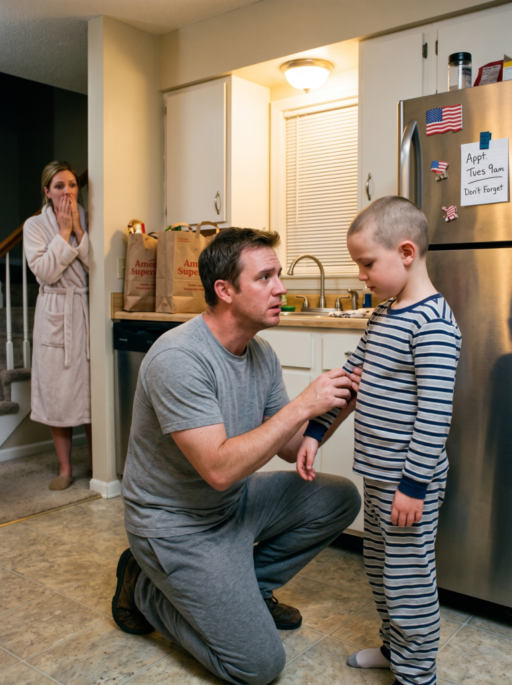
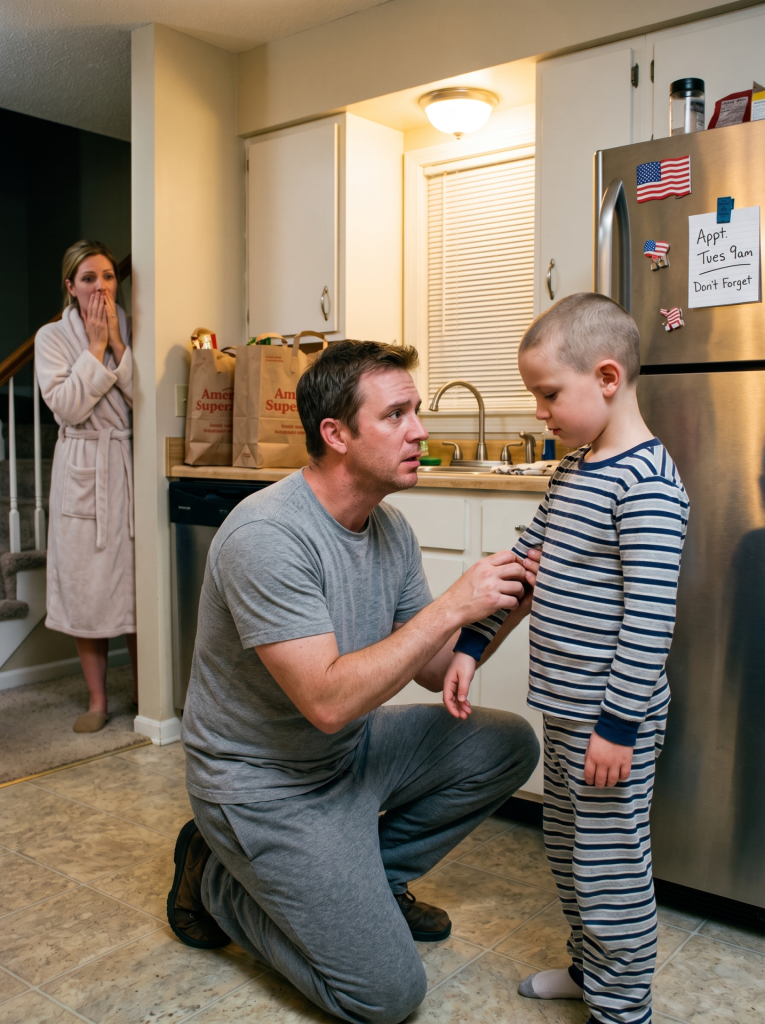

The day my six-year-old son disappeared began like an ordinary Thursday. Eggs cooked in butter on the stove while a vanilla candle burned beside the sink, and Ethan sat at the kitchen table in his dinosaur hoodie, kicking his feet against the chair as he waited for breakfast.
His afternoon appointment was supposed to be routine, just one final orthopedic follow-up after a bicycle fall three weeks earlier. The reminder was still attached to our refrigerator beneath a small American flag magnet, and I tapped it twice that morning to make sure everyone remembered.
“Two o’clock. Hospital orthopedics.”
Ethan nodded with the seriousness of a child receiving an important assignment. Then my wife, Sarah, entered the kitchen carrying coffee and casually announced a change I hadn’t agreed to.
“Actually, Mom is going to take him.”
I stopped cooking and looked at her.
“Why?”
“She offered.”
That was how Gertrude operated. My mother-in-law was always offering to help, but her favors had a habit of becoming opportunities to take control; she might volunteer to buy groceries and then reorganize our pantry, or babysit Ethan for an hour and return with new shoes because she thought the ones we bought made him look neglected.
I had spent years telling Sarah that her mother treated boundaries as personal insults. Sarah had spent just as long asking me not to turn every disagreement involving Gertrude into a larger conflict, because she had grown up inside that behavior and learned to interpret control as concern.
“You have that meeting,” she said. “Mom knows how to handle appointments. Please don’t make this a whole thing.”
I reluctantly agreed, and at ten that morning Gertrude arrived in her spotless silver Mercedes. She barely acknowledged me before turning toward Ethan with the sweet, affectionate expression she always reserved for him.
“Ready, sweetheart?”
Ethan looked at me before walking toward the car. There was no fear in his expression because he trusted his grandmother, but I would later replay that small glance more times than I could count.
I zipped his backpack and handed it over.
“Straight to the appointment, okay? Call me when you get there.”
Gertrude gave me a tight smile.
“We know.”
I watched the Mercedes disappear down the street before returning inside and trying to work. By 2:15, however, I had reread the same paragraph several times, so I finally called the clinic to confirm Ethan had arrived.
After placing me on hold, the receptionist returned sounding noticeably more careful.
“Sir, we don’t show Ethan Richardson as checked in today. Are you sure the appointment wasn’t rescheduled?”
My hand tightened around the phone. I opened the patient portal immediately, but the appointment was still listed for 2:00 p.m. in the same department with the same confirmation number.
I called Gertrude.
Voicemail.
I tried again.
Voicemail.
Then I called Sarah and received no answer. By 3:39, after repeated attempts to reach Gertrude and several calls to the hospital, I finally left a message.
“Gertrude, this is Michael. Call me immediately. The hospital says Ethan was never checked in.”
At exactly 4:00 p.m., the hospital scheduling office confirmed what I already feared.
“He never checked in.”
That was when I started saving everything: screenshots of my call history, Ethan’s appointment confirmation, the patient portal, and every unanswered voicemail. I wasn’t deliberately trying to build a case against anyone, but something inside me understood that if this became worse, simply telling the truth might not be enough.
Sarah returned shortly after five carrying groceries and found me pacing between the kitchen and back door. She seemed confused by my panic until I told her Ethan had never arrived at his appointment.
“Where is Ethan?”
“Mom probably took him for ice cream.”
“He missed his hospital appointment.”
Sarah hesitated before offering another explanation.
“Maybe she went to the wrong entrance.”
“The hospital said he never checked in.”
Sarah put the grocery bags down harder than necessary and looked at me with the frustration I had seen countless times whenever I questioned her mother.
“You always do this. You turn everything involving my mother into a crisis.”
I showed her the hospital portal, the appointment confirmation, and the growing list of unanswered calls. Sarah studied the evidence before looking away.
“Mom will explain.”
That answer frightened me more than I wanted to admit. Our six-year-old son had been gone for hours, yet Sarah was still waiting for her mother to provide an explanation instead of asking the question that consumed me: where was Ethan?
I contacted the police non-emergency line and explained that a family member had taken my son to a medical appointment but never arrived. The dispatcher asked for his name, age, clothing, vehicle information, and relationship to the person who had taken him, and I forced myself to answer every question clearly.
Sarah stood near the sink listening until I ended the call.
“You called the police on my mother?”
I stared at her.
“Our son is missing.”
She had nothing to say to that.
The hours that followed became increasingly unbearable. I checked the driveway constantly and called Gertrude until her phone stopped ringing and began going directly to voicemail, while Sarah eventually left her own message shortly after nine.
“Mom, this isn’t funny. Call me.”
By midnight, our house felt more like a waiting room than a home. Sarah sat on the stairs staring at her phone while I watched every car passing beneath the porch light, and shortly after one in the morning, an officer called to ask whether there had ever been conflict within the family.
“Any family conflict?”
I looked toward Sarah before answering.
“Yes.”
Then, at 3:47 a.m., the back door opened.
Ethan stepped into the kitchen alone, but he looked nothing like the child who had climbed into Gertrude’s Mercedes that morning. His dinosaur hoodie, backpack, and shoes were gone, unfamiliar sweatpants and an oversized shirt had replaced his clothes, and his hair had been cut almost completely to the scalp.
His lips were cracked and his hands were trembling. When he saw me, his face crumpled with the exhausted relief of a child who had spent hours trying to get home.
“Daddy…”
I dropped to my knees in front of him and forced myself to keep my voice gentle.
“Buddy, where were you?”
His eyes filled with tears.
“Grandma told me I’m not allowed to say where we went.”
Then Ethan instinctively pulled his sleeve farther down his arm. It was a tiny movement, but it immediately told me there was much more behind his disappearance than a missed hospital appointment.
“Can I look?”
He nodded without meeting my eyes.
When I carefully lifted his sleeve, Sarah came down the stairs and froze. There was a mark on Ethan’s forearm that neither of us could explain as ordinary playground roughness, and suddenly his shaved head, unfamiliar clothing, missing belongings, and twelve-hour disappearance became pieces of something far more disturbing.
Before either of us could ask another question, my phone lit up on the kitchen floor.
Gertrude.
I answered on the third ring and switched the call to speaker. Ethan immediately pressed himself against my chest as his grandmother’s calm voice filled the kitchen.
“Before you start acting hysterical, Michael, you need to understand I did what your wife was too weak to do.”
Sarah covered her mouth while I held Ethan closer.
“What did you do?”
Gertrude answered without hesitation.
“I corrected him.”
And at that moment, Sarah finally began to understand that the woman she had defended for years had taken our son somewhere she still refused to name.
Gertrude’s voice remained disturbingly calm through the speaker, as though disappearing with a six-year-old for nearly eighteen hours and returning him alone in the middle of the night required nothing more than a reasonable explanation. Ethan stayed pressed against my chest while Sarah stood several feet away, staring at the phone as the version of her mother she had defended for years began collapsing in front of her.
“I corrected him.”
For several seconds, neither Sarah nor I responded. Gertrude had said those words with complete confidence, not like someone ashamed of what she had done, but like someone convinced she possessed the authority to decide what our son needed.
Sarah finally managed to speak.
“Mom?”
Gertrude’s voice immediately sharpened.
“Don’t you start. You let that child run wild. You let Michael fill his head with nonsense. I took him somewhere safe.”
I looked down at Ethan, still wearing unfamiliar clothes with his hair cut almost to the scalp. Nothing about the frightened child clinging to me suggested he had spent the day somewhere safe.
“Where?”
Gertrude ignored the question.
“Where did you take my son?”
She gave a short laugh before answering.
“You should be thanking me.”
That was when I noticed Ethan’s backpack was still missing. Gertrude had taken him from our house with his dinosaur hoodie, shoes, and blue backpack, yet he had returned with none of them, and I began wondering whether something inside that bag could reveal where she had taken him.
“Buddy, did Grandma take your backpack?”
Ethan nodded once.
I looked toward Sarah and watched the color drain from her face. For years, she had found explanations whenever I questioned her mother’s behavior, but there was no explanation broad enough to cover what was standing in our kitchen.
Gertrude continued talking about discipline, family standards, and embarrassment, speaking about Ethan as though being his grandmother gave her ownership over him. While she lectured us, I glanced at my phone and noticed the call timer moving across the screen.
I was recording everything.
I hadn’t consciously planned to record the call, but when Gertrude’s name appeared, instinct had apparently moved faster than thought. Sarah noticed the recording symbol too, and her knees seemed to weaken before she lowered herself onto the bottom stair.
“Mom…”
This time, Sarah didn’t sound angry. She sounded like someone realizing that the person she had trusted throughout her childhood might never have been the person she believed she was.
Gertrude continued without hesitation.
“You always let him make me the villain. But when that boy is older, he’ll understand who loved him enough to make hard choices.”
Ethan whimpered against my chest, and that small sound seemed to reach Sarah in a way none of my warnings ever had. She stood again and looked directly at the phone.
“Mom, where is his backpack?”
Gertrude suddenly stopped talking.
Her silence answered more than another explanation could have. Whatever had happened during those missing hours, she knew the backpack mattered, and for the first time, Sarah appeared unwilling to let her mother redirect the conversation.
At 4:06 a.m., the officer handling Ethan’s disappearance returned my earlier call after receiving my message that Ethan had come home. I placed Gertrude on hold and explained everything as clearly as possible: Ethan had returned alone, his clothes had been changed, his hair had been shaved, there was a visible mark on his arm, his backpack was missing, and I had recorded Gertrude admitting that she had “corrected” him.
The officer immediately told us not to delete or alter anything. He instructed us to photograph Ethan’s unfamiliar clothing, preserve every hospital record and call log, save the recording in multiple locations, and write down Ethan’s exact words rather than questioning him repeatedly.
For the first time since the hospital told me Ethan had never arrived, having concrete instructions gave me something useful to focus on. I wasn’t trying to understand Gertrude anymore; I was preserving what had happened before anyone could rewrite it.
Sarah brought a blanket from the living room and carefully wrapped it around Ethan’s shoulders. Her hands trembled as she tucked the fabric around him, and when she finally spoke, her voice was barely audible.
“I’m sorry.”
Ethan didn’t answer.
His silence affected Sarah more deeply than anger would have. She had spent years asking me to overlook her mother’s behavior, but now our son’s body had learned what those compromises could cost, and he wasn’t ready to reassure her that everything was fine.
I photographed the clothes Ethan had returned wearing and saved screenshots of his hospital appointment, patient portal, and every unanswered call. Then I exported the recording of Gertrude’s confession twice and wrote down the sentence Ethan had spoken immediately after coming home.
“Grandma told me I’m not allowed to say where we went.”
At 5:22 a.m., an officer arrived at our house. The groceries Sarah had brought home the previous evening were still sitting on the counter, the porch light remained on, and Ethan’s missed appointment reminder was still attached to the refrigerator beneath the little American flag magnet.
The officer spoke gently with Ethan and deliberately kept his questions limited. Ethan answered some of them, but when the officer asked where Gertrude had taken him, he hesitated and looked toward Sarah before saying anything.
That glance devastated her.
Sarah turned away and covered her face while the officer continued taking notes without pressuring Ethan. He didn’t promise arrests, explanations, or immediate justice, but he treated what Ethan said as something worth documenting rather than something that needed to be defended against.
Later that morning, Sarah called Gertrude again while the officer was still present. This time, Gertrude didn’t answer, and the woman who had sounded so confident only hours earlier had suddenly become unreachable.
Her disappearance didn’t surprise me. People who depend on controlling the story often become much less confident once there are timestamps, recordings, photographs, and witnesses they cannot manipulate.
The days that followed were consumed by appointments, reports, and attempts to understand what Ethan was ready to tell us. His orthopedic appointment was eventually rescheduled, and this time there was never any question about who would take him.
I drove. Sarah came with us.
By then, Ethan’s blue backpack had finally been returned, but several things he had packed himself were missing. His dinosaur water bottle was gone, along with his crayon folder and the little plastic triceratops he always carried in the front pocket for luck.
Sarah sat in the hospital waiting room holding that half-empty backpack across her lap. She barely spoke while we waited, and the expression on her face made it seem as though the small blue bag weighed more than everything that had happened to our marriage.
The orthopedist eventually cleared Ethan physically to return to recess. Under different circumstances, that sentence would have been the only thing that mattered that day.
But the bicycle injury had never been the real danger.
The real danger had been allowing an adult to mistake family connection for unrestricted access to our child. Gertrude had spent years disguising control as concern, and Sarah and I had spent far too long arguing about whether her behavior was annoying instead of recognizing what happened when nobody finally told her no.