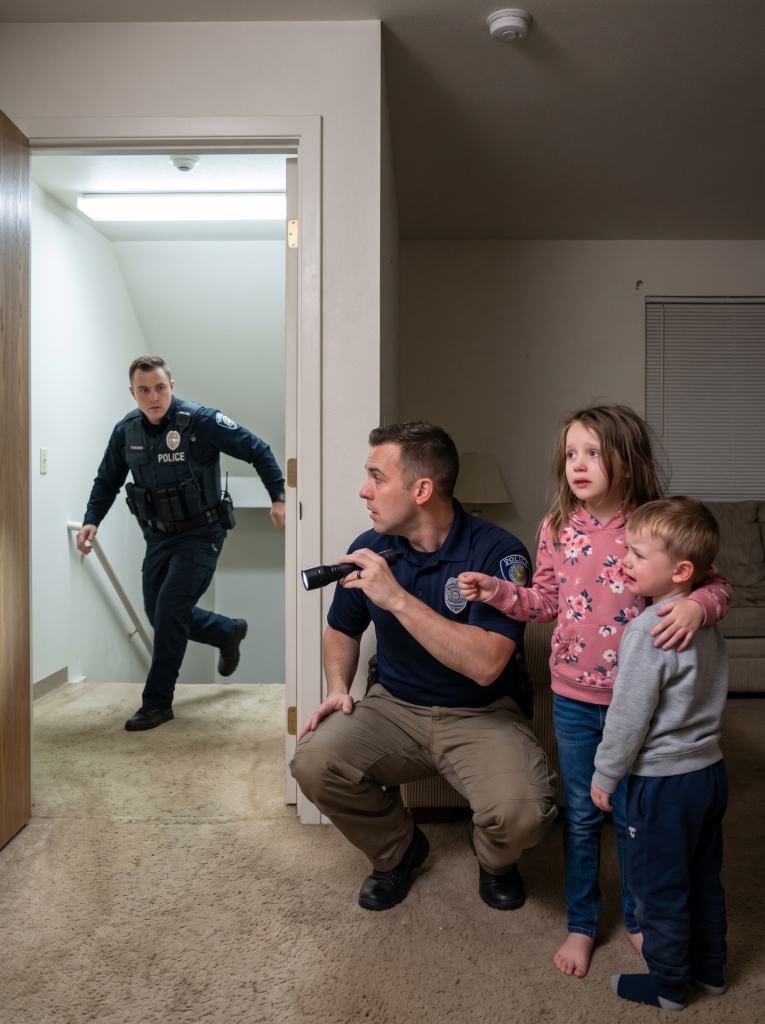

Caleb had no consistent answer.
They asked why apartment 4B lost power immediately afterward, despite every neighboring unit retaining electricity. Caleb first denied touching the electrical panel, but investigators already had Sarah’s messages showing he had previously threatened to shut off the apartment’s power.
The final contradiction concerned the photograph.
Caleb initially claimed he had never been to his father’s cabin recently. When detectives told him they had found his half of Sarah’s photograph there, along with documents tracking her routine, he stopped answering questions and requested an attorney.
For Sarah, his arrest did not instantly make everything normal.
Leo was recovering, but Lily had begun asking whether she had caused her father to be arrested by calling 911. Sarah repeatedly explained that adults were responsible for their own choices and that Lily’s only responsibility that night had been asking for help when she and her brother were no longer safe.
The public story also began changing.
The same neighbors who had accused Sarah of abandoning her children now watched police return to the building and seal the utility corridor for evidence. The livestream that had portrayed Sarah as a careless mother quietly disappeared, although screenshots of the accusations continued circulating.
Sarah refused to respond publicly.
She had more important decisions to make.
Before leaving the hospital, a victim advocate helped her request an emergency protective order. The apartment locks would be replaced, building management agreed to secure access to the electrical panel, and Sarah arranged to stay temporarily with her sister rather than immediately returning to 4B.
That evening, Lily finally asked the question Sarah had been dreading.
“Are we going home?”
Sarah looked at both children before answering.
“Not to that apartment yet.”
Lily seemed worried.
“Because Dad knows where it is?”
Sarah nodded.
For years, she had measured safety by whether Caleb was physically inside their home. Now she understood that safety meant something larger: boundaries he could not bypass, adults Lily was allowed to call, and a life that did not depend on keeping his anger quiet.
Two days later, Rachel called with an update from the prosecutor.
The evidence supported charges related to Sarah’s confinement, interference with emergency assistance, unlawful entry and other conduct from that night. The exact outcome would depend on the court, but Caleb would not simply be walking back into their lives as though nothing had happened.
Then Rachel mentioned something else.
Investigators had reconstructed why the date was written beneath the cabin address.
And what they discovered showed that Caleb’s plan for that night had originally gone much further than locking Sarah in a basement room.
The date on the back of the photograph had not been written as a reminder of Sarah’s disappearance. Detectives discovered it matched the date Caleb had marked on a printed copy of the upcoming custody schedule found at the cabin, beside a handwritten note indicating that he intended to confront Sarah before the hearing and pressure her into changing the arrangement.
Nothing investigators found proved that Caleb had planned to physically harm Sarah at the cabin. What the evidence did show was that his appearance at apartment 4B had not been spontaneous, and the documents tracking Sarah and the children suggested he had been preparing for a confrontation long before that night.
The photograph helped complete the timeline. Caleb had taken it from Sarah’s belongings during an earlier unauthorized visit, carried his cut-out half to the cabin, and written the address and date on the remaining piece before returning it. Investigators believed it was meant to frighten Sarah by reminding her of the threat she already associated with that location.
Sarah remembered finding the photograph several days earlier but had been too frightened to ask Caleb about it. She slipped it into Lily’s canvas bag while gathering documents for the custody hearing, never imagining her daughter would eventually be the person carrying it to police.
The criminal case moved forward over the following months. Caleb ultimately admitted that he had gone to the apartment despite Sarah telling him to stay away, confronted her downstairs, locked her inside the utility room, taken her keys, and interfered with the apartment’s electricity before leaving.
He continued insisting that he never intended for the children to remain alone for hours. The prosecutor pointed out the obvious problem with that defense: Caleb knew Lily and Leo were upstairs when he prevented their mother from returning to them.
The court imposed a protective order preventing Caleb from contacting Sarah or approaching the children outside arrangements approved through the legal process. The custody case was separately reviewed, with Lily and Leo’s safety placed ahead of Caleb’s demands for immediate access.
Sarah did not return to apartment 4B.
With help from her sister and a local family-support program, she moved the children to a smaller apartment in another part of the city. The new place was not impressive, but Lily cared about only two things when she first walked inside: every light worked, and her mother was standing beside her.
Leo recovered completely from the fever. Lily’s recovery was quieter and slower.
For several weeks, she checked the front door repeatedly before sleeping. If someone knocked unexpectedly, she froze and looked toward Sarah before moving, and Sarah realized that her daughter had learned far too young to associate a knock at the door with danger.
So they created new rules together.
Lily was still never required to open the door for anyone, but she was allowed to call Sarah, her aunt, a trusted neighbor, or 911 whenever she felt unsafe. Most importantly, Sarah told her there was no longer any rule requiring her to decide whether a situation was “serious enough” before asking an adult for help.
Months later, Rachel visited the family as part of a follow-up. Lily proudly showed her Leo’s drawings taped across the refrigerator and explained that her brother no longer needed her to check whether he felt hot every few minutes.
Before Rachel left, Lily asked whether she remembered their first conversation.
Rachel smiled. “I remember.”
“I broke Mom’s rule when I called 911.”
Sarah heard her from the kitchen.
“No,” she said. “You followed the most important rule.”
Lily looked confused.
Sarah crouched beside her.
“You asked for help when you needed it.”
The story people in the apartment complex had told that first night had been much simpler. A mother disappeared, two children were found alone, and strangers decided they already understood what had happened.
The truth required more patience.
Sarah had not abandoned Lily and Leo. She had been prevented from returning to them. The dark apartment had not been evidence of neglect; its electricity had been deliberately shut off. The barricaded door, the abandoned purse, the prescription, the interrupted emergency call and the photograph had all been pieces of the same frightened family trying to stay safe.
But the most important evidence had never been inside the apartment.
It had been Lily’s voice at 2:17 that morning.
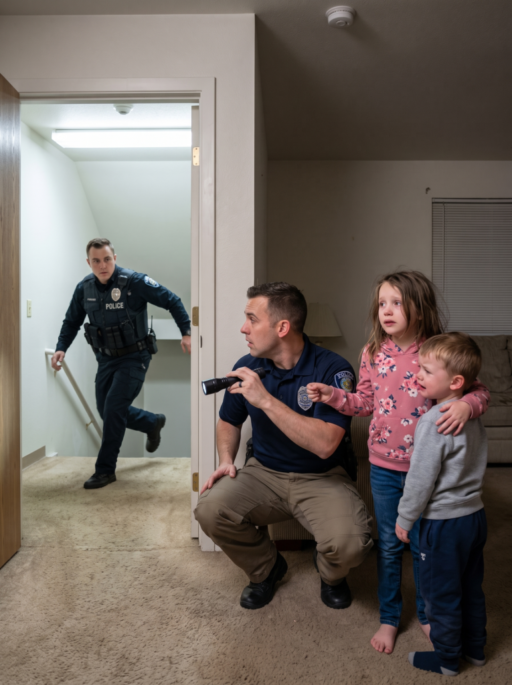
Seven years old, frightened and unsure whether she was even allowed to ask for help, she had picked up the phone anyway. That decision brought an ambulance for Leo, led officers to Sarah and preserved the details that eventually exposed what had happened before strangers could permanently replace the truth with their assumptions.
Lily had spent that night believing she was waiting for her mother to come home.
In the end, she was the reason her mother did.