
When I opened the hospital-room door, Noah stopped at the entrance. His eyes moved from the breathing tube to the monitors and finally to Daniel’s still face, and for several seconds, he seemed too frightened to take another step.
Then he noticed Daniel’s bare feet beneath the edge of the blanket. Noah walked closer, placed the military cap on the chair, and pulled out the folded family drawing he had hidden inside it.
“I fixed your medals,” he whispered. “I gave you ten because Grandma said you saved somebody.”
Daniel did not respond. Noah looked at me, waiting for an explanation, but there was nothing I could say that would make the silence easier for him.
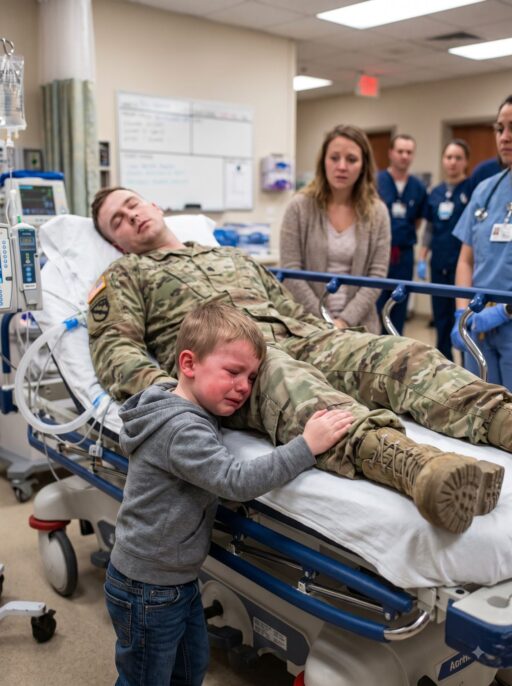
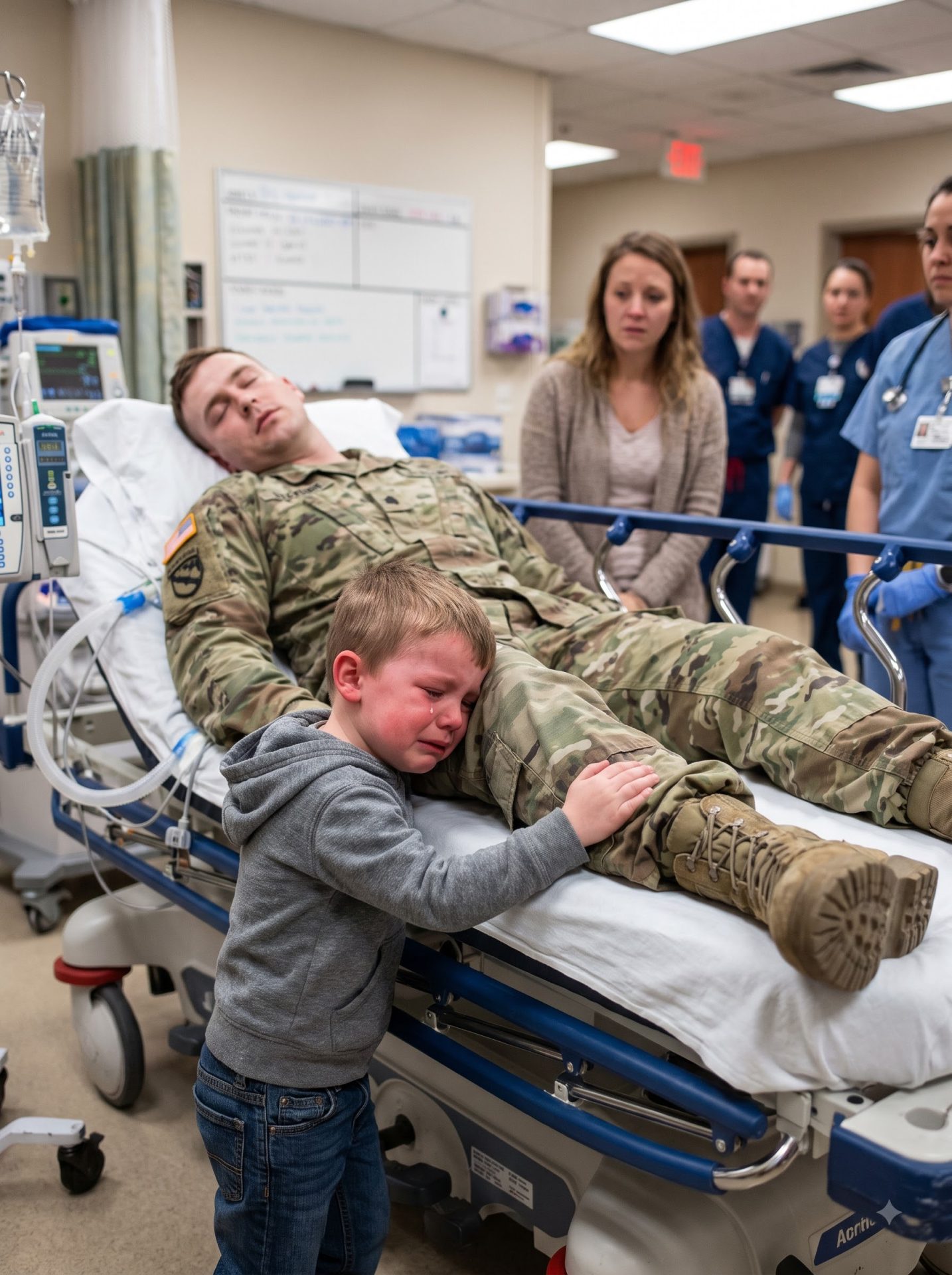
He placed the picture on Daniel’s chest and touched his father’s hand. When Daniel remained motionless, Noah moved toward the foot of the bed, wrapped both arms around his father’s leg, and gently began to shake it.
“Daddy, wake up. Please wake up. You promised you’d come home for my birthday.”
Margaret turned away as Noah pressed his cheek against Daniel’s leg. He apologized for saying he did not need him and promised never to become angry when Daniel missed another school event.
I knelt beside Noah and tried to pull him into my arms, but he refused to let go. He kept repeating that Daniel had never broken a promise before and only needed someone to help him wake up.
The heart monitor suddenly began sounding faster. A nurse rushed into the room, followed by the doctor, who asked us to step away while she checked Daniel’s pupils and vital signs.
Margaret pulled Noah toward the door, but I remained close enough to see Daniel’s right hand beside the folded drawing. As the doctor called his name, one of his fingers slowly curled around the edge of the paper.
Then Daniel’s eyelids began to move.
Daniel’s eyelids fluttered, but they did not open. The doctor asked us to remain quiet while she checked his responses, and Noah stood beside me with both hands covering his mouth as if even breathing too loudly might make his father disappear again.
The movement was more than a simple reflex. Daniel’s heart rate changed when Noah spoke, and his fingers tightened whenever our son touched the drawing, although the doctor warned us that these responses did not guarantee he would regain consciousness.
Noah did not understand the difference between reacting and waking. He believed his voice had reached his father, so he asked if he could return every day until Daniel finished opening his eyes.
Over the next week, Noah sat beside the bed and told Daniel about preschool, cartoons, and the birthday cake he wanted. Each visit ended with the same request: “Daddy, you have to wake up before Saturday because I’m turning five.”
Daniel remained unconscious, and his condition began to deteriorate. The doctors controlled the swelling in his brain, but an infection weakened his body and forced them to postpone several procedures.
One afternoon, Daniel’s commanding officer, Captain Hayes, arrived carrying a small backpack recovered with his personal belongings. Inside were his wedding ring, a damaged phone, Noah’s preschool photograph, and a memory card sealed in a plastic envelope.
Captain Hayes explained that Daniel had recorded messages for our family before dangerous missions. He did not know how many videos were on the card, but Daniel had asked him to deliver them if anything prevented him from coming home.
The first video showed Daniel sitting inside a military tent, smiling tiredly at the camera. He recorded messages for Noah’s birthdays, first day of school, graduation, and other moments he feared he might miss.
In the final recording, Daniel spoke about their difficult last call. He told Noah that fathers sometimes had to miss important days, but they never stopped loving their children because of one angry sentence.
“I’m coming home, buddy. Even if I have to crawl the last mile, I’m coming home.”
Captain Hayes then told me what had happened during the attack. Daniel had already reached safety after carrying an injured soldier away, but he heard a little boy crying near a damaged vehicle and ran back before anyone could stop him.
The boy was five years old. Daniel shielded him when another explosion struck, suffering the injuries that had left him unconscious while the child survived with only minor wounds.
That night, I showed Noah the final video. He touched his father’s face on the screen and finally understood that Daniel had never blamed him or chosen to remain away.
Saturday morning arrived with balloons taped around Daniel’s hospital room and a small cake waiting on the table. Noah climbed beside his father, held his hand, and played the recording he had made at home.
“Today I’m five, Daddy. You kept your promise and came home, so now you need to open your eyes.”
As Noah’s voice filled the room, Daniel’s heart monitor changed. His lips moved beneath the oxygen mask, and this time, I heard him struggle to form a word.
“Noah.”
For several seconds, I thought grief and exhaustion had made me imagine Daniel’s voice. Then he moved his lips again, and Noah leaned closer as his father whispered his name for the second time.
The medical team entered immediately and asked us to step back while they examined him. Daniel could not keep his eyes open for more than a few seconds, but he followed the doctor’s voice and squeezed Noah’s hand when asked.
Noah began crying, although he insisted they were happy tears. He told everyone that Daniel had awakened because soldiers were not allowed to miss birthday cake, and even Margaret laughed through the tears running down her face.
The doctors reminded us that waking up was only the beginning. Daniel struggled to speak, had limited movement on his left side, and sometimes stared at me with confusion because his memory returned in disconnected pieces.
The first person he consistently recognized was Noah. Whenever our son entered the room, Daniel’s expression softened, and his fingers reached toward the family drawing now taped above his bed.
Daniel spent another month in the hospital before being transferred to a rehabilitation center. There were days when he could sit upright and speak several clear sentences, followed by mornings when pain and frustration left him unwilling to look at anyone.
Noah never asked why his father could not simply stand up and come home. He accepted that Daniel’s body needed to relearn things, just as he had once learned to tie his shoes and write his name.
During one therapy session, Daniel became angry when his injured leg failed to support him. He pushed the walking frame away and said he was no longer the father Noah remembered.
Our son walked across the room and wrapped his arms around the same leg he had held in the hospital. This time, he did not shake it or beg Daniel to wake up.
“You’re still my daddy. I can wait until your leg remembers.”
Daniel covered his face and cried for the first time since regaining consciousness. After that day, he stopped measuring his recovery against the soldier he had been and began measuring it by the small things he could do with us.
Six months later, Daniel was allowed to leave the rehabilitation center using a cane. His steps were slow, his speech still became difficult when he was tired, and the doctors could not promise that he would ever fully recover.
Noah waited outside wearing Daniel’s military cap and holding the drawing with ten crooked medals. When Daniel reached the final stretch of pavement, our son took his free hand and matched every careful step.
“It’s okay, Daddy,” Noah said. “I’ll help you walk home.”
Daniel looked at me, then down at the little boy who had once begged him to wake up. He squeezed Noah’s hand and continued forward, no longer the same man who had left for deployment, but still the father who had kept his promise.