
The family courtroom in Knoxville felt colder than the January air outside. I sat at the narrow wooden table with my eight-year-old son, Nolan, beside me, his small hand tucked inside mine while my ex-husband Grant sat across the aisle looking as calm as if the outcome had already been decided.
Grant wore a tailored charcoal suit and a watch that probably cost more than six months of my rent. For most of the previous year, he had told the court he was struggling financially, yet child-support payments arrived late or incomplete while his lifestyle never seemed to change.
My own life looked very different.
After our divorce, I lost my job when an anonymous complaint accused me of mishandling company records. The allegation was eventually dismissed, but by then the position was gone, and two landlords later rejected my applications after receiving negative references I could never trace.
I could not prove Grant caused every setback.
But I knew he benefited from all of them.
The worse my finances looked, the stronger his custody argument became.
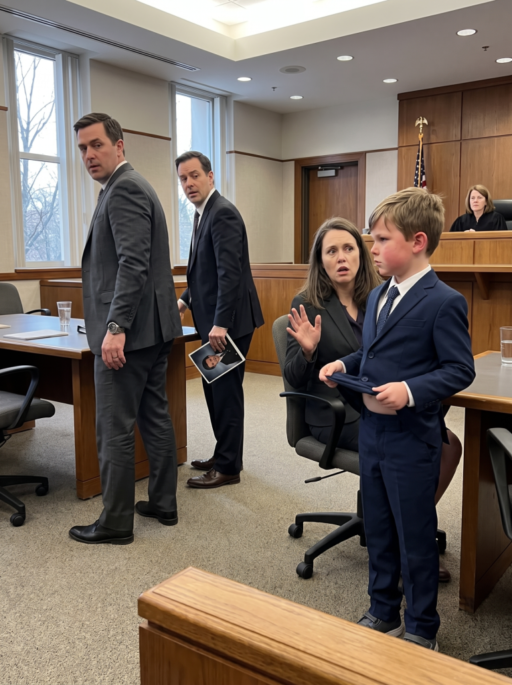
That morning, his attorney, Mr. Carroway, stood and lifted a glossy photograph toward the judge. It showed Nolan leaving school three days earlier wearing the navy-blue shirt he had on beside me now, with dark sticky stains across the front.
“Your Honor, this photograph was taken by a licensed investigator,” Carroway said. “The child has repeatedly appeared in soiled clothing while in his mother’s care.”
Nolan’s fingers tightened around mine.
Carroway continued.
“His mother works inconsistent hours, struggles with housing, and cannot reliably provide even basic necessities. We believe primary custody should be transferred to Mr. Grant.”
Across the room, Grant gave me the smallest smile.
That smile hurt more than the accusation.
Four months earlier, when money became especially tight, I had pawned my grandmother’s antique locket to buy Nolan new school clothes for his birthday. He chose that blue shirt because of the tiny moon embroidered above the pocket, and he wore it whenever he wanted to feel “lucky.”
The stains had appeared three days earlier.
I knew because Nolan had come home wearing them.
What I did not know was how Grant’s investigator had managed to photograph him only minutes afterward.
I opened the folder in front of me.
My attorney had already collected child-support records, emails, and the timeline surrounding my job loss. We were prepared to show that my financial hardship did not equal neglect.
But the photograph was effective.
It was simple.
It looked obvious.
I could see the judge studying Nolan’s shirt.
Then Carroway placed the enlarged picture on an easel.
“Sometimes the evidence speaks for itself.”
Nolan lowered his head.
I leaned toward him.
“You don’t have to listen to this.”
He looked at me.
“Yes, I do.”
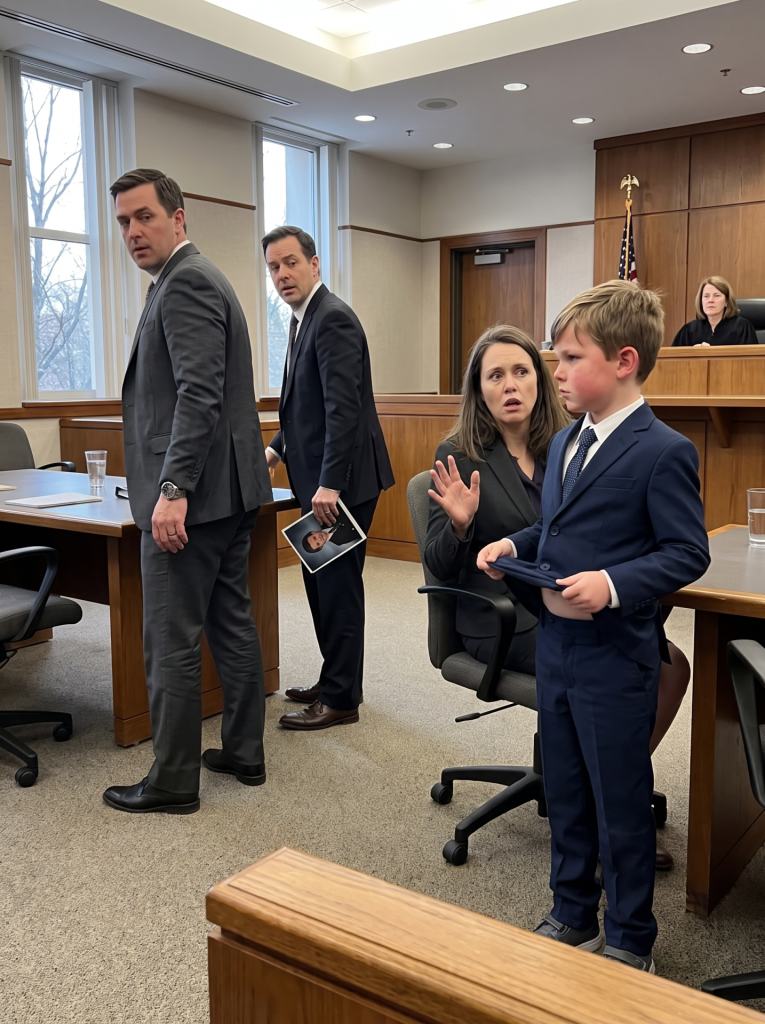
Before I understood what he meant, he pulled his hand from mine and stood.
My attorney whispered his name, but Nolan was already stepping toward the judge.
“Your Honor?”
The judge looked down.
“Yes, Nolan?”
His voice trembled once, then steadied.
“My dad’s lawyer is lying about that picture.”
Grant’s expression changed.
Nolan turned toward him and grabbed the hem of his blue shirt.
Then he started lifting it.
And the moment I saw what was still taped beneath the fabric, I finally understood why Grant had been so confident that photograph would never be questioned.
Nolan lifted the hem of his blue shirt until the judge could see the rectangular medical dressing still taped beneath his ribs. A small printed label was attached to the edge, showing the name of an urgent-care clinic, the date, and the time he had been treated three days earlier.
The courtroom went quiet.
The judge leaned forward.
“What happened to you, Nolan?”
He looked at me first, then at Grant.
“I got sick when I was with Dad.”
Grant’s attorney stood immediately.
“Your Honor, I object to—”
The judge raised one hand.
“Sit down, Mr. Carroway.”
Nolan kept his shirt raised just enough to show the dressing.
He explained that Grant had picked him up from school that afternoon for scheduled visitation. On the drive, Nolan became nauseated, and by the time they reached a restaurant, he had vomited down the front of his shirt and complained of sharp pain in his side.
Grant took him to urgent care.
The clinic ran tests, treated him for dehydration, and placed the dressing over the area where a monitor had been attached.
I turned toward Grant.
He looked completely different now.
The confidence was gone.
The judge picked up the photograph again.
“What time was this image taken?”
Carroway checked the investigator’s report.
“Approximately 5:40 p.m.”
My attorney opened the clinic record we had received only that morning.
“Nolan was discharged at 5:18.”
The judge looked at Grant.
“So this photograph was taken twenty-two minutes after the child left urgent care?”
Grant shifted in his chair.
“I didn’t know when the investigator took it.”
Nolan spoke before anyone else could.
“Yes, you did.”
My stomach tightened.
Grant stared at him.
Nolan lowered his shirt.
“You told the man in the parking lot to take pictures before Mom picked me up.”
Nobody moved.
I looked at my son.
“You saw him?”
Nolan nodded.
“He was standing near Dad’s car.”
Grant’s attorney leaned toward him and whispered something urgently.
The judge noticed.
“Mr. Grant, did you arrange for an investigator to photograph your son immediately after a medical appointment?”
Grant swallowed.
“I had already hired someone to document his condition.”
“That is not what I asked.”
The courtroom felt smaller.
Finally, he said, “Yes.”
That single word changed the meaning of the photograph completely.
Grant had known why Nolan’s shirt was dirty.
He had known Nolan had become sick during his visitation.
He had known the stains had nothing to do with whether I washed my child’s clothes.
Yet he still allowed his attorney to present the photograph as proof of neglect.
My attorney stood.
“Your Honor, we request that the investigator’s full timeline be entered into evidence.”
Carroway objected, but the judge allowed it.
The report contained more than the photograph.
It included timestamps.
Vehicle locations.
And one note that immediately caught my attorney’s attention.
At 5:23 p.m., five minutes after Nolan left urgent care, the investigator had written:
Client instructed me to document clothing before maternal pickup.
I stared across the courtroom at Grant.
For months, he had been building a case that my financial problems made me an unfit mother.
Now there was written proof that at least one of his strongest exhibits had been deliberately staged to look worse than it was.