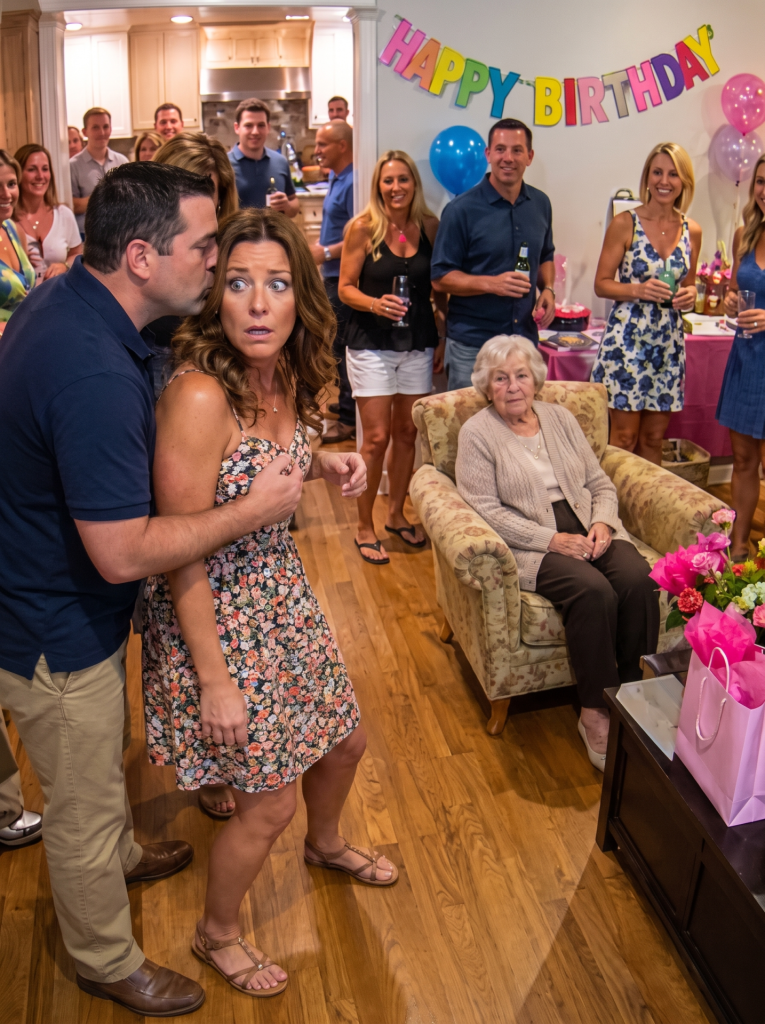

“You’re safe, Grandma. We’re going to figure everything out.”
Her fingers weakly tightened around mine.
As the ambulance pulled away, I looked through the rear window at the house where I had celebrated birthdays, Christmases, and countless Sunday dinners.
For the first time, it didn’t feel like home.
Because Daniel and Megan might not have been the only people who knew what was happening inside it.
Grandma remained in the hospital for the next two days while doctors monitored her and allowed the excess medication to leave her system. The transformation was impossible to ignore because as the sedatives wore off, the confused and exhausted woman we had seen on her birthday gradually became alert again.
By the second morning, Grandma could hold a normal conversation and clearly remember details from weeks earlier. That alone challenged Daniel’s repeated claims that his mother had become too mentally impaired to manage her own finances or make important decisions.
“I knew I was tired all the time, but Daniel said that was normal at my age.”
I sat beside her bed holding her hand.
“Did you know your medication had been increased?”
Grandma frowned.
“No. Daniel handled the pharmacy. He said the doctor wanted me taking more because I wasn’t sleeping.”
Investigators soon discovered that the truth was considerably darker. Grandma’s physician confirmed that someone had repeatedly contacted the office requesting stronger medication, describing Eleanor as increasingly restless, confused, and difficult to manage.
Those requests had not come from Grandma.
Daniel had gradually positioned himself as the person responsible for communicating with doctors, pharmacies, and financial institutions. Because he was Eleanor’s son, people had assumed he was helping rather than questioning why an elderly woman who had previously managed her own affairs was suddenly losing control over every part of her life.
The financial investigation revealed the same pattern. Over several months, money had disappeared through suspicious withdrawals, questionable reimbursements, and transfers disguised as household expenses, while documents recovered from Grandma’s office appeared designed to eventually give Daniel and Megan control over nearly everything that remained.
When investigators showed me copies of the records, I recognized several payments Grandma would never have approved. There were expensive purchases, unexplained cash withdrawals, and transfers connected to accounts belonging to Daniel and Megan.
Then came another uncomfortable discovery.
Several relatives had known something was changing.
Aunt Lisa admitted that Daniel had repeatedly told the family Grandma was becoming difficult and needed stricter supervision. Other relatives had noticed that Eleanor seemed unusually sleepy during visits, but they accepted Daniel’s explanation that her condition was simply worsening.
“Why didn’t anyone call me?”
Lisa began crying.
“Daniel kept saying he had everything under control.”
That sentence made me angrier than any excuse Daniel had offered.
Nobody needed to understand exactly what was happening to recognize that Grandma was disappearing inside her own life. Yet because Daniel spoke confidently and called his behavior caregiving, people had stopped asking questions.
When Grandma finally learned what investigators had found, she didn’t react the way I expected. There was no shouting or dramatic breakdown; she simply sat against the hospital pillows, staring toward the window.
“I trusted them.”
Her voice became quieter.
“My own son.”
I squeezed her hand, but there was nothing I could say that would make the betrayal smaller.
David remained beside me throughout everything. One evening, after another exhausting meeting with investigators, I admitted that I couldn’t stop imagining what might have happened if he had ignored the conversation he overheard at the birthday party.
“If you hadn’t said something, she might have signed those papers.”
David shook his head.
“I almost convinced myself it wasn’t my business.”
I looked at him.
“What changed your mind?”
“I saw your grandmother earlier that evening. She could barely keep her eyes open, and Daniel kept telling everyone she was just tired.”
He paused.
“Then I heard him talking about making her sign something.”
The combination had been enough.
By the time Grandma was discharged, the questionable documents had been secured as evidence and her financial institutions had been alerted. Daniel and Megan were under investigation, and attorneys were working to protect everything still legally belonging to her.
But the hardest question remained unanswered.
Daniel and Megan had carried out the plan.
What none of us knew yet was how many relatives had seen enough to stop it and simply chosen not to look closer.
Grandma moved into my house after leaving the hospital because none of us wanted her returning to the place where everything had happened. David prepared our guest room for her, while I organized her medications and appointments so that she could regain control over the parts of her life Daniel had quietly taken away.
Her recovery was surprisingly quick once the unnecessary medication was gone. Within weeks, she was reading every morning, balancing her own checkbook again, and arguing with David about how much coffee an eighty-five-year-old woman should be allowed to drink.
“I survived raising three children. I think I can survive a second cup of coffee.”
David smiled.
“I’m not brave enough to argue with that.”
The emotional damage was much slower to heal. Every time the phone rang, Grandma glanced toward it nervously, and whenever someone mentioned Daniel, the confidence returned to her face only after several seconds of visible effort.
Meanwhile, the investigation continued expanding. Financial specialists traced months of transactions, while handwriting experts examined signatures on the power-of-attorney forms, property documents, and revised will recovered from Grandma’s office.
Several signatures appeared inconsistent with verified samples of Grandma’s handwriting. Investigators also found digital drafts of financial documents connected to Megan, strengthening suspicions that she had helped prepare paperwork intended to transfer control of Eleanor’s assets.
Daniel insisted everything had been done for his mother’s benefit.
“I was trying to protect her finances before she became incapable of managing them.”
Grandma’s attorney responded with medical evaluations showing that Eleanor remained capable of understanding her property and financial decisions. Her temporary confusion had worsened during the same period in which her medication had apparently been mishandled, making Daniel’s explanation increasingly difficult to accept.
Then the family began dividing into camps.
Some relatives immediately supported Grandma, but others insisted we were destroying Daniel’s life before the investigation was complete. A cousin called me one evening and accused David of creating the entire crisis by involving police instead of allowing the family to resolve matters privately.
“You could have talked to Daniel first.”
“And given him time to remove the documents?”
“You don’t know that he would have.”
“I know what police found.”
The conversation ended shortly afterward.
What disturbed me most was how many relatives seemed more uncomfortable with the public scandal than with what had happened to Grandma. They talked about Daniel’s reputation, Megan’s career, and how humiliating it was for neighbors to know our family business, as though embarrassment were the greatest harm anyone had suffered.