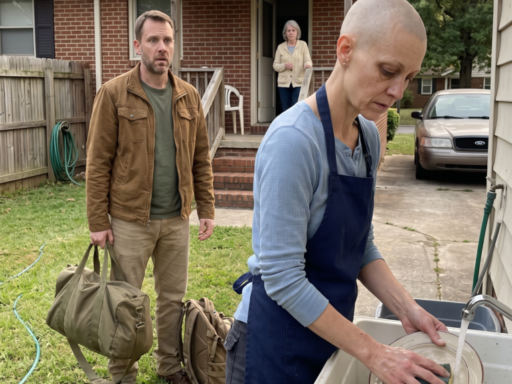
For nine years, I bought medicine and cooked meals for my elderly neighbor, never thinking he noticed more than I gave. After his funeral, I received a letter in his handwriting. “You left food at my door for years. Now look inside the old freezer in your basement.”
PART 1: The Envelope Harold Left Behind
The lawyer found me beside the coffee urn after Harold Bennett’s funeral, holding a paper cup I had not touched.
“Nora?” she asked gently.
I nodded.
She offered me a sealed envelope with my name written across the front. “Harold asked me to give this to you after the service.”
Before I could take it, his estranged son, Mark, stepped closer.
“What’s that?”
“A private letter addressed to Nora,” the lawyer said.
“From my father?”
“Yes.”
Mark looked at me as if I had already done something wrong.
For a second, my hand froze. That was my old habit: step back, keep peace, and avoid making a scene. But Harold had written my name on that envelope.
So I took it.
Mark’s mouth tightened. “Funny. I didn’t realize bringing casseroles made someone family.”
I held the letter against my chest and met his eyes.
“It doesn’t, Mark,” I said. “But showing up does.”
Nine years earlier, I had moved into the small white house next door with my two children, Ava and Miles, and a divorce decree folded in my glove box. I was forty-eight, newly divorced, and trying to make the house feel like a fresh start instead of the place we landed after everything fell apart.
One snowy January afternoon, I noticed Harold’s mailbox overflowing, his steps untouched, and a pharmacy bag wedged in his door. I told myself it was none of my business.
Then I filled a container with chicken soup and crossed the lawn.
Harold opened the door in a robe, pale and irritated.
“I’m fine,” he barked.
“I didn’t ask,” I said. “Your mail says otherwise.”
He refused charity, but he took the soup. The next day, he returned the empty container and complained there was too much pepper.
That was how it started: soup, medicine, errands, and two stubborn people pretending they were not lonely.
PART 2: Ordinary Kindness
After that, a quiet routine formed.
When I cooked stew or roasted chicken, I brought Harold a portion. When I went to the pharmacy, I texted him first.
His answer was always, “No.”
Five minutes later, another message would arrive.
“Maybe milk.”
Then, “And those crackers Alice liked.”
Alice was his late wife. Little by little, Harold let me see the parts of the house that still belonged to her: her mug by the sink, her sweater over a chair, her recipe cards tucked in a tin.
One morning, I found him on the porch with two cups of coffee.
“It’s Alice’s birthday,” he said.
I did not tell him I was sorry. Instead, I asked, “What kind of cake did she like?”
“Lemon. From scratch. She hated shortcuts.”
The next day, I brought him lemon cake. It had sunk in the middle.