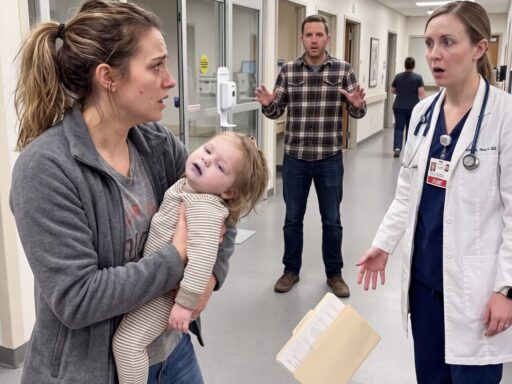

Ridgeview Children’s Hospital called me at 6:11 on a Tuesday morning. The nurse said my eight-year-old daughter had arrived severely dehydrated and barely responsive, but the detail that frightened me most was that our neighbor had brought her in instead of my wife.
I drove to the hospital without remembering a single traffic light. Lily had been running a fever the previous evening, yet Vanessa texted me that it was mild and I should not leave my overnight shift.
After Lily’s mother died four years earlier, I convinced myself that keeping the mortgage paid and the refrigerator full made me a dependable father. When Vanessa entered our lives, she organized appointments, meals and school schedules so efficiently that I confused control with care.
Over the previous year, Lily became quieter. She asked permission before taking food, watched Vanessa’s face before answering questions and apologized whenever she cried about her mother.
Vanessa always had an explanation. Lily was sensitive, struggling with grief or testing boundaries, and I accepted the adult who sounded calm instead of questioning why my child looked afraid.
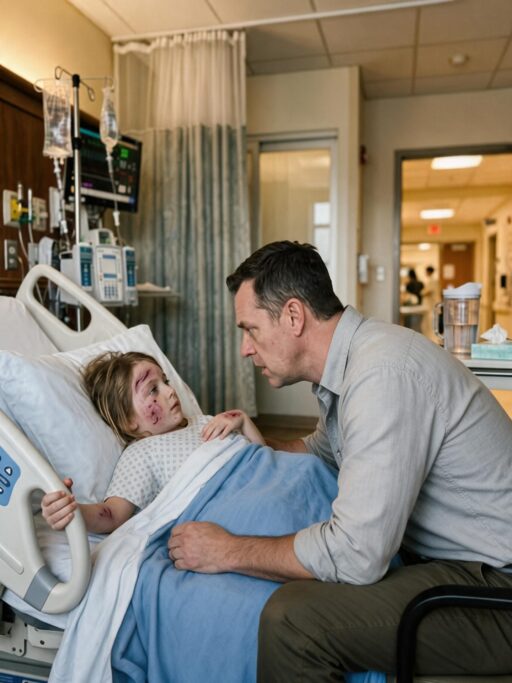
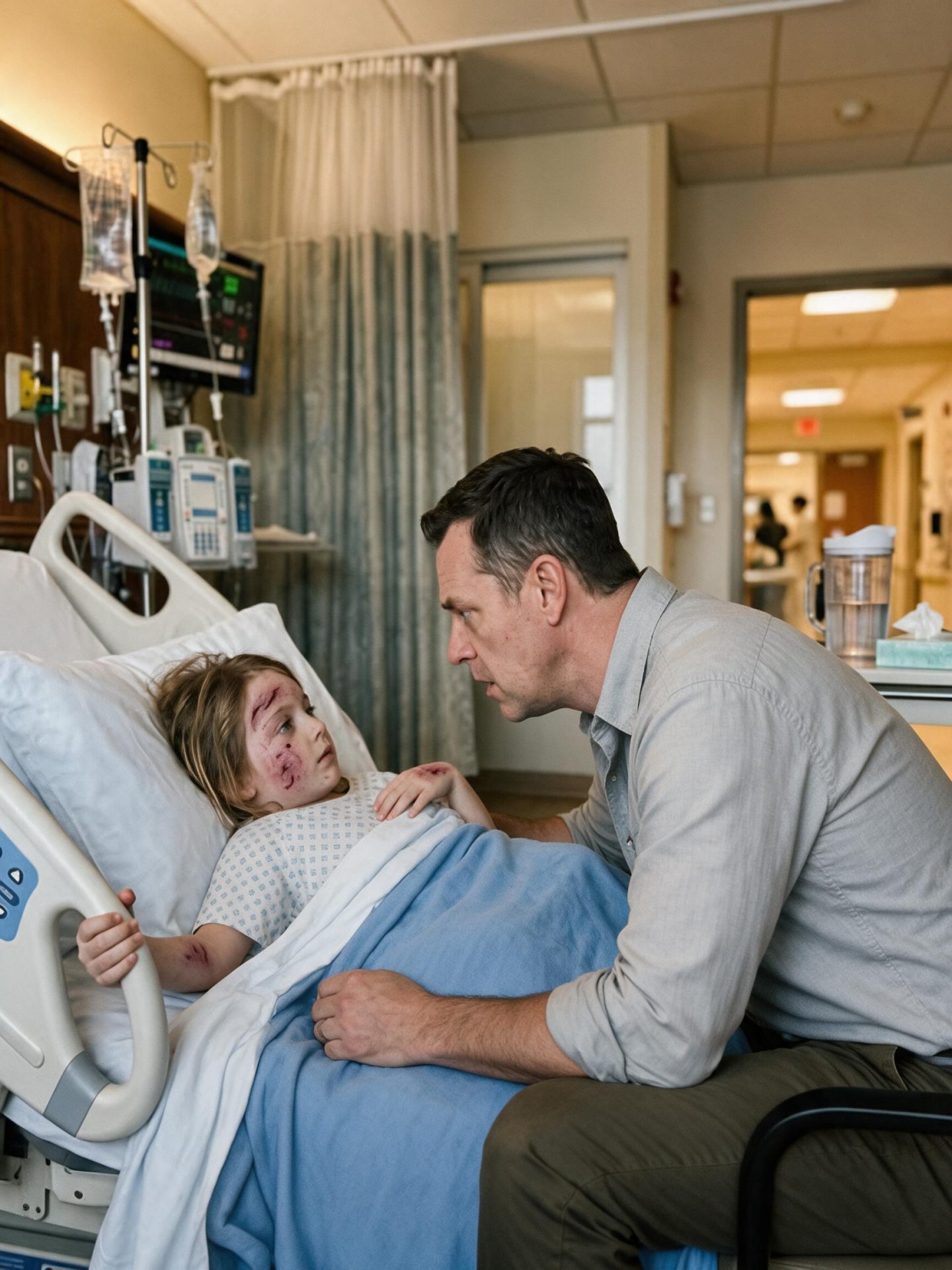
At the hospital, a nurse led me to a room where Lily lay beneath a white blanket with an IV taped to her hand. Her brown curls were tangled around her face, and she appeared smaller than the daughter I kissed goodbye the previous afternoon.
“Daddy?”
“I’m here, sweetheart.”
Lily gripped my fingers and looked toward the door. Her eyes widened when footsteps approached from the hallway.
“Please don’t let Vanessa come in.”
The request was barely louder than the monitor beside her bed. I leaned closer and asked whether my wife had hurt her, but Lily only repeated that she did not want Vanessa inside.
Before I could respond, the door opened several inches. Vanessa stood in the hallway wearing the gray suit she used for work, her expression composed despite the fact that Lily had been brought to an emergency department without her.
“There you are,” she said to me. “This has been completely blown out of proportion.”
Lily pulled the blanket higher and pressed herself against the raised side of the bed. I stepped between them before Vanessa could enter.
“She doesn’t want you in the room.”
Vanessa’s smile disappeared briefly. She reminded me that Lily was eight, sick and confused, then said I could not make family decisions based on an upset child’s imagination.
That argument would have worked the day before. It almost worked again because believing Vanessa meant I had been tired and distracted, while believing Lily meant something had been happening inside my home while I looked away.
Then Lily whispered a second question.
“Even if she gets mad?”
I asked the nurse to keep Vanessa outside. My wife stared at me as though I had violated an agreement between us, but the door closed before she could answer.
A pediatrician named Dr. Patel sat beside Lily and asked a few simple questions without rushing her. He explained that Lily’s fever, vomiting and lack of sufficient fluids had created a dangerous level of dehydration.
Her condition did not come from missing one glass of water. According to the blood work and our neighbor’s account, Lily had been sick for more than a day without receiving appropriate care.
Lily said Vanessa sent her to her bedroom after she took crackers from the kitchen without permission. When she later asked for water because her stomach hurt, Vanessa accused her of trying to avoid punishment.
“Could you leave the room?” I asked the doctor, thinking Lily might feel safer speaking only to me.
Dr. Patel gently explained that a hospital social worker needed to be involved because the information raised concerns about Lily’s safety. I felt defensive for one second, then realized protecting my pride would repeat the same mistake that brought us there.
I told him to stay. Lily needed adults who would listen carefully, even if what she said exposed how badly I had failed to notice.
She described a small slide lock attached to the outside of her bedroom door. Vanessa called it a safety measure and used it whenever Lily was “too emotional to follow rules.”
The previous night, Lily became dizzy and began tapping on her bedroom window. Our neighbor, Mrs. Palmer, heard the sound while taking out her trash and saw Lily sitting on the floor behind the glass.
Mrs. Palmer used the emergency key I had given her years earlier. She found Vanessa’s car gone, the bedroom locked from the hallway and Lily too weak to stand without support.
Vanessa had told me she remained at home throughout the night. The message was still on my phone, sent shortly before midnight.
Lily’s fingers tightened around mine as a hospital social worker entered. She asked whether the outside lock was still on the bedroom door, but I had never seen it.
“Vanessa takes it off before you come home,” Lily whispered.
A knock interrupted us. Vanessa was demanding to speak with me, insisting she had proof that Lily frequently lied to gain attention.
The social worker asked whether I wanted hospital security nearby before opening the door. I said yes, then told Lily she would not have to speak to Vanessa.
When I stepped into the hallway, my wife held out her phone. The screen displayed messages supposedly sent by Lily’s teacher, pediatrician and maternal grandmother, all describing the child as manipulative and difficult.
I recognized the grandmother’s name immediately. Lily’s grandmother had not spoken to us in nearly a year because Vanessa claimed she wanted no further contact.
Before I could examine the messages, Mrs. Palmer approached with a police officer. She carried a clear plastic bag containing the metal slide lock removed from Lily’s bedroom door.
Vanessa stopped talking.
Mrs. Palmer then gave the officer a memory card from her doorbell camera. The footage showed Vanessa leaving our house shortly after ten the previous night while Lily was still tapping weakly against the upstairs window.
As the officer began asking questions, Vanessa turned toward me and lowered her voice.
“If you let them believe that child,” she said, “they’re going to discover what really happened to her mother.”
Vanessa’s warning struck the guilt I had carried since Lily’s mother died. Four years earlier, Sarah was killed when another driver ran a red light while she was speaking to me through the car’s hands-free system.
The investigation found that Sarah had the right of way and was not using her phone by hand. I still blamed myself because I had called about an argument that could have waited until she reached home.
Vanessa knew every detail. I told her during the first year of our relationship because she said honesty was the only way a grieving family could begin again.
“What does Sarah’s accident have to do with Lily being locked in her bedroom?” I asked.
Vanessa glanced at the police officer and refused to answer. She said anything involving our marriage should be discussed privately, without doctors, neighbors or strangers interfering.
The officer asked her to step away from Lily’s room while he reviewed Mrs. Palmer’s footage. Vanessa left the pediatric floor only after hospital security explained that she could not enter without permission.
A social worker named Ms. Carter remained with us. She told Lily that nobody in the room would punish her for answering, and she could stop whenever she became tired.
Lily described rules that changed whenever I went to work. She needed permission to open the refrigerator, use the bathroom after bedtime or call anyone outside the house.
Vanessa inspected her bedroom each morning. If clothes were not folded correctly or a toy remained on the floor, Lily lost meals, family phone calls or access to the stuffed rabbit that had belonged to her mother.
“She says Bunny makes me act like a baby,” Lily whispered. “Sometimes she hides him.”
I remembered asking why the rabbit repeatedly disappeared. Vanessa claimed Lily misplaced it to create attention, and I believed her because accepting that explanation required nothing from me.
Dr. Patel reviewed Lily’s earlier medical records. During the previous year, Vanessa had canceled two pediatric appointments, telling the clinic that I was seeking care elsewhere.
She also submitted school notes saying Lily was receiving therapy for grief-related behavioral problems. Lily had not attended therapy since the counselor she saw after Sarah’s death retired two years earlier.
Vanessa had constructed a version of my daughter that made every sign of fear appear to be manipulation. I helped her by repeating those explanations whenever a teacher or neighbor expressed concern.
Ms. Carter asked what Vanessa said about Sarah’s accident. Lily looked toward me and began picking at the tape around her IV.
“She says you made Mommy crash.”
My throat tightened, but I did not interrupt. Lily explained that Vanessa showed her part of the accident report containing my phone number and told her the police had protected me because I was Sarah’s husband.
The report said nothing of the kind. Vanessa used one true fact—that I was speaking to Sarah—to create a lie powerful enough to frighten an eight-year-old.
“She said if I told people about the rules, they would investigate you,” Lily continued. “Then you’d go away, and I’d have nobody.”
I apologized without defending myself. I should have explained the accident in an age-appropriate way long before Vanessa had the opportunity to fill the silence with fear.
The police officer returned after viewing the camera footage. It showed Vanessa leaving shortly after ten and returning at 5:42 the following morning, less than twenty minutes before Mrs. Palmer brought Lily to the hospital.
Vanessa told him she had gone to a twenty-four-hour pharmacy. No pharmacy bags were visible when she returned, and transaction records could be checked later.
For the moment, the hospital established a safety plan preventing her from visiting Lily. The officer explained that investigators and child-protection workers would determine what additional action the evidence supported.
Nothing happened as quickly as my anger wanted. Vanessa was not handcuffed in the hallway, and nobody promised that one video or one statement would settle everything.
I sent her a message saying she was not to return to Lily’s room or contact her directly. I also told her that Lily and I would not be staying with her after discharge.