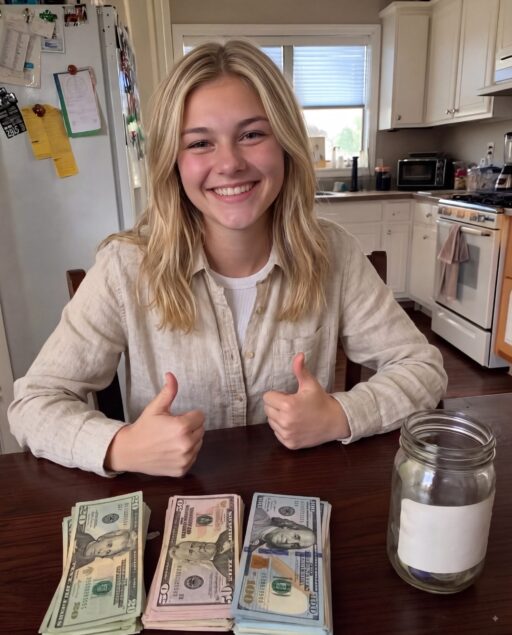

My sixteen-year-old daughter, Lily, had worked almost every day that summer and saved $4,086 toward her first car. On the Saturday morning we were finally supposed to buy it, I placed her father Michael’s old metal keychain beside my coffee mug, imagining that by lunchtime her first car key would be hanging from it.
Michael had died four years earlier, and the keychain had been buried in our junk drawer ever since. Attached to it was a small metal tag stamped with one word: HOME. He had carried it everywhere, so giving it to Lily felt like the perfect way to include him in a milestone he should have been there to see.
“Ready?”
Lily didn’t answer. When she finally entered the kitchen, she was still wearing jeans and the old café T-shirt she had worked in all summer, her hair unbrushed and her purse nowhere in sight.
“We can’t go.”
At first, I assumed something had happened with the seller. Then Lily sat across from me and admitted the real problem.
“I don’t have the money anymore.”
I stared at her, confused.
“You have four thousand eighty-six dollars.”
“Had.”
That one word erased my excitement. When I asked whether someone had accessed her account, whether she had bought something, or whether someone online had convinced her to send them money, Lily shook her head at every question.
“I gave it away.”
I struggled to remain calm because I had watched her earn every dollar. While her friends spent summer weekends at the lake, Lily carried plates through a crowded café, cleaned tables, worked long shifts, and came home smelling like coffee and pancake batter.
She wanted that car badly, not because it was some passing teenage obsession, but because it represented independence. She could drive herself to school, get to work without borrowing my car, and stop depending on friends for rides.
The milestone also carried memories of Michael. When Lily was nine, he once let her sit behind the wheel of his parked truck and proudly announced that he was teaching her early until I objected.
“Dad said yes.”
Michael immediately raised both hands.
“Dad has reconsidered.”
Lily still laughed whenever she told that story. Now the money she had spent three months earning for that long-awaited milestone had vanished.
“All of it?”
She nodded.
“Four thousand dollars?”
Another nod.
I forced myself to keep my voice low.
“Who did you give it to?”
Lily wiped at her eyes.
“Mom, I need you to understand something first.”
“No. I need a name first.”
She hesitated before answering.
“It’s not one name.”
I stared at her.
“What?”
“Seventeen names.”
Twenty minutes later, Lily convinced me to follow her to the café. My mind raced through increasingly troubling possibilities as we walked, because at sixteen, generosity and recklessness could exist dangerously close together.
Mrs. Patel, the café owner who had hired Lily in June, was unlocking the front door when we arrived. She looked at Lily, then at me, and her smile immediately disappeared.
“You told her?”
Lily nodded.
“You knew?”
Mrs. Patel quietly led us into the café and opened a cabinet inside the cramped office where Lily usually counted her tips. From behind a box of receipt paper, she removed an old index card with bent corners and a coffee stain along one edge.
Sixteen names were written across the front. Beside several was the word FRIDAY. I recognized the handwriting immediately. It belonged to Michael. My husband had been dead for four years.
Yet somehow, the explanation for Lily’s missing $4,086 had begun with a secret he had never told me …
I took the stained index card from Mrs. Patel and stared at Michael’s handwriting. Sixteen first names were listed across the front, each accompanied by a date, and several had the word FRIDAY written beside them.
“No.”
Mrs. Patel said nothing. I turned toward Lily, trying to understand how something written by my husband four years after his death had somehow ended up connected to the money she had spent all summer earning.
“Where did you find this?”
“In July.”
Mrs. Patel finally asked me to sit down, but I remained standing. She explained that Michael had been a regular customer at the café long before Lily started working there, something I already knew because my husband had possessed an almost unreasonable loyalty to diner coffee served in thick white mugs.
Then Mrs. Patel pointed to the first name on the card. George.
About seven years earlier, Michael had entered the café early one morning and noticed a man washing his face in the restroom. George had been sleeping in his car and was trying to make himself presentable for a job interview.
Michael noticed his wrinkled shirt and asked whether he had an interview.
“I’m fine.”
“Didn’t ask that.”
I closed my eyes because I could practically hear Michael saying it. He had always been irritated when someone answered a different question simply to avoid admitting they needed help.
Mrs. Patel told me Michael bought George breakfast, took him to a discount store for a clean shirt, and gave him enough money for transportation. George attended the interview and got the job.
At first, I thought that explained the name on the card. It didn’t.
Three days later, George nearly lost the job because his first paycheck wouldn’t arrive until Friday. He didn’t have enough money left for transportation to keep showing up for work until then.
Michael found out and stepped in again, but he didn’t try to solve George’s entire life. He covered bus fare, laundry, and a few inexpensive meals, just enough to keep George working until his first paycheck arrived.
After that, Michael started noticing similar situations everywhere.
One woman had already been hired at a restaurant but couldn’t afford the required nonslip shoes for her first shift. A young father had secured a warehouse job but needed temporary childcare until his first paycheck, while another person needed twenty dollars of phone service so an employer could contact him.
None of those problems required thousands of dollars. They were simply small obstacles standing between people and opportunities they had already earned.
Lily looked toward Mrs. Patel.
“What did Dad call it?”
Mrs. Patel smiled.
“Getting somebody to Friday.”
That was when I finally sat down.
I had been married to Michael for fourteen years. I knew how he drank his coffee, how he couldn’t sleep while wearing socks, how he confidently sang incorrect lyrics to almost every song, and the expression that appeared on his face whenever he was worried.
But I had never known about this.
“Sixteen?”
Mrs. Patel nodded and explained those were simply the sixteen people she knew Michael had helped. Every few months, he would return to the café and ask how many “Fridays” they had reached, turning his private acts of kindness into a ridiculous little scoreboard against himself.
I looked down at the card again. Then I turned it over. The handwriting on the back wasn’t Michael’s. Seventeen numbers had been written there in newer ink.
I slowly looked at Lily.
“You wrote these?”
“Yeah.”
“Seventeen people?”
She nodded.
“This summer.”
Suddenly, I understood that Lily hadn’t simply discovered her father’s old list. She had started one of her own.
Mrs. Patel glanced toward the café entrance and mentioned that someone was already at work. When I asked who she meant, Lily shoved both hands into the pockets of her hoodie.
“Mom, before we go, there’s something else.”