
Three weeks after my husband died, my father used an emergency key to enter my house and told me I had until sunset to leave. I was eight months pregnant, still sleeping with Lucas’s T-shirt beneath my pillow, and too stunned to understand why Charles believed he could remove me from the home I owned.
His twenty-four-year-old wife, Courtney, followed him into the kitchen carrying a folder and two empty suitcases. She looked around as though she were already deciding which of my belongings should remain.
“Lucas left debts,” Charles said. “The house must be sold before the bank takes it.”
I pushed the folder back across the table. “My name is on the deed, and no bank has contacted me.”
Lucas had purchased the house before our marriage, then added me to the deed two years later. We had lived there together for six years, and every room still contained some ordinary reminder that he was not coming back.
Charles dismissed the deed as something Lucas had probably changed without understanding the consequences. He said he would handle the estate because pregnancy and grief had made me incapable of making financial decisions.
“You don’t represent me,” I replied. “Take Courtney and leave.”
His expression hardened. Charles had always treated disagreement as disrespect, especially when it came from me.
I stood carefully with one hand beneath my stomach. When I moved toward the hallway to retrieve my phone, he grabbed my arm.
“Sit down and sign the authorization.”
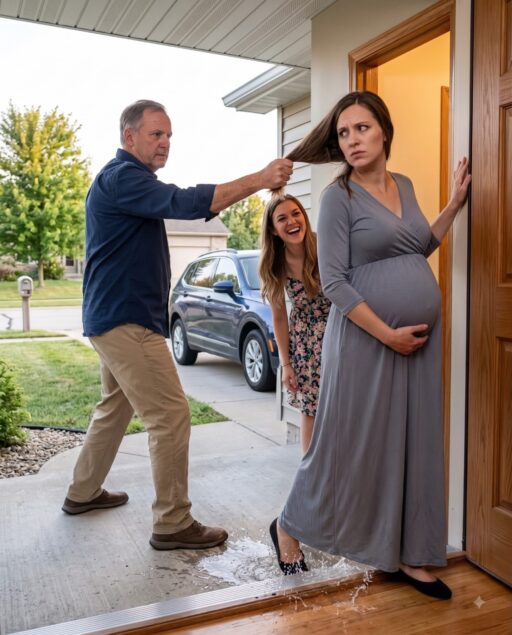
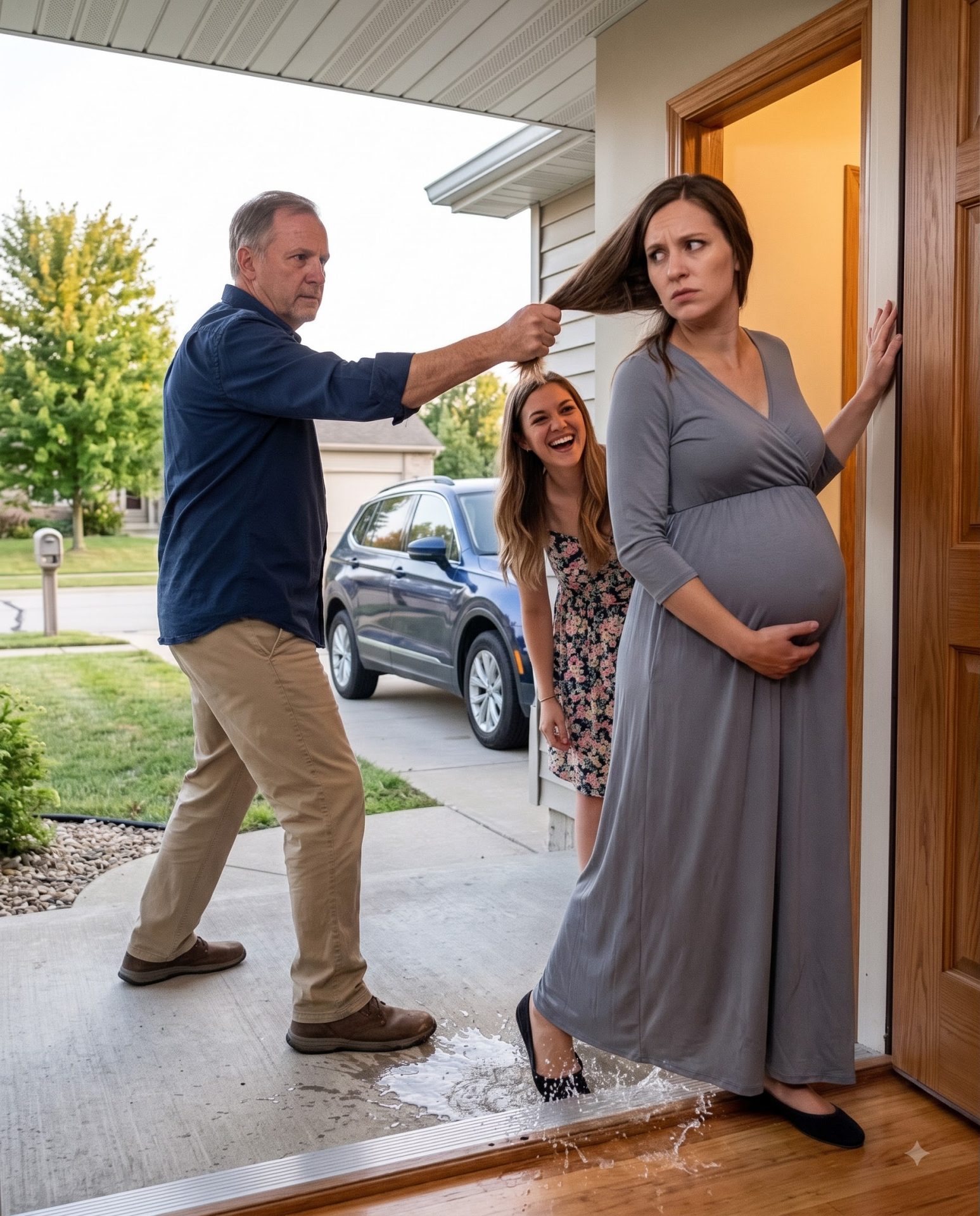
I pulled away. His other hand caught in my hair, and he forced me toward the front door while Courtney accused me of turning a business problem into family drama.
“Dad, stop. You’re hurting me.”
He opened the door and pushed me onto the porch. I landed on one knee and managed to protect my stomach, but a sudden rush of fluid soaked through my clothes.
For one second, none of us spoke. Courtney’s amused expression disappeared as I looked down and realized what had happened.
“My water broke.”
Charles tossed my handbag beside me. “Then call an ambulance, but you are not coming back inside until you calm down.”
I called 911 immediately. The dispatcher kept me seated against the porch railing, asked about contractions and bleeding, and sent both an ambulance and police.
Only after help was on the way did I call Samantha Vance, the attorney who had handled Lucas’s estate planning. She answered on the second ring.
“My father is inside my house,” I said. “He tried to make me sign something, forced me outside, and now he’s searching Lucas’s desk.”
Samantha’s voice became sharply controlled. She told me not to reenter the house, confront Charles, or touch any documents he offered.
“Victoria, Charles contacted my office yesterday. He claimed you had appointed him to act for you.”
“I never did.”
“I know. Your estate documents require confirmation directly from you.”
Through the open doorway, I watched Charles remove papers from Lucas’s desk. Courtney stood beside him, reading over his shoulder while the emergency folder remained on the kitchen table.
Samantha explained that Lucas had placed his investment accounts and company shares in a trust for me and our child. The house was separately protected by the recorded deed, and Charles had no authority to sell it.
A siren sounded at the end of the street. Inside, Charles’s phone began ringing.
He answered with the same confidence he had shown when he entered my home. Then his shoulders stiffened.
“What do you mean the transfer has been suspended?” he demanded.
Courtney moved closer, but Charles turned away from her. He listened for several seconds before looking through the doorway at me.
Samantha heard him through my phone. “That will be the bank’s fraud department. I asked them to preserve everything connected to his request.”
“What request?”
She paused before answering. “This morning, Charles attempted to use a power of attorney to gain control of Lucas’s business shares and the estate account.”
The ambulance stopped in front of the house as two police officers approached the porch. Charles remained frozen beside Lucas’s desk, clutching his phone.
Samantha’s final sentence followed me as the paramedics lifted me onto a stretcher.
“The document carries your signature, Victoria—and according to its date, you signed it the day after your husband died.”
The paramedics focused on my pregnancy while the officers separated Charles and Courtney inside the house. My contractions had begun by the time the ambulance left the driveway.
One officer rode behind us after photographing the folder, Lucas’s disturbed desk, and the papers Charles had removed. He also collected the emergency key that had allowed my father to enter without permission.
At the hospital, doctors confirmed that my water had broken early. They monitored the baby while preparing me for the possibility that labor could progress quickly.
Samantha remained on the phone until a nurse asked me to put it away. Before ending the call, she said the bank had suspended every transaction connected to the disputed power of attorney.
Nothing had been transferred. The restriction simply prevented Charles from moving estate funds or exercising Lucas’s voting shares until the document could be verified.
My father called repeatedly while I was being examined. I did not answer, but his first voicemail described the confrontation as a misunderstanding.
“I was trying to protect the company,” he said. “Courtney became upset, you became emotional, and everything got out of control.”
He did not mention grabbing me, forcing me outside, or searching Lucas’s office. He also failed to explain why a document bearing my signature had been submitted without my knowledge.
Courtney left a separate message claiming she had believed Charles owned the house. She apologized for “laughing nervously” but insisted she had not understood that I was in labor.
I saved both messages for the police. Explaining their motives was not my responsibility while doctors were trying to protect my child.
Labor continued despite medication and monitoring. Shortly before midnight, my daughter was born five weeks early.
She weighed less than five pounds and needed help maintaining her temperature, but she was breathing without a ventilator. The neonatal team placed her in an incubator and told me her early signs were encouraging.
I named her Lucy, the name Lucas and I had chosen together. Seeing it written on the hospital card nearly broke me.
Grief and relief arrived at the same time. Lucas would never hold his daughter, yet the last decisions he made were now protecting the home where I hoped to raise her.
The following morning, Samantha came to the hospital with certified copies of the deed, trust documents, and business records. She waited until I returned from visiting Lucy before discussing them.