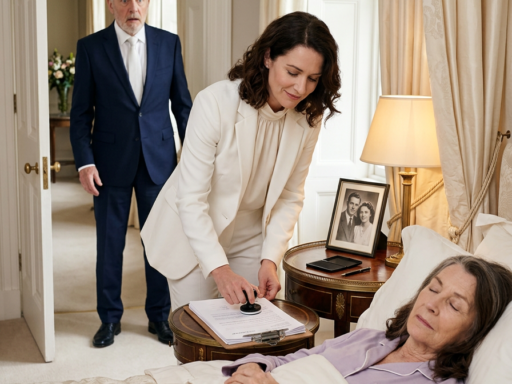


When Everett Langston asked me to marry him, I was thirty-six years old, raising my ten-year-old daughter alone, and watching my savings disappear faster than I could replace them. Everett was seventy-four, wealthy enough that money was no longer a concern, and living alone in a beautiful house outside Raleigh, North Carolina, after losing his wife several years earlier.
Once people learned about our marriage, most reached the same conclusion without bothering to ask me what had actually happened. They assumed I was a struggling younger woman who had married a rich older man because I wanted access to his money, but the truth behind our arrangement was far more complicated.
“Marry me, move into this house with your daughter, and I’ll make sure she has everything she needs. But understand something, Laurel. I’m not looking for romance. I’m looking for a family.”
When Everett first made that offer across his kitchen table, I searched his face for whatever condition he wasn’t telling me. Life had taught me to distrust generosity, especially when I desperately needed what someone was offering.
My daughter Brielle had been dealing with recurring respiratory problems for months, and her doctor wanted her to receive consistent treatment, regular follow-up care, and a healthier living environment. Meanwhile, the rent on our tiny apartment had increased again, while I cleaned offices every morning and spent my afternoons doing housekeeping jobs in private homes throughout Raleigh and Cary.
Everett’s house had been one of those jobs for nearly two years. He knew I was struggling, but he didn’t understand how badly until one afternoon when he found me quietly crying while I dusted a framed photograph of his late wife.
Instead of embarrassing me by pretending he hadn’t noticed, Everett made coffee and asked what was wrong. Something about his patience broke through the defenses I usually kept firmly in place, and I ended up telling him about Brielle’s health, the rent, my dwindling savings, and how terrified I was that eventually I wouldn’t be able to provide what my daughter needed.
A week later, Everett proposed an arrangement that sounded almost impossible. We would have separate bedrooms and no romantic expectations, while he would cover Brielle’s medical treatment, education, and our living expenses.
After three years, he would also transfer a modest townhouse into my name and provide enough money for Brielle and me to begin living independently. I couldn’t understand why a man with so many resources would make an offer like that to his housekeeper.
“Why me?”
“Because you’ve been inside my home every week for two years and never taken advantage of me once. Because you put your daughter ahead of yourself every single day. And because this house has plenty of rooms, Laurel, but it hasn’t felt like a home in a very long time.”
I refused him at first because accepting seemed too dangerous. Then Brielle became sick again, and three weeks later, I finally agreed.
Our courthouse wedding was deliberately simple, with no flowers, expensive gown, or reception afterward. Everett wore a navy suit, I wore a cream dress I already owned, and Brielle stood between us smiling as though the day represented something wonderful rather than an unusual agreement between two adults who needed completely different things.
Within a week, Brielle and I moved into Everett’s house, and he immediately began keeping every promise he had made. Brielle received consistent medical care, grew stronger, enrolled in a good nearby school, and discovered that Everett had filled one bedroom with books he thought she would enjoy.
The two of them also began spending afternoons playing chess together. Before long, Brielle started calling him Grandpa Everett without anyone suggesting it, and the first time the word left her mouth, Everett froze before breaking into a smile that remained on his face for the rest of the evening.
Watching them together should have eliminated my fears, but my past wouldn’t allow me to relax so easily. My father had died when I was young, my mother had become emotionally distant afterward, and Brielle’s father, Dalton, had eventually walked away from our marriage when our daughter was six.
Dalton contributed financially for a while before becoming increasingly difficult to reach, so I had learned to survive without expecting anyone to rescue me. That instinct followed me into Everett’s home, quietly warning me that good things never lasted and generosity always came with a price.
Then I began noticing something strange between Everett and Brielle. They whispered when they thought I wasn’t listening, stopped conversations when I entered rooms, and exchanged secretive looks I couldn’t understand.
One afternoon, I passed the sitting room and heard my daughter speaking quietly.
“Mom really can’t know?”
“Not yet. You’ll ruin everything if you tell her too soon.”
I immediately stepped into the room, and both of them jumped. Everett was holding construction paper while Brielle sat surrounded by markers, and within seconds I realized they had simply been making a birthday card for me.
I laughed nervously and apologized, embarrassed by where my imagination had gone. A few days later, however, I looked through the kitchen window and saw Everett remove several bills from his wallet before secretly handing them to my ten-year-old daughter.
Brielle glanced toward the house, folded the money quickly, and slipped it into her pocket. Everett leaned closer and whispered something I couldn’t hear.
This time, I didn’t interrupt them.
I simply stood behind the window and watched.
After seeing Everett hand Brielle money, I tried to convince myself there was an innocent explanation. He had never behaved inappropriately toward her, and everything he had done since we moved into his home suggested that he genuinely cared about my daughter, yet the secrecy surrounding their conversations kept feeding the part of me that had learned never to trust good fortune.
Over the next few weeks, I noticed more moments that made me uneasy. Everett and Brielle would disappear behind closed doors, conversations abruptly ended whenever I entered, and sometimes my daughter would smile after Everett gave her a meaningful look that seemed to contain an entire conversation I wasn’t allowed to understand.
I hated becoming suspicious of the man who had transformed Brielle’s life. Everett had provided medical care, stability, education, and affection without once demanding anything beyond the arrangement we had openly agreed upon, but knowing all of that still wasn’t enough to silence the fear created by years of disappointment.
Two nights before Christmas, I woke shortly after midnight and noticed something that immediately pushed every reasonable explanation out of my mind. Brielle’s bed was empty.
I checked the bathroom before stepping into the hallway, but she wasn’t there either. Then I heard faint voices downstairs and recognized both of them as I moved quietly toward the staircase.
Everett and Brielle were in the living room.
I descended carefully and approached the partially open door, trying not to make a sound. Just before I reached it, Everett lowered his voice enough that I had to concentrate to understand him.
“Quickly. We need to finish before your mother comes downstairs.”
My stomach tightened instantly. I grabbed my phone, pushed the living room door open, and prepared myself for whatever I might find.
Instead, I stopped in the doorway.
Everett and Brielle were sitting together on the carpet beside the Christmas tree, surrounded by wrapping paper, ribbons, gift bags, tape, and several badly wrapped packages. Brielle was laughing while Everett wrestled unsuccessfully with an enormous decorative bow that refused to cooperate.
“Grandpa, that looks terrible.”
“I spent forty years running companies, young lady. Nobody ever told me gift wrapping would be harder.”
Brielle picked up a long rectangular package and studied it with the seriousness of someone making an extremely important decision.
“Do you think Mom will like it?”
“She’ll love it because you chose it.”
Neither of them had noticed me, so I remained quietly in the doorway as every suspicious detail from the previous weeks rearranged itself into something completely different. The secret conversations, the closed doors, the hidden money, and the sudden silences had never represented anything threatening.
Everett had given Brielle money so she could choose and purchase a Christmas present for me herself. Their whispered conversations had been about keeping the surprise hidden, while the closed doors had concealed nothing more dangerous than wrapping paper and a ten-year-old girl trying desperately not to reveal her mother’s gift.
I backed away before they noticed me and quietly returned upstairs. Once I reached my bedroom, I sat on the edge of the bed and began crying, not because of anything Everett had done, but because I finally understood what my fear had revealed about me.
Life had disappointed me so consistently that I had become suspicious of kindness itself. Whenever someone offered help without immediately asking for something in return, I automatically searched for the hidden condition because experience had convinced me there always had to be one.
Everett wasn’t trying to take advantage of my vulnerability. He was simply helping Brielle experience the childhood I had been struggling so hard to provide, and the secrecy that frightened me had been nothing more than a grandfather helping his granddaughter surprise her mother at Christmas.
After that night, something inside me began to change. I stopped observing Everett as though I needed to discover his hidden motive and finally allowed myself to know the person he actually was.
He began telling me more about his late wife, Marjorie, whom he had loved throughout forty-six years of marriage. They had desperately wanted children but never had any, and when Everett spoke about her, I could hear a tenderness that time and loss had never erased.
One evening, we sat together on the porch while Brielle worked on her homework inside. Everett looked toward the garden and admitted that he had spent most of his life believing family was supposed to follow a predictable sequence.
“I used to think family arrived in one particular way. Marriage, children, grandchildren. Life apparently had other plans.”
He glanced through the window toward Brielle.
“Turns out family can arrive seventy years late.”
Several months later, Everett’s nephew Reid Calloway came to visit from Charlotte. Reid was forty, worked as an architect, and had been especially close to Everett since losing his own father as a teenager.
From the moment Reid walked through the door, I could tell he didn’t trust me. He remained perfectly polite throughout dinner, but his questions and careful observations made it obvious that he was trying to determine whether I was exploiting his wealthy uncle.
The following afternoon, I overheard him confronting Everett in the study.
“You married a woman nearly forty years younger than you who happened to be struggling financially. You don’t think I’m allowed to be concerned?”
Instead of allowing Everett to defend me, I walked into the room.
“You can ask me directly.”
Reid hesitated, but only briefly.
“Fine. Did you marry my uncle because of his money?”