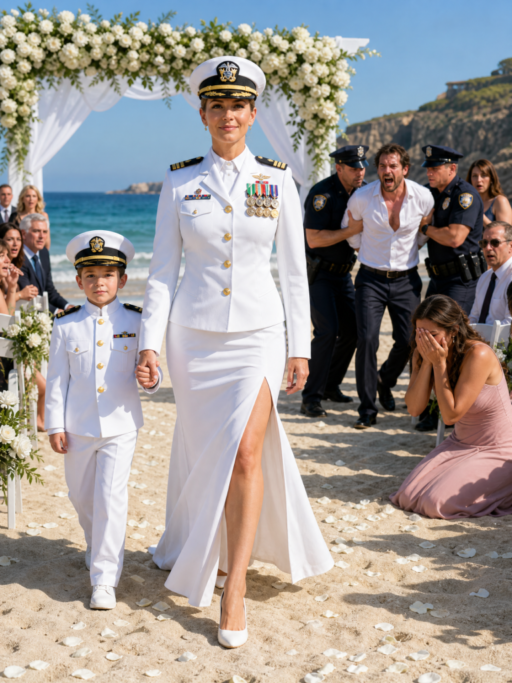
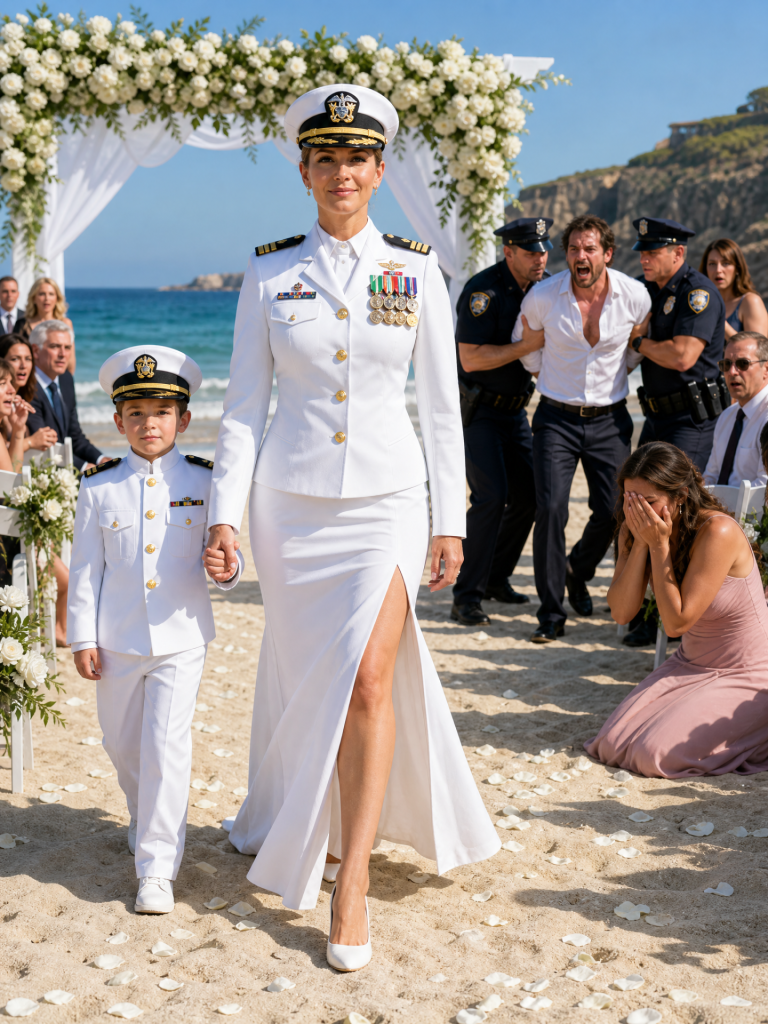

I turned away before they could answer and placed my hand through General Hale’s offered arm. He escorted me toward the altar with the solemn pride of the father figure he had become through years of guidance, trust, and respect.
Ethan waited at the top of the steps. When General Hale placed my hand in his, no one suggested that I was being transferred from one man’s authority to another; the gesture felt like one honorable person standing beside another until she reached the future she had chosen.
The priest regained his composure and began the ceremony. Ethan and I exchanged our vows in clear voices, promising partnership rather than possession and choosing each other with a certainty forged by everything that had happened that morning.
When he slid the gold band onto my finger, I realized I no longer cared that there was no lace covering my shoulders or train flowing behind me. I stood before him exactly as I was, wearing the evidence of a life I had built through discipline, sacrifice, and courage.
The priest pronounced us husband and wife, and Ethan kissed me as the church erupted. The applause was not restrained or ceremonial; guests cheered, whistled, and struck their feet against the wooden floor until the sanctuary seemed to tremble around us.
When I turned toward the congregation, I noticed three empty places in the front pew. During the celebration, Frank, Carol, and Tyler had slipped through a side door because they could not remain in a room where their attempt to humiliate me had instead revealed their own behavior.
They did not stay for photographs, offer congratulations, or attend the reception. By the time Ethan and I emerged from the church, their car had already disappeared from the parking area.
I expected their absence to hurt, but what I felt was relief. For the first time on a family occasion, I was not monitoring Frank’s temper, anticipating Carol’s criticism, or waiting for Tyler to turn a private vulnerability into a joke.
The reception became the celebration I had hoped for, even though it looked nothing like the one I had planned. Without the oppressive presence of my family, guests laughed freely, the band played until the floor shook, and every person around me seemed determined to replace the ugliness of the previous night with genuine joy.
General Hale gave a toast about leadership, resilience, and knowing when a battle required endurance rather than retreat. Ethan’s father then invited me to dance, twirling me carefully across the floor while the buttons and decorations on my uniform flashed beneath the lights.
I no longer wished for one of the ruined gowns. Those dresses had represented a softer version of myself that I believed I needed permission to express, but Ethan’s family showed me that strength and femininity had never been opposites.
Sarah embraced me and said she would always regret that my mother had not protected me. I told her Carol had made her decision years earlier, and the wedding had simply forced me to stop pretending silence was different from participation.
That evening, Ethan and I left surrounded by people who had chosen to stand beside us. I understood then that family was not defined solely by blood, shared history, or the names printed beside one another on an invitation.
In the following days, Frank attempted to reclaim control by leaving messages accusing me of publicly humiliating him. He insisted that the dresses had been a private family matter and claimed my decision to reveal the truth inside the church had damaged his reputation.
I did not respond. I changed my number, blocked my parents and Tyler from contacting me online, and arranged for a friend to collect the few belongings I had left in my childhood room.
The shredded gowns remained behind. I did not need photographs of the damage or scraps of fabric to remind me why I had walked away, because every time I put on my uniform, I remembered what they had tried and failed to destroy.
Months passed without direct contact. Ethan and I settled into married life, and the peace inside our home felt unfamiliar at first because no one mocked my work, punished my independence, or demanded that I become smaller to protect a man’s pride.
Then, almost a year after the wedding, a Christmas card arrived with Carol’s handwriting across the envelope. Inside, she blamed Frank’s “stress” for what happened and asked me to stop punishing the family over four dresses.
At the bottom, she had added one final sentence: Frank expected me to apologize before he would allow me to come home.
I held the card for several seconds, then made a decision that proved the daughter they once controlled no longer existed.
I returned Carol’s Christmas card without writing a response. Her message confirmed that she did not regret standing beside Frank while he destroyed my belongings; she regretted only that his actions had produced consequences she could no longer control.
Frank expected an apology because admitting the truth would require recognizing that I was not the cause of his humiliation. He had embarrassed himself the moment he entered my bedroom with those shears, and the church had merely become the place where everyone finally saw him clearly.
I kept my distance. When relatives attempted to mediate, I explained once that reconciliation would require genuine accountability, not excuses about stress, money, or my supposedly provocative independence.
Frank refused to apologize, Carol continued protecting him, and Tyler dismissed the destruction as a joke that had gone too far. Their responses made maintaining no contact painful but uncomplicated.
Some people told me blood relationships were too important to abandon permanently. They did not understand that I had spent years trying to preserve those relationships while my family repeatedly demanded that I sacrifice my dignity as the price of belonging.
Walking away was not revenge. It was the first boundary strong enough to prevent them from continuing the same harm.
Three years after the wedding, Ethan and I lived in Dallas in a comfortable house with a wide porch and a large backyard. Our marriage was built around shared responsibilities and mutual respect, the ordinary things my childhood home had taught me not to expect.
Ethan never asked me to reduce my ambitions so he could feel more important. When my work required long hours or sudden changes in plans, he supported me without treating my service as competition.
I supported his career with the same respect. We disagreed at times, but neither of us confused love with authority, and no argument ended with one person trying to frighten the other into submission.
My military career continued progressing, and I eventually earned promotion to major. I still flew, accepted difficult assignments, and entered the sky with the same discipline that had carried me through the morning of my wedding.
The dress uniform I wore that day remained carefully preserved inside its heavy black canvas bag. It hung in the back of my closet, protected more attentively than any of the four bridal gowns had ever been.
Sometimes I opened the bag when old memories returned. I would study the midnight-blue fabric, the polished buttons, and the decorations that my family had once mocked because they represented a version of me Frank could not command.
The uniform had never made me invulnerable. I had still been devastated while kneeling among the ruined dresses, and I had still wanted my mother to cross the room, take the shears from Frank, and defend her daughter.
Strength did not mean the betrayal had failed to hurt me. It meant I refused to let that pain determine what happened next.
For a long time, I mourned the delicate wedding experience I had lost. I had wanted white lace, flowers, and the simple happiness of walking toward Ethan without needing to prove anything to anyone.
Eventually, I understood that my actual entrance had revealed more love than the perfect ceremony I imagined. Ethan saw me in my uniform and called me breathtaking, Sarah encouraged me to enter proudly, the veterans stood in respect, Aunt Linda confronted Frank, and General Hale offered the support my biological father had denied me.
My family believed cutting the gowns would erase the bride. Instead, their cruelty removed the costume and forced everyone to see the accomplished woman underneath.
They also believed softness belonged only to obedient women. Ethan taught me that I could be gentle without surrendering my authority, while military service taught me that courage did not require hiding every wound.
I never recovered the money spent on the dresses, and I never asked Frank to reimburse me. The most valuable thing he took that night was my final illusion that one more achievement, one more act of patience, or one perfect wedding might finally make him proud.
Losing that illusion set me free. I stopped measuring my worth through the approval of people committed to misunderstanding me.
Years later, when I looked at our wedding photographs, I no longer noticed the absence of white fabric. I saw Ethan’s expression at the altar, General Hale standing proudly nearby, and an entire church rising as I walked toward a future my family had tried to cancel.
Frank had said that without a dress, there could be no wedding. He was wrong because the ceremony had never depended on silk, lace, or his permission.
My family thought they had destroyed the woman I wanted to be. In reality, they gave me one final reason to stop hiding the woman I already was—strong, loved, and completely beyond their control.