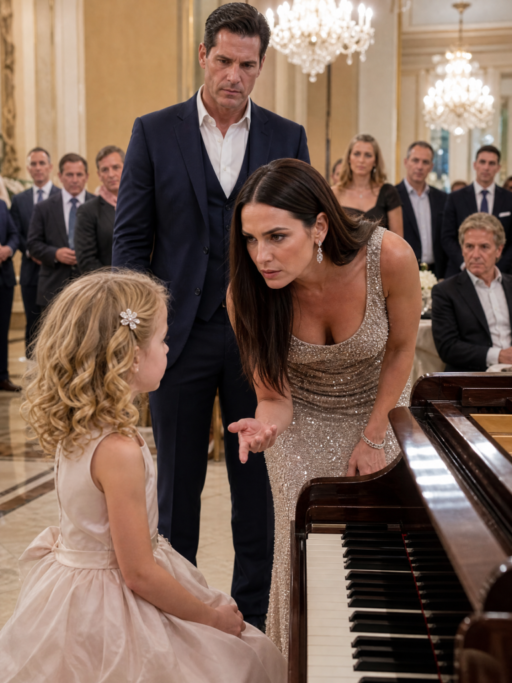
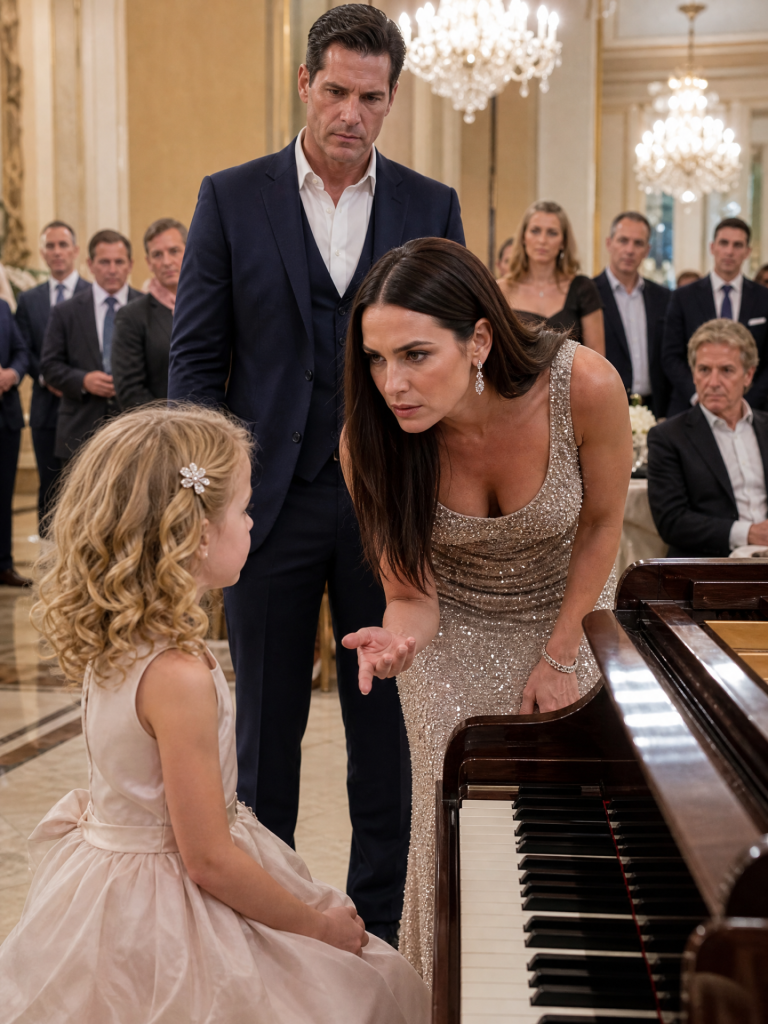

Dante Moretti refused to let anyone leave the engagement reception after his three-year-old daughter, Lily, recognized the melody his fiancée Victoria had just played on the piano. He ordered the exterior doors secured and had his bodyguards temporarily collect Victoria’s and his cousin Adrian’s phones until his attorney arrived.
Victoria stood near the piano while Adrian remained beside the chair he had stumbled into during the confusion. In the adjoining sitting room, Maria, the longtime Moretti housekeeper, comforted Lily, who was still quietly crying.
Dante looked directly at Victoria.
“Answer me.”
“I already told you. I must have heard Lily humming it.”
Maria immediately shook her head.
“No.”
Everyone turned toward her. Maria had served the Moretti family for sixteen years and had known Dante’s late wife, Grace, long before Lily was born. After Grace died in a highway accident fourteen months earlier, Maria became one of the few people who could preserve the routines Lily still associated with her mother.
“Lily only remembers the first part,” Maria explained.
Grace had composed the melody herself and played it whenever Lily struggled to sleep. She called it Lily’s song, and according to Maria, she never wrote it down because she preferred improvising it differently each time.
Dante slowly turned back toward Victoria.
“But you played the ending.”
Victoria said nothing.
Adrian suddenly stood.
“This is getting ridiculous.”
“You tried to drag Lily out of the room,” Dante replied.
“Because I knew what you would assume.”
“What should I assume?”
Adrian hesitated.
“That Victoria somehow knew Grace.”
“Did she?”
“No.”
The answer came too quickly. Worse, Victoria glanced at Adrian before looking away.
Dante walked toward the piano and opened the padded bench. Inside were old sheets of music, pencils, and Grace’s forgotten metronome, but nothing that explained Victoria’s knowledge.
Then Maria remembered something strange.
“Turn the bench over.”
She explained that two months before Grace died, Grace had specifically warned her never to let Adrian throw the bench away. Dante flipped it onto its side and immediately noticed fresh scratches underneath.
Someone had recently removed the wooden panel beneath the seat, but whatever had once been hidden there was gone.
Forty minutes later, Dante’s attorney Rebecca Sloan arrived and stopped him from tearing apart the entire mansion. She documented the bench, separated Adrian and Victoria, and began collecting statements.
Maria then revealed another detail. Near the end of Grace’s life, she had started locking the music room, which was unusual because Grace rarely locked anything inside her own home. Adrian had also been visiting the estate constantly during that same period.
When questioned separately, both Adrian and Victoria claimed they had barely known each other before Dante introduced them. Victoria also insisted she had never met Grace and had never entered the Moretti estate before Dante brought her there eight months earlier.
Their stories sounded carefully rehearsed.
Two days later, a child therapist spoke gently with Lily about the melody. Lily couldn’t name the song, but she remembered something far more useful.
“Mommy goes slow there.”
She tapped three fingers against the table.
“Miss Victoria did it fast.”
That changed everything.
Lily wasn’t simply recognizing a tune. She remembered the exact structure and tempo of something Grace had repeatedly played for her in private. Victoria hadn’t guessed the melody or heard Lily humming a few notes.
She knew the complete sequence.
Dante began examining Victoria’s past while Rebecca investigated Grace’s charitable foundation, the Moretti Family Arts Fund. Then they discovered that two months before her death, Grace had quietly requested a complete review of the foundation’s vendors.
The review was suddenly canceled through an email sent from Grace’s account.
Dante stared at the timestamp.
9:18 p.m.
He remembered that night.
Grace had been sitting across from him at dinner in Wisconsin.
Which meant someone else had been using his dead wife’s identity.
Rebecca refused to treat Dante’s memory as evidence, so they began verifying everything. Restaurant records and security logs confirmed that Dante and Grace had been together in Wisconsin when the audit cancellation was sent, while digital records showed that the email had originated from a desktop computer inside the Moretti family office in Chicago. Only two employee badge entries from that evening remained in the old access system: one belonged to Adrian, and the other belonged to his executive assistant, who remembered leaving around six while Adrian stayed behind.
Then the assistant remembered something else.
“There was a woman with him.”
She could only describe the visitor as a light-haired woman in her thirties wearing formal clothes, but an old parking validation provided something far more useful. Investigators traced the license plate and discovered that the vehicle had belonged to Victoria Lane. The date was three months before Grace died, nearly a year before Adrian claimed he had first met Victoria.
When confronted with the record, Victoria finally changed her story. She admitted knowing Adrian before Grace’s death but insisted that their relationship had been purely professional. According to her, Adrian had considered hiring her event-planning company, Lane Cultural Events, for a charity event.
Rebecca checked the financial records and discovered that Victoria’s company had received six payments from Grace’s Arts Fund totaling $184,000. The invoices claimed expenses for venues, sponsorship consulting, educational programs, and event preparation, yet several of those supposed events could not be verified. Adrian had authorized every payment.
Dante called Victoria.
“Did you steal from my wife?”
“No.”
“Then tell me why your company received six payments you forgot to mention.”
After a long silence, Victoria insisted that she had performed legitimate work but claimed that her old business records were incomplete. Dante kept his voice controlled as he confronted her.
“You’ve already lied about knowing Adrian. Now you expect me to believe the proof disappeared too?”
Victoria accused him of condemning her because Lily had recognized a few minutes of music.
“Forty-three seconds,” Dante corrected her. “And my daughter knew you shouldn’t know a single one.”
The preliminary files from Grace’s abandoned audit soon made the situation worse. Her accountants had identified three suspicious vendors, including Victoria’s company, and beside one questionable payment, Grace had written a simple note in her own handwriting: “Why is A. protecting this?” The accountant who had worked with Grace also remembered her asking whether electronic approvals could be manipulated to appear as though they came from someone else. Three days later, the investigation was canceled using Grace’s credentials from Adrian’s office.
Grace died seven weeks afterward.
Dante briefly wondered whether her accident might have been connected, but Rebecca forced him back toward the evidence. The crash had been thoroughly investigated, and another driver had clearly caused it. The betrayal did not need a second conspiracy to be devastating.
Then Maria remembered an argument between Grace and Adrian shortly before her death. She had overheard only one sentence clearly.
“You brought her into my house.”
Dante finally understood who Grace might have meant. The missing contents of the piano bench supplied the next clue: Grace had once used the underside to store document envelopes, and estate records revealed that one sealed envelope labeled “Arts Fund” had later been placed inside her safe-deposit box.