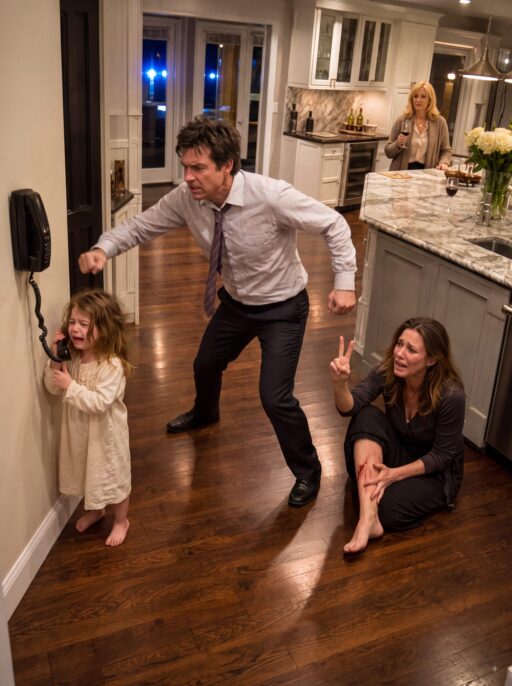
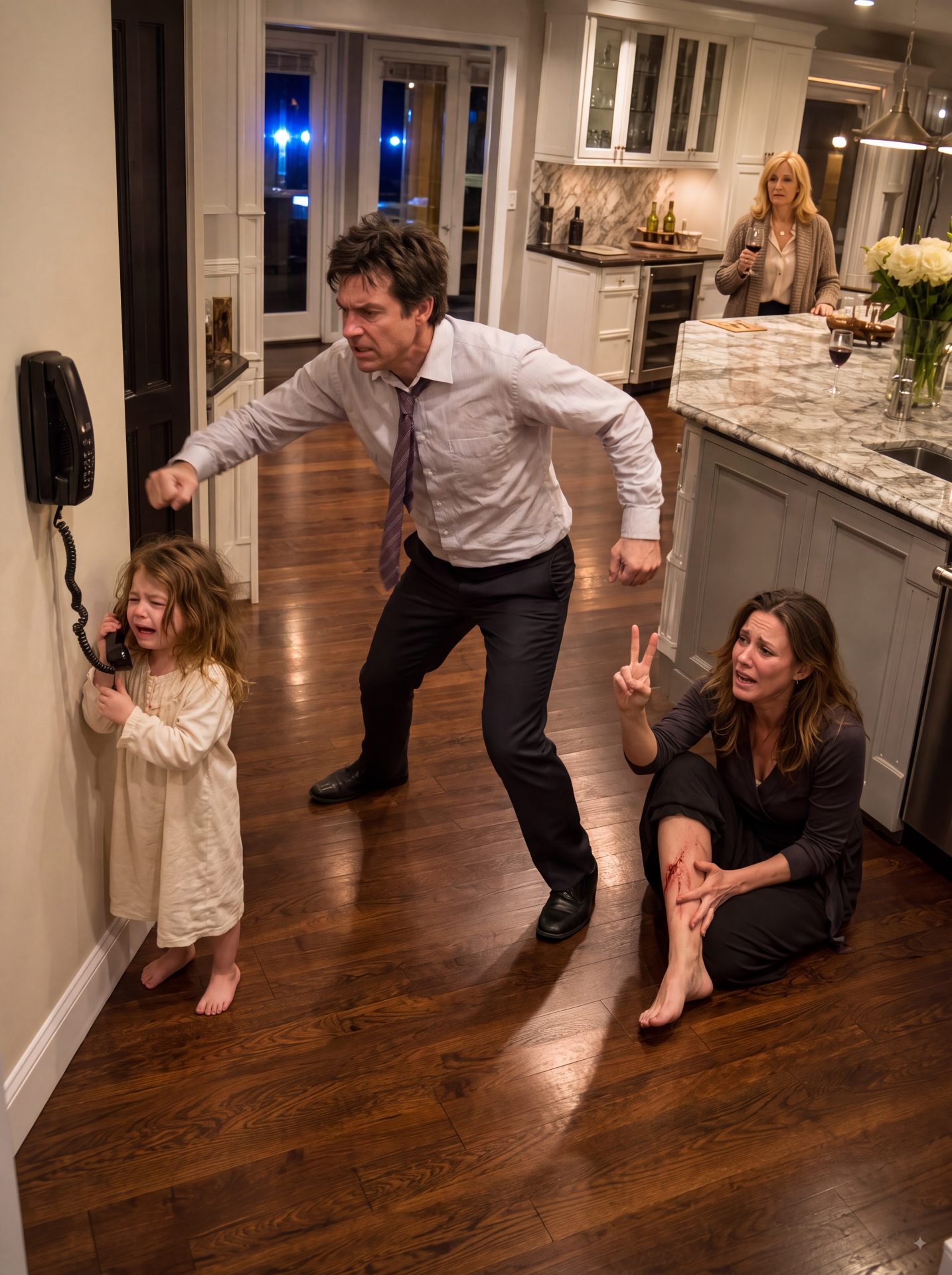

The officers documented the kitchen carefully, including my phone, torn blouse, the floor, Margaret’s wineglass, and the emergency card beneath the phone. Before the paramedics arrived, one officer gently asked Emma what she had witnessed.
“Can you tell me what you saw?”
Emma held tightly to her grandfather’s hand.
“Daddy pushed Mommy.”
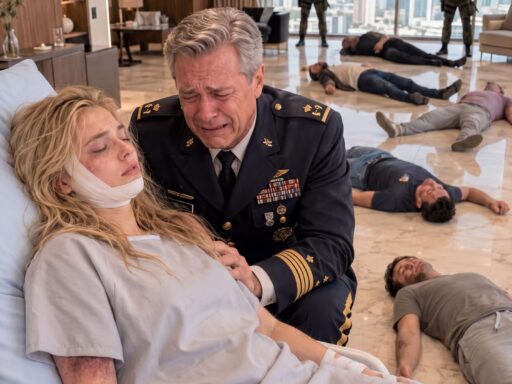
At the hospital, X-rays confirmed that my leg had suffered a serious fracture, and the intake nurse documented suspected domestic assault in my medical record. I kept asking where Emma was until someone assured me she was safe in the waiting room with my father, wrapped in his jacket and drinking apple juice.
When Emma finally came into my room, she cried at the sight of my cast. She carefully climbed beside me, touched my fingers, and looked at me as though she needed reassurance that she hadn’t made a mistake.
“I did the game right.”
That was when I finally cried. I wrapped my good arm around her because no mother wants her four-year-old child to become the person who summons help, even when that child has done exactly what she was taught to do.
The police case did not depend on David’s version of events because there was already a clear timeline. The bank transfer had occurred at 8:17 p.m., Emma’s emergency call was logged at 8:31, photographs documented the kitchen and my injuries, and Emma later gave her account with a child advocate present.
Before sunrise, my father retained an attorney for me and contacted the bank’s fraud department. David’s transfer had not fully cleared, so the bank was able to freeze the transaction before most of my inheritance disappeared.
David tried calling me from the station, followed by Margaret and then David’s sister. Their messages used different words but carried the same argument, asking me to consider misunderstandings, privacy, and the importance of protecting the family.
My attorney saved every voicemail and text instead of allowing me to respond emotionally. I was beginning to understand that control didn’t disappear simply because David was no longer standing in the same room with me; it could return through phone calls, guilt, relatives, and pleas for silence.
I did think about my family. I thought about Emma standing on the staircase with her hand covering her mouth, and I remembered the moment my four-year-old daughter had been forced to tell her grandfather that her mother looked like she might die.
So I made the decision David never expected me to make.
I did not go back.
The criminal case moved slowly, but for once David couldn’t control the direction of the story. The prosecutor had my medical records, the emergency call log, photographs from the kitchen, the bank documents, and Emma’s account of what she had witnessed, while Margaret’s claim about a wet floor immediately weakened when the responding officer confirmed there had been no water near the island.
David’s attorney tried to portray me as emotional and irrational because I had discovered money missing from my inheritance. That strategy only made the financial records more important because the transfer ledger showed exactly what had happened before our confrontation and proved that my anger had not appeared out of nowhere.
Emma was spared from testifying in open court. Her recorded interview with a child advocate was sufficient for the hearing that mattered, although watching it privately with my attorney was one of the hardest things I had ever done.
On the recording, my daughter answered questions with the same simple honesty she had shown on the night she called my father. I had to pause the video twice because hearing a four-year-old calmly describe something that had terrified her reminded me how much David’s behavior had forced her to understand.
Eventually, David accepted a plea agreement that included supervised visitation restrictions, mandatory counseling, restitution proceedings, and a protective order. The financial case continued separately, but because my father had contacted the bank so quickly, the freeze protected most of the inheritance David had attempted to move.
Margaret never gave me a real apology. Instead, she sent a letter through an attorney saying she hoped I would not “poison Emma against her family,” as though protecting my daughter from what she had witnessed was somehow more damaging than the event itself.
I placed the letter in a folder and never answered it. For years, I had wasted energy defending myself against people who could transform every consequence of their behavior into evidence that someone else was cruel, and I was finally learning that silence could also be a boundary.
Six months later, Emma and I moved into a smaller house near my father. It had none of the impressive features of the home I had shared with David, but after everything that happened, marble floors and chandeliers no longer looked like success to me.
Our new kitchen had a window above the sink and yellow curtains that Emma chose herself. On the counter sat another phone with three emergency numbers beside it, and Emma drew little flowers around the red button as though she were turning something frightening into something that belonged to her.
My physical recovery happened in recognizable stages. The cast eventually became a walking boot, and the boot was followed by the frustrating process of learning to walk normally again without anticipating pain every time I placed weight on my leg.
Emotional recovery was much less predictable. Some nights I woke suddenly because I imagined smelling bourbon, and ordinary household sounds could return me to that kitchen before I had time to remind myself that David was no longer there.
Emma had her own way of processing what happened. For a while, she recreated our emergency routine with dolls, making one raise two fingers while another ran for help, and her therapist explained that play was one of the ways children moved fear out of themselves.
I sometimes wondered whether teaching Emma the secret signal had protected her or burdened her with knowledge no four-year-old should need. Then, near the end of that year, I found her standing quietly in our kitchen looking at the phone.
“Are you scared?”
Emma shook her head.
“I just like knowing it works.”
Her answer changed the way I understood everything we had survived. The red button was no longer simply connected to the worst night of our lives because, to Emma, it also represented the certainty that someone would answer when she asked for help.
David had spent three years convincing me that I was isolated, fragile, and dependent on him. Yet the moment I finally needed help, one secret number had exposed the truth he needed me never to discover.
I had never been as alone as he wanted me to believe.
Life in the smaller house was quieter, but quiet no longer frightened me in the same way. For years, silence had meant waiting for David’s mood to reveal itself, while now it meant Emma coloring at the kitchen table, my father stopping by with groceries, or both of us going to sleep without wondering what version of David would walk through the door.
The legal process continued in the background, but I stopped allowing it to define every day. My attorney handled the remaining financial proceedings, the protective order stayed in place, and every message from David’s side of the family went through proper channels instead of reaching me directly.
That distance helped me understand how much energy I had once spent anticipating other people’s reactions. I had measured every word, delayed difficult conversations, and tried to make myself smaller because I believed keeping David calm was the same thing as keeping Emma safe.
It wasn’t.
Safety meant having people who answered the phone. It meant records, boundaries, emergency numbers, and the freedom to tell the truth without first calculating who might punish you for it.
Emma adapted faster than I expected, although her recovery had its own strange rhythm. Some days she seemed completely ordinary, laughing over cereal or arguing about which socks she wanted to wear, while other days she returned to the doll game where one toy raised two fingers and another rushed for help.