

Lauren agreed to meet Andrea and provide the original photograph, along with a statement about what she had heard in the parking lot. She looked exhausted when she arrived at my mother’s house, and she did not ask me to forgive her.
“I have spent years telling myself Derek was just blunt,” she said. “I knew he could be controlling, but I kept calling it stress, work, anything except what it was.”
“You did not protect her when you could have,” I said.
“I know.”
Her answer did not repair anything. Still, it was the first time anyone in Derek’s family had admitted that keeping peace with him had come at someone else’s expense.
At the emergency hearing two days later, Derek arrived in a suit and carried a folder full of parenting articles. He looked more like the man who had convinced neighbors he was dependable than the man who had stood beside the hot car arguing about a broken window.
His attorney said I was making a temporary lapse into a reason to separate a father from his child. Derek sat beside her, nodding slowly, as though he was hurt by the idea that anyone might misunderstand him.
Then Andrea placed the message thread before the judge.
She walked through it carefully: Lauren’s warning before Derek entered the store, the message saying the baby was crying, the repeated requests for him to return, and the nineteen minutes between the last warning and the officer’s intervention.
Derek’s attorney argued that Lauren was unreliable because she had initially tried to minimize what happened. Andrea did not deny it.
“Lauren did hesitate,” she said. “But her messages were sent in real time, before anyone had a reason to shape a story.”
The judge read the timestamps in silence. Then she turned to Derek.
“Did you receive a warning that your infant daughter was in a hot vehicle?”
Derek adjusted his tie. “My sister was worried. She often overreacts.”
“That is not what I asked.”
For the first time, he looked less certain. “She said it was hot.”
“Did you return to the car after she told you the baby was crying?”
Derek’s gaze moved toward me, then toward the floor. “I believed the baby was fine.”
The words landed differently in court than they had in the parking lot. There was no family member left to hush, no frightened wife trying to keep the day from becoming difficult, and no broken window to blame.
The judge continued the order for no unsupervised contact and required that any future contact be supervised while the investigation proceeded. She also ordered a full parenting assessment before the next hearing.
Derek stood as the judge left the courtroom. He looked at me with a mixture of anger and disbelief, as though I had betrayed him by allowing strangers to see what I had spent months trying to explain away.
Outside, he caught up to me near the elevators.
“You are going to regret this,” he said quietly. “You are turning everyone against me.”
Andrea stepped between us before I could answer. “Do not contact my client except through counsel.”
Derek walked away, but not before I saw the expression on his face. It was not remorse.
That evening, Lauren called me again.
“I just remembered something,” she said. “The day before the parking lot, Derek asked me to delete a video from my phone. I told him I had, but I didn’t.”
Then she sent it to me.
The clip was only forty seconds long, but it showed Derek standing beside our daughter’s crib while she cried, speaking into the room as though he wanted someone to hear him.
“You’ll learn,” he said. “Eventually, you’ll learn nobody comes just because you make noise.”
I watched Lauren’s video once, then sent it to Andrea without watching it again. Forty seconds was enough to show that Derek’s words in the parking lot had not come from a single bad decision; they came from an idea he had been practicing inside our home.
The next morning, Andrea provided the video to the investigator assigned to the case. She also told me something I needed to hear: evidence mattered, but so did my willingness to stop minimizing what I had seen.
For months, I had treated my discomfort like a personal weakness. I had told myself Derek was simply tired, that new parenthood was hard, and that I should be grateful he had not raised his voice or walked away from us completely.
But control does not always arrive as shouting. Sometimes it arrives as a person repeatedly telling you that your instincts are irrational until you begin apologizing for having them.
The investigation continued through the following weeks. Lauren gave her full statement, and the officer’s report, the message timestamps, the car-window photographs, and the video were included in the file.
Derek’s attorney tried to characterize everything as a parenting disagreement. The facts did not support that version: he had been warned that the baby was crying, he had chosen not to return, and he had changed his account of how long he had been away.
The court kept the no-unsupervised-contact order in place. Derek was required to complete a parenting assessment and follow the safety conditions set by the court before any future contact could be considered.
That was not the ending he wanted. He had assumed I would accept an apology, let time soften the memory, and return to the life where he decided which concerns counted.
Instead, I moved into a small apartment near my mother. It was not as spacious as our old home, and I had to rebuild my work schedule around childcare and legal appointments, but every decision inside those walls belonged to me.
Lauren contacted me occasionally. At first, her messages were mostly apologies, and I did not know how to respond.
Eventually, I told her the truth. “I believe you regret what happened. But my daughter’s safety comes before repairing any relationship.”
She accepted that without arguing. It was the first boundary I had ever set with someone in Derek’s family without immediately trying to make it easier for them.
Months later, Derek accepted responsibility in court for the choices that had put our daughter at risk. The case did not erase the fear of that afternoon, and it did not magically turn him into the father I once hoped he would become.
It did establish something that mattered: his version of events was no longer the only version anyone had to accept.
My daughter is older now. She laughs easily, reaches for me when she needs comfort, and has no idea that her small cry in a parking lot changed the course of both our lives.
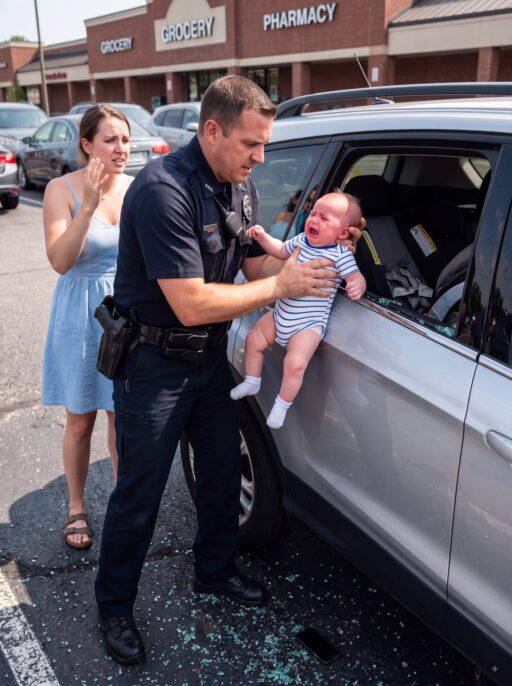
Sometimes, when she falls asleep against my shoulder, I think about the officer who heard her and refused to walk past. I think about the message Lauren sent, the timestamp Derek could not explain, and the moment I finally understood that protecting my child was never an overreaction.
I do not know what kind of mother my daughter will remember me as. I hope she remembers warmth, patience, and a home where she never had to earn the right to be comforted.
But I also hope she learns one thing from the life we built afterward.
When someone tells you that your pain, your fear, or your voice is inconvenient, you do not have to become quieter to make them comfortable.