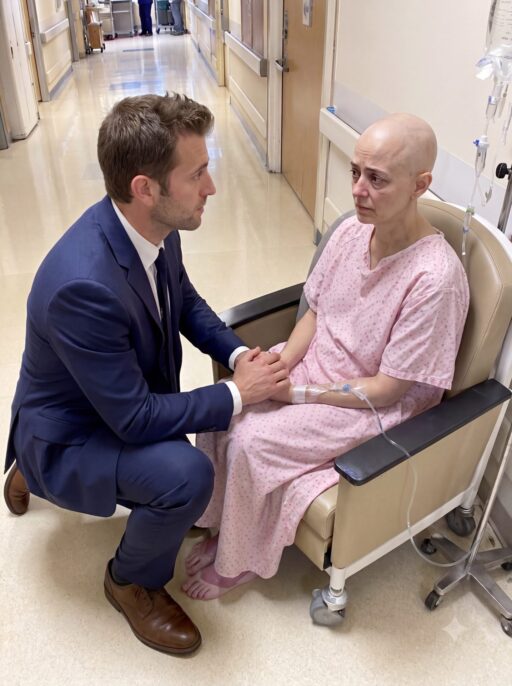
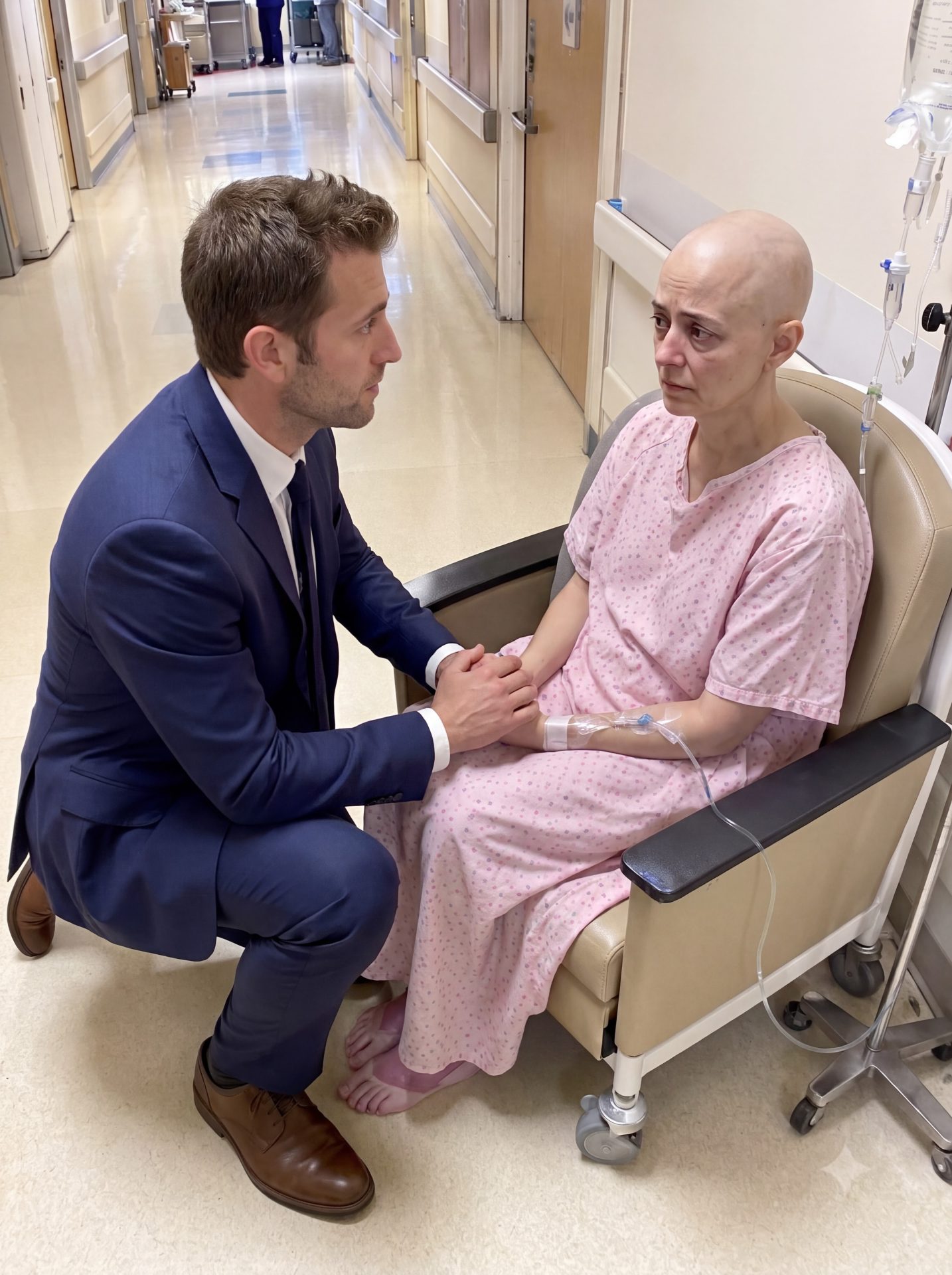

“Are you doing this because you feel responsible?”
I told her I did feel responsible for disappearing into work, ignoring what was happening between us, and allowing grief to turn me into a stranger. But guilt wasn’t why I kept returning.
“Then why?”
“Because when I saw you in that hallway, I realized the divorce ended a legal marriage, not what you mean to me.”
Sophie warned me not to promise a future simply because I was terrified of losing her. So I didn’t.
“Tomorrow morning, I’ll be here. When you wake up, if they let me, I’ll be here. After that, I’ll ask again.”
Then Sophie finally admitted how furious she had been when I asked for the divorce just as she was preparing to tell me about her illness. Yet she also remembered hearing me quietly crying after our second miscarriage, holding the tiny yellow socks we had bought for the baby.
“I never stopped loving you,” she whispered. “But I don’t know if love is enough to trust someone again.”
“That’s fair.”
Slowly, Sophie extended her hand from beneath the blanket.
I took it.
The following morning, they wheeled her toward surgery. At the double doors, Sophie chose Linda to accompany her farther, but just before disappearing, she turned toward me.
“When you go to my apartment again, you can read the letter.”
Nearly five hours later, Dr. Shah returned with the news we had desperately wanted. The surgery had gone well, the tumor had been removed, and there were no immediate complications.
Two days later, I returned to Sophie’s apartment. The envelope was still waiting in the drawer. I sat on the edge of her bed and opened it.
Sophie had written the letter after doctors discovered the abnormality following her miscarriage. She admitted she was terrified and didn’t know how to carry that fear, but what hurt most was reading that she had wanted me beside her.
She had asked me to accompany her to an appointment the following Thursday.
“Not as a perfect husband.
Not as someone who knows what to say.
Just as you.
Please.”
I remembered that Thursday perfectly. While Sophie had gone to the hospital alone, I had been sitting in a conference room discussing quarterly projections. That evening, I came home irritated about traffic, completely unaware that my wife had just faced one of the most frightening appointments of her life without me.
By the time I finished the letter, I was crying.
For years, I had believed our marriage collapsed because grief had damaged us beyond repair. Now I saw something more complicated because we had both become so frightened of burdening the other with pain that we stopped speaking honestly about what we needed.
When I returned to the hospital, Sophie knew immediately.
“You read it.”
“I did.”
“I wish I had come with you that Thursday.”
Her eyes filled with tears.
“I wish I had given you the letter.”
“I wish I had made it easier for you to give it to me.”
Neither of us tried to decide who had failed more. For once, we simply acknowledged how many moments had disappeared because two people who loved each other had chosen silence when they most needed conversation.
“I don’t want us to spend the rest of our lives wishing we had done things differently,” Sophie whispered.
“Neither do I.”
“But I can’t go back to what we were.”
“I don’t want to.”
She looked surprised.
I told her I didn’t want the marriage we had at the end, where we lived beside each other and called our isolation protection.
“So what do you want?”
I reached for her hand.
“A chance to find out who we are now.”
Sophie lowered her head and quietly cried. There was no miraculous reconciliation and no promise that everything would suddenly become easy.
I had finally learned that love couldn’t guarantee that terrible things would never happen.
Sometimes love meant something much simpler.
It meant refusing to disappear when they did.
The months after Sophie’s surgery were difficult, but this time neither of us pretended difficulty meant failure. Recovery came slowly, with follow-up appointments, medication, scans, good days when she could walk around the block, and harder days when simply getting out of bed felt like an accomplishment.
I went with her whenever she wanted me there. When she preferred Linda, I respected it, and when she needed space, I gave it without treating distance as rejection. Most importantly, whenever Sophie called in the middle of the night because fear had returned, I answered.
Every time.
I continued therapy, and eventually Sophie began seeing a therapist too. Months later, we attended a session together and finally talked honestly about the pregnancies we had lost instead of circling around the grief they had left behind.
I admitted how helpless I had felt after the second miscarriage and how work became my hiding place because spreadsheets never cried and meetings never asked questions I was afraid to answer. Sophie told me how abandoned she had felt sitting beside a husband who was physically present but emotionally disappearing.
Neither of us tried to prove who had suffered more.
That might have been the first real sign that we were healing.
Six months after surgery, Sophie’s scans showed no evidence that the tumor had returned. Monitoring would continue, but when Dr. Shah gave us the news, Sophie squeezed my hand and I held hers beneath the same gray Chicago sky that had covered the city when I first found her alone in the hospital hallway.
“Coffee?” I asked.
“Is this a date?”
“I was hoping.”
She smiled.
“You’ll have to impress me.”
That coffee became another, then dinner, and eventually we began dating again. It felt strangely awkward considering we already knew each other’s childhood stories, favorite foods, sleeping habits, and worst arguments, but this time we were learning the things we had failed to ask during our first marriage.
A year after the hospital, Sophie moved out of her small apartment. She didn’t move into mine because we chose a new home together, a small place overlooking a park where neither of us had memories of silently avoiding the other.
There was no nursery.
Maybe there would be someday, and maybe there wouldn’t. For the first time, we allowed that uncertainty to exist without deciding it made our life incomplete.
One evening, Sophie unpacked our old wedding photograph, the same picture she had once kept facedown beside her bed. She brushed the dust from the frame and placed it on a shelf.
“Are you sure?”
“That happened,” she said. “The good parts happened too.”
Two years after her surgery, I took Sophie back to the restaurant where we’d had our first date. I didn’t bring a ring because this time I wanted the conversation to come before the gesture.
“Do you think you could ever marry me again?”
She stared at me before laughing.
“You’re proposing without a ring?”
“I learned to start with the conversation.”
Her smile softened.
“That might be the smartest thing you’ve ever learned.”
“So?”
Sophie reached across the table.
“Yes.”
Our second wedding was small, surrounded only by family and close friends. We didn’t make grand promises that life would always be easy because both of us finally understood that love wasn’t protection from grief, illness, fear, or uncertainty.
Years later, Sophie still keeps the letter she wrote before our divorce. It sits in a box beside hospital bracelets, therapy notebooks, and pieces of the life that nearly broke us, but we no longer need to read it.
When something hurts now, we talk.
Sometimes through tears. Sometimes after sitting quietly until one of us finally finds the right words.
But we talk.
When I remember the day I found Sophie sitting alone in that hospital hallway, I no longer think of it simply as the day I discovered she was sick. I think of it as the day I finally stopped walking away.
The divorce ended our first marriage. The hospital didn’t magically restore it.
We did something harder. We built another one. One conversation at a time.