
My mother was the kind of woman who apologized for being ill. At seventy, Helen Park had spent her entire life learning how to take up as little space as possible, so even cancer somehow became another inconvenience she believed she needed to apologize for.
She apologized for chemotherapy, for being tired, for needing rides to appointments, and for taking up our guest room. She even apologized for barely eating because the treatment had stripped away her appetite.
I had spent forty years asking her to stop.
She never did.
My name is Sara Choi-Bennett, and I had been married to Gabriel Bennett for nine years when Mom was diagnosed with stage three breast cancer. Her oncologist, Dr. Reyes, explained that the treatment would be aggressive but that the survival outlook was encouraging if Mom had proper support.
“I’ll manage,” Mom said.
“Mrs. Park, managing alone during chemotherapy is not advisable.”
“I’ve managed alone before.”
She had been doing exactly that for nineteen years since my father died. Mom had organized her entire life around never needing anyone, but this time I refused to let her turn independence into isolation.
“You’re staying with me.”
“Sara.”
“You’re staying with us.”
“I don’t want to be in the way.”
“You’re not in the way.”
Then she said Gabriel’s name with a question hidden inside it.
“Gabriel?”
“I’ve already talked to him.”
Technically, that was true. Gabriel had said he was not thrilled and had immediately asked how long she would be staying, but eventually he agreed.
“She’s not going to be here for long, right?”
“For as long as she needs to be.”
“I just need to know there’s an end date.”
“Gabriel, she has cancer. I don’t have an end date.”
After a long silence, he finally answered.
“All right. Fine.”
The first-floor guest room was the obvious place for Mom because it sat directly across from the bathroom and required no stairs. It also had a window overlooking the backyard garden she loved watching whenever she visited.
When I brought her home on Monday, she arrived with one suitcase and a small bag of medications. Naturally, she apologized for both.
“I probably packed too much.”
“Mom.”
“I’m just saying.”
“You can bring as much as you want. This is your room.”
She looked around the guest room and smiled faintly.
“It’s a nice room.”
“It’s across from the bathroom. I thought that would make things easier after chemo.”
“That’s thoughtful.”
Then, without adding an apology, she simply said:
“Thank you.”
Three days later, I drove her to her first chemotherapy treatment. I sat beside her through five hours of infusion, holding her hand when the nausea began and feeling the helplessness of watching something painful happen to the person who had spent her whole life protecting me.
“I’m sorry,” she whispered.
“Mom.”
“This is not pleasant for you.”
“It’s less pleasant for you.”
She looked down at our joined hands.
“I don’t know how to let people help me.”
“I know.”
“It feels like weakness.”
I squeezed her fingers.
“It isn’t.”
At the time, I thought the hardest part of Mom staying with us would be convincing her that she was allowed to need help.
I had no idea that the person who would make her feel most unwelcome was my own husband.
Two weeks into Mom’s stay, I had to leave for a four-day business trip to Seattle. Before leaving, I organized everything as carefully as possible because chemotherapy had already made even ordinary tasks difficult for her, and I knew she would rather struggle silently than ask anyone for help.
I wrote out her medication schedule on a laminated card and left copies in both the kitchen and the guest room. I stocked the refrigerator with the few foods she could tolerate, including crackers, ginger tea, rice, broth, and applesauce, then went over the routine with Gabriel one more time.
“She needs the anti-nausea medication at eight in the morning and eight in the evening.”
“I know.”
“She won’t ask you to check on her. You need to do it anyway.”
“I’ll check on her.”
“Gabriel.”
“Sara, I’ve got it.”
I wanted to believe him, so I left for Seattle and focused on work as much as I could. Every evening, Mom sent brief messages saying she was fine, eating a little, sleeping reasonably well, and taking her medication, which reassured me enough to stay until the final day.
That last meeting ended four hours earlier than expected, so I changed my flight and headed home without telling Gabriel. When I pulled into the driveway that evening, I noticed his brother Danny’s car parked outside, but I assumed they were simply spending some time together.
The kitchen immediately told me something was wrong. Empty beer bottles covered part of the counter, an open pizza box sat nearby, and there were chips and other signs of a mess that had clearly been left sitting for more than a few hours.
Then I heard football coming from the guest room. I walked down the hallway and opened the door to find Gabriel stretched across the bed while Danny sat in the chair I had placed beside the window for my mother.
The television was on, beer and snacks were scattered around them, and both men looked completely comfortable in the room I had specifically prepared for a seventy-year-old woman going through chemotherapy. Gabriel’s face changed the moment he saw me, and the shock in his expression told me he had never expected me to come home early.
“Honey. I didn’t know you were coming home.”
“Where is my mother?”
“My brother came over and we wanted to watch the game in here because there’s a TV.”
“Where is she?”
“I put her in the basement.”
For a moment, I genuinely thought I had misunderstood him. The basement was finished in the most basic sense, but it had no bedroom, no window, no bathroom, and certainly nothing appropriate for someone who could barely manage stairs on a good day.
“What?”
“She’s comfortable down there.”
“This is her room, Gabriel.”
His expression hardened instead of softening. Rather than admitting he had made a terrible decision, he doubled down.
“No, it’s not. It’s my room. Just like this entire house.”
Then he said the sentence that changed something fundamental in the way I looked at our marriage.
“I’m the man of the house.”
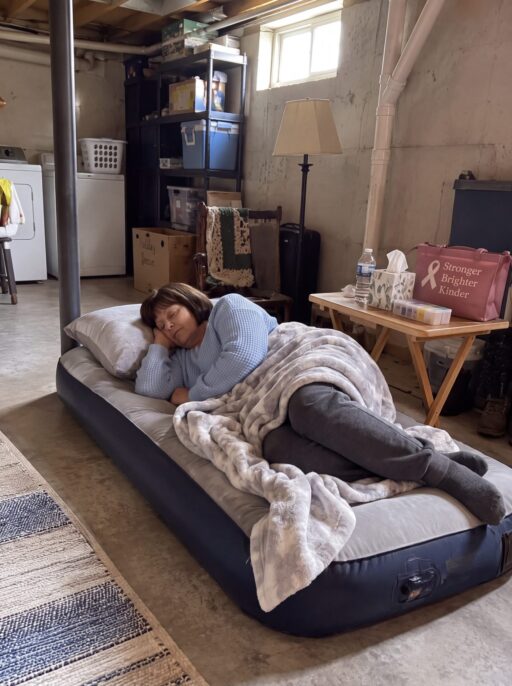
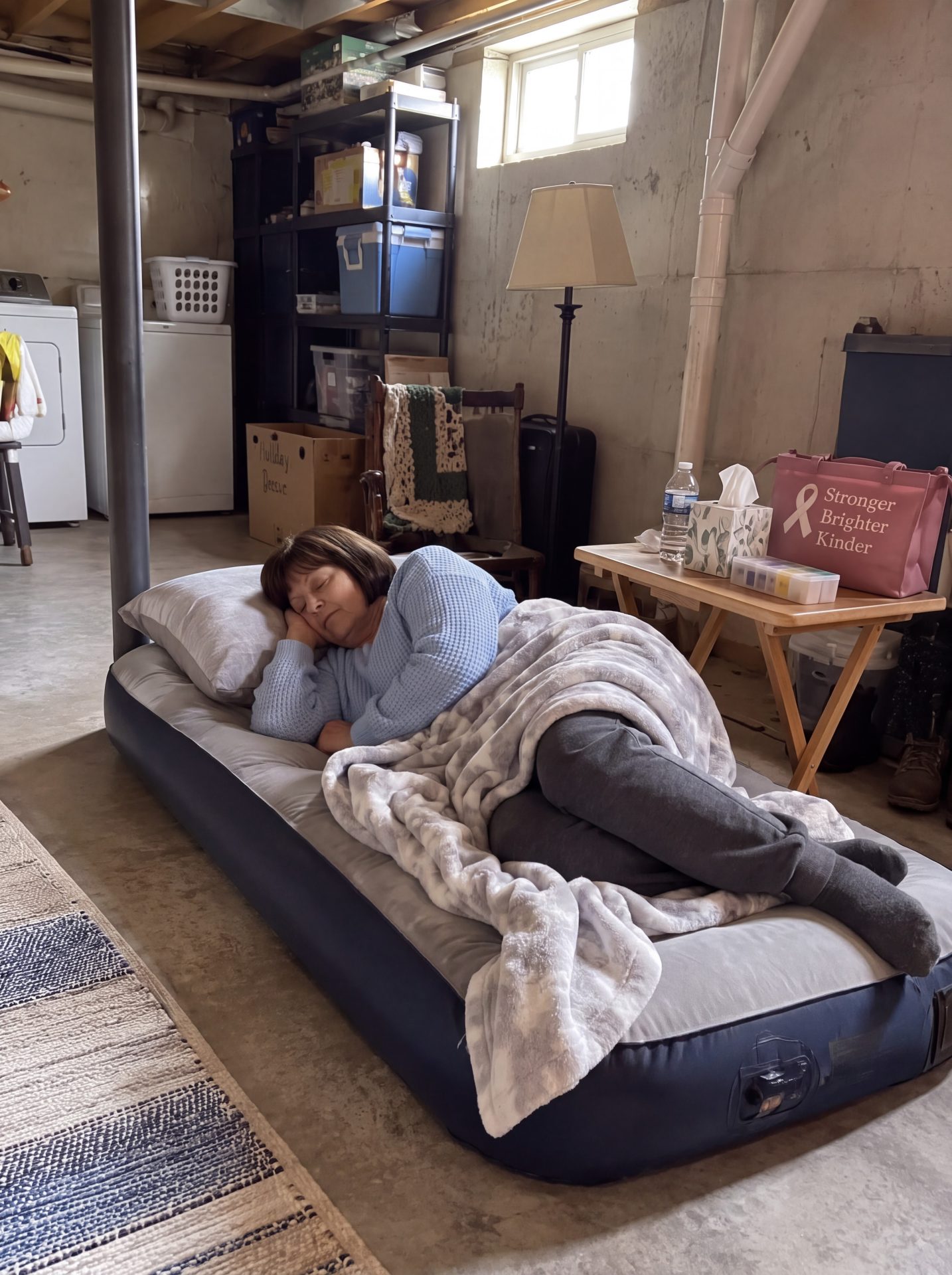
I did not waste time arguing with him. I turned away, walked downstairs, and found my mother asleep on an air mattress in the middle of the basement with her medication bottles sitting on the floor beside her.
She looked smaller than she had when I left four days earlier. Three weeks of chemotherapy had already taken weight from her, and seeing her on that mattress made the entire situation feel even worse.
She stirred when she heard me and slowly opened her eyes.
“Sara? You’re home early.”
“Yes.”
Then, because she was still my mother and still herself despite everything, she immediately apologized.
“I’m sorry I’m down here. Gabriel said they needed the room. I didn’t want to cause trouble.”
“You didn’t cause anything.”
“I can manage down here.”
She said it with complete sincerity, which hurt more than if she had complained. After seventy years of making herself small for other people, she genuinely believed enduring discomfort was preferable to becoming inconvenient.
“You are not staying down here.”
I helped her stand, and the moment I took her arm, I realized how much lighter she felt than before. She moved carefully toward the stairs, apologizing for needing help even as I guided her upward one step at a time.
“You’re coming upstairs.”