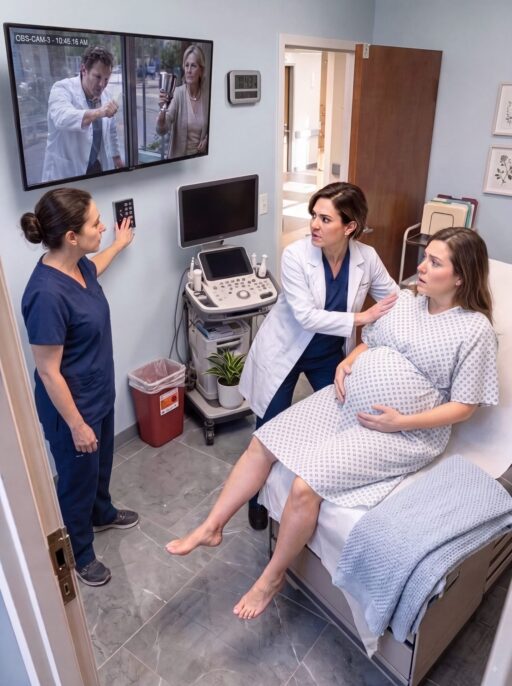
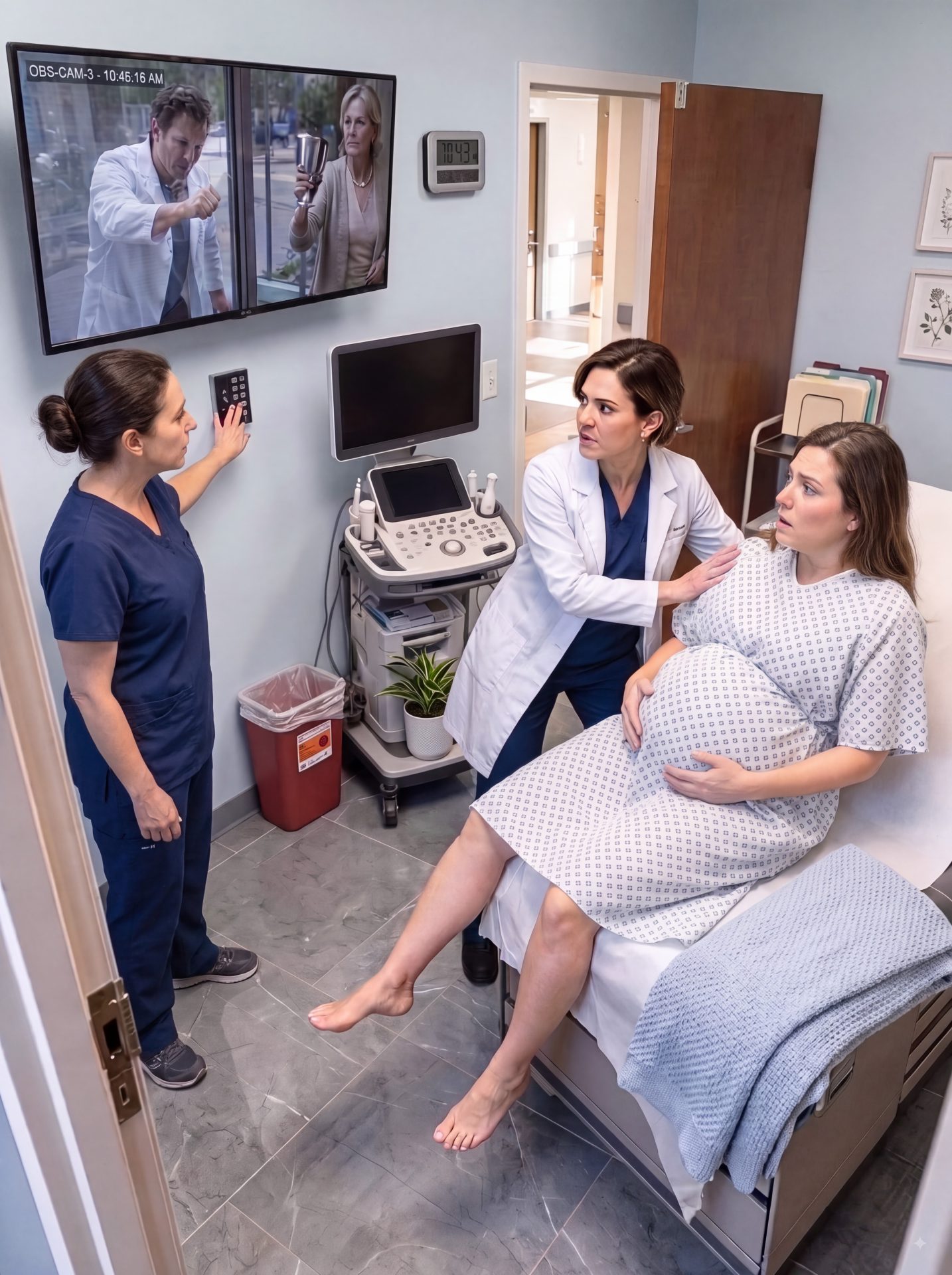

The nurse photographed every message and documented the timestamps. Meanwhile, Aaron began telling the receptionist that I suffered from anxiety, had left home without medication, and might endanger myself or the baby if he was not allowed to take control of my treatment.
Dr. Reed closed the examination-room door after listening for only a moment. She told me they were arranging a direct hospital transfer through a secured hallway and that Aaron would no longer determine who had access to me.
“But he may follow us.”
“He may try. But he no longer decides who sees you.”
Those words broke through something I had not realized I was still holding inside. Aaron had taken my keys, my phone, my medical independence, and eventually my confidence, always claiming that surrendering those things was necessary for my protection.
Police sirens approached outside before the transfer could begin. On the security screen, Aaron suddenly reached toward the silver cup Sylvia was holding, but she stepped away from him.
“Give it to me.”
Sylvia did not move.
“What was in those packets?”
“Your prenatal mixture.”
“That isn’t what you called it at home.”
She slowly placed the silver cup on a concrete ledge and raised her hands away from it.
“I’m not touching it again.”
Aaron immediately stopped pretending to be calm. When two officers and the clinic security guard approached, he pointed at Sylvia and claimed she had been secretly giving me unapproved herbal products.
For a moment, Sylvia simply stared at her son. Then she opened her handbag and removed several folded packets held together with a rubber band.
“Aaron gave these to me. He wrote the days on them and told me to mix one into her drink every morning.”
Aaron insisted his mother was confused, but Sylvia looked through the clinic window until our eyes met.
“I thought they were herbs. At first.”
Those last two words told me everything I needed to know.
Sylvia had eventually suspected something was wrong.
And she had kept giving me the drinks anyway.
The ambulance crew entered through a secured hallway while police officers kept Aaron away from me at the front of the clinic. Before I was transferred, Dr. Reed asked whether there was anyone I trusted enough to call, and after a long pause, I gave her my father’s number.
Aaron had spent two years telling me that my parents were controlling, resentful, and determined to interfere with our marriage. Sitting there with strangers protecting my choices better than my husband ever had, I finally understood how completely he had isolated me from the people who had always tried to keep me safe.
During the ambulance ride, every member of the medical team asked permission before adjusting a monitor, tightening a strap, or examining me. Each simple question reminded me how many decisions Aaron had quietly taken away while insisting that those choices were too complicated or dangerous for me to make myself.
At the hospital, specialists safely removed the modified device without harming my son. The object was immediately preserved as evidence, and blood tests revealed a sedating medication in my system that had never been prescribed to me.
Later, traces of the same substance were found on the device and in the remaining liquid from Sylvia’s silver cup. The physician reviewing the results explained that the medication could account for the dizziness, weakness, memory lapses, and exhaustion Aaron had repeatedly used to justify taking away more of my independence.
That realization changed everything.
Aaron had not simply been responding to my symptoms.
He had been helping create them.
My father arrived before sunset wearing the old work jacket he always kept in his truck. He stopped at the doorway, looked at the monitors around my bed, and asked the first question anyone in my family had asked me in months that did not contain an expectation.
“May I come closer?”
I nodded and immediately started crying. He took my hand without asking why I had disappeared from the family or reminding me that he had warned me about Aaron before we married.
“Your mother is packing a bag. We’re here for as long as you need us.”
Aaron continued calling the hospital. First he introduced himself as my treating physician, then as my husband, and finally as the father of my unborn child, but none of those titles gave him access anymore.
I formally removed him from my medical records, revoked every authorization that allowed him to speak on my behalf, and instructed the hospital not to admit him to my room. Nobody asked me to reconsider.
Several days later, Sylvia requested permission to speak with me. I refused, but she sent a written statement through the patient advocate and surrendered the remaining packets Aaron had given her, along with a handwritten schedule listing the mornings I was supposed to receive injections, drink the prepared mixture, and remain asleep.
One message among the documents destroyed every explanation Aaron had tried to offer.
“Keep her foggy until delivery. Once the baby is here, she will stop talking about leaving.”
Investigators confronted Aaron with the message, but he claimed the wording had been exaggerated and insisted that I had verbally agreed to the treatment during a conversation I simply could not remember. My medical records told a different story because there was no documentation authorizing the device or the medication.
Text messages from the night Aaron inserted the device were even more damaging. I had asked why I was bleeding and begged him to explain what he had done.
His response had been one word.
“Protection.”
As the medication gradually left my body, the dizziness and mental fog began to fade. For the first time in months, I realized how much of the person I had become had been shaped by chemicals, fear, and the constant suggestion that I could not trust myself.
Aaron had spent years convincing me that dependence was safety.
The evidence was finally proving otherwise.
As the medication cleared from my system, the constant dizziness and mental fog slowly began to disappear. My son’s heartbeat remained strong, the contractions settled, and every day I felt a little more like the woman I had been before Aaron convinced me that exhaustion, confusion, and dependence were normal parts of pregnancy.
Dr. Reed visited before my discharge and reviewed my new care plan with me in detail. She answered every question without rushing, even when I repeated myself, and that patience felt almost unfamiliar after months of being told that too much information would only make me anxious.
“You do not have to earn the right to know what happens to your body.”