
“We believe he planned it.”
The investigator showed me a sequence of messages recovered from Michael’s department-issued phone. Most were ordinary work exchanges, but one thread had been deleted badly enough to leave fragments behind.
The messages were between Michael and Tyler.
“Get your phone ready,” Michael had written that afternoon. “She’ll act tough until people see what she really is.”
Tyler’s reply appeared beneath it.
“What if Mom gets upset?”
Michael had answered, “Your mother always gets upset. That’s why she’ll back down.”
I read the words twice.
Then I handed the phone back before anger could make me crush it in my grip.
Michael had not just wanted to humiliate me. He wanted to frighten my mother into choosing him again.
He believed that if he made me look unstable, loud, and dangerous, she would retreat into the role he had trained her to play for years: the woman who apologized for everyone else’s behavior and asked her daughter to endure it for the sake of peace.
But this time, his plan had unfolded on an open Pentagon line.
This time, his own son had recorded it.
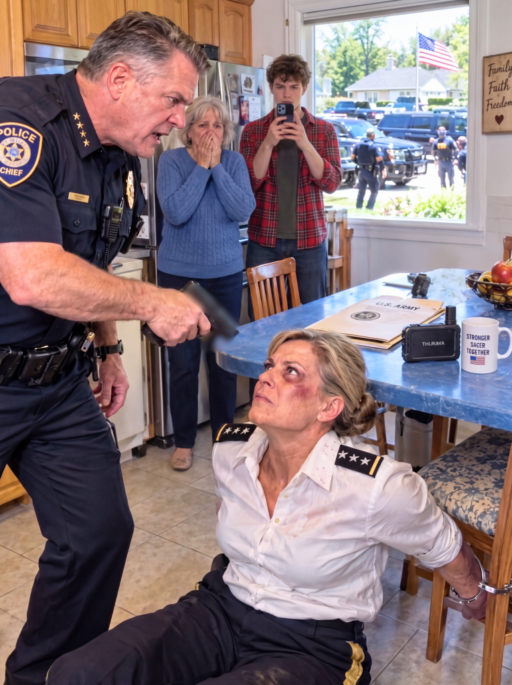
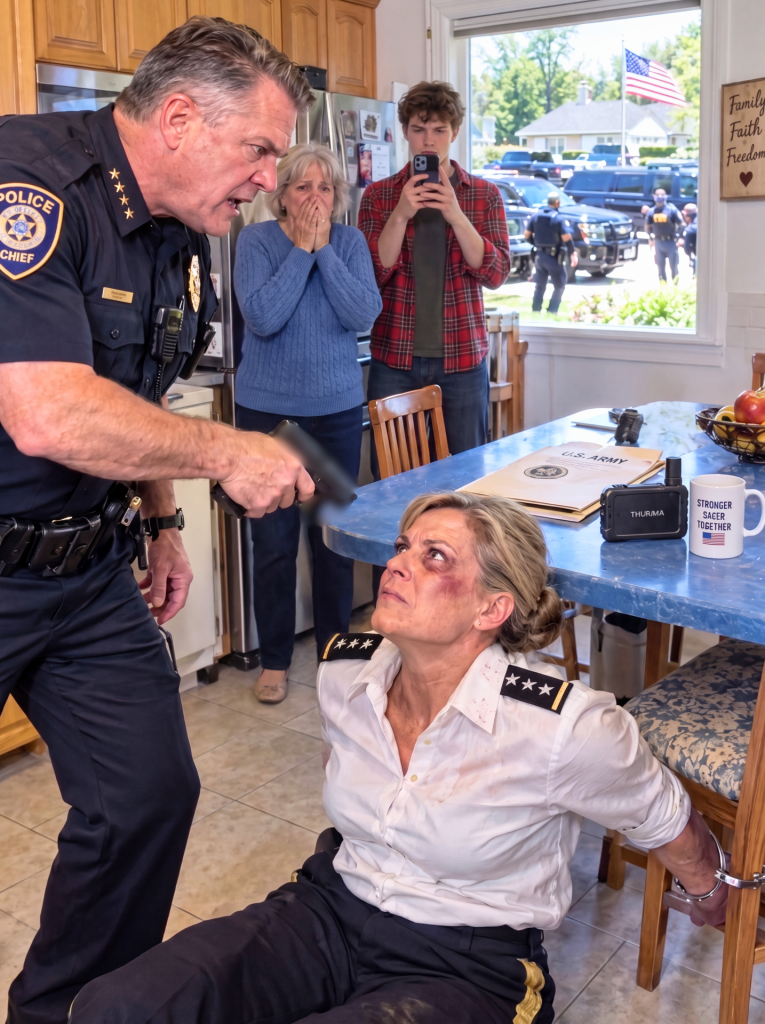
And this time, my mother had watched him point a gun at me.
The department’s review widened quickly. Officers who had once avoided conflict with Michael started speaking to investigators.
One detective described being pressured to rewrite arrest reports. A former dispatcher recalled Michael destroying a complaint form in front of her and telling her that “problems disappear when the right person controls the paper.”
The local news did not receive the details immediately, but rumors traveled faster than any official statement.
By the end of the week, Michael’s name was no longer spoken with admiration at the diner.
People lowered their voices for a different reason.
My mother did not celebrate any of it. She was too busy trying to understand how much of her life had been shaped by fear.
She began counseling at a church community center on Tuesday evenings. The folding chairs were uncomfortable, and the coffee was weak, but she went every week.
The first time she came home afterward, she stood at the kitchen counter for a long time before speaking.
“My counselor asked why I stayed,” she said.
I did not answer for her.
“He made me think being loved meant making myself smaller,” she continued. “And after enough years, I forgot I was allowed to take up space.”
I reached for her hand.
“You are allowed to take up all the space you need.”
She smiled at me, faintly but genuinely.
Then the doorbell rang.
We both froze.
Old fear is stubborn. It hears a knock and assumes the past has found a way back inside.
But when I checked through the window, it was not Michael.
It was Tyler.
He stood on the porch alone, without his father’s truck behind him. His shoulders were hunched, and he looked younger than I had seen him in years.
My mother opened the door only after I stood beside her.
Tyler’s eyes went first to me, then to the changed locks, then to the kitchen where he had once laughed while I was handcuffed.
“I need to tell you something,” he said.
My mother’s voice stayed calm. “You can tell us from there.”
He nodded, swallowing hard.
“Dad has a copy of the house key,” he said. “He kept one before the locks were changed.”
My mother’s face tightened.
Tyler looked at me again. “And he told me he was coming back tonight. He said he had to make Mom understand that none of this was over.”
Outside, the evening was already getting dark.
And somewhere beyond the quiet street, Michael Harris was still convinced my mother belonged to him.
My mother did not panic when Tyler warned us Michael was coming.
A month earlier, she would have. She would have apologized for something she had not done, turned off the lights, and asked me whether we could make the situation easier for him.
Instead, she picked up her phone and called the investigator.
Then she looked at me and said, “I am not leaving my own house.”
We waited inside with the porch light on.
Tyler sat at the kitchen table, his hands clasped so tightly that his knuckles had turned white. He had given investigators the messages Michael sent him, along with the unedited version of the video.
“I thought Dad was just going to scare you,” he said. “I thought he was always right.”
“You knew he was not,” my mother said.
Tyler looked down.
She did not say it cruelly. That was what made it land.
“You knew because you laughed,” she continued. “And then you knew because you stopped laughing.”
A few minutes later, Michael’s truck turned onto the street.
He got out holding a ring of keys and walked toward the porch as if nothing had changed. But the locks had changed.
So had my mother.
When he found the front door secured, he struck the glass once with the side of his fist.
“Emma,” he called. “Open this door.”
My mother stood behind the curtain, visible but out of reach.
“No.”
Michael’s face tightened. “This is my house.”
“No,” she said again. “It never was.”
The patrol cars arrived before he could say anything else.
He saw them pull up behind his truck. He saw the investigator step out, holding the emergency protective order my mother had obtained that afternoon.
For once, Michael had nowhere to direct his anger.
He was ordered away from the property and later charged for violating the order, along with the separate investigation into the assault, unlawful restraint, and the complaints he had buried during his years as chief.
I watched him leave from the kitchen window.
There was no satisfaction in it. No grand victory.
Only the quiet recognition that he had finally met a boundary he could not intimidate into disappearing.
The department terminated Michael several months later. The outside review found a pattern of misconduct that stretched back years, and the prosecutor’s office pursued the charges connected to what he had done to me.
Tyler gave a formal statement.
Then, gradually, he began the harder work of learning how to be different from his father.
My mother did not rush to forgive him. But she let him attend counseling with her when he asked, and she made him understand that being sorry was not the same thing as becoming safe.
The house changed in small ways after that.
My mother replaced the burned-out porch bulb and painted the front door a deep blue. She moved Michael’s chair into the garage, then eventually gave it away.
At the kitchen table, she placed a plain wooden chair from the laundry room.
It did not match the others.
“It looks odd,” she told me one afternoon.
I looked at the chair, then at the sunlight falling across the blue tiles.
“No,” I said. “It looks like you chose it.”
She smiled.
For the first time in years, it was a smile that did not ask permission.
I returned to duty after my wrist healed, carrying the same rank, the same responsibilities, and the same understanding of what strength really means.
I had faced danger in distant places, under orders and with teams who knew their roles. But nothing had prepared me for the fight of helping my mother believe she deserved to live without fear.
People still ask what it felt like when Michael shouted, “Who do you think you are?”
I tell them the truth.
I was a major general. I was a daughter. I was a woman who had learned to remain calm under pressure.
But in that kitchen, I was also someone who finally understood that power means very little if you do not use it to protect the people you love.
My mother kept the old breakfast table.
She kept the chipped blue tiles, the uneven refrigerator, and the small American flag on the porch. But every morning, she drank fresh coffee at that table with the curtains open.
And no one in that house ever again had to make themselves smaller to keep the peace.