
Outside the room, Trevor sat with his tie loosened and his hands clasped between his knees. When I finally allowed him inside, he began crying before he spoke.
“I didn’t know.”
I believed he had not known the full truth. But that did not erase the years he had spent pretending Miriam’s cruelty was harmless.
“You knew she hated me,” I said. “You knew she crossed every boundary. You just kept asking me to tolerate it.”
“I thought ignoring her kept the peace.”
“It kept your peace.”
He lowered his head. Neither of us said anything else.
Two days later, a short funeral video appeared online. In the comments, beneath messages of sympathy, one account wrote something that made my blood turn cold:
Check Miriam’s other children. This isn’t the first time she used calming powders on babies.
I sent the comment to Detective Alvarez immediately.
Within hours, investigators began reopening old family records.
And I realized the truth about my sons might be only the beginning.
Detective Alvarez did not promise that the anonymous comment would lead anywhere. Old memories were unreliable, old records disappeared, and grief often made families rewrite the past.
But within a week, he called me back.
“We found two infant deaths connected to Miriam’s extended family,” he said. “Both were ruled unexplained at the time.”
One had been a baby cousin who died during a visit to Miriam’s house in 1998. Another was a nephew who had spent weeks in the hospital after what relatives called a “crib accident.”
Neither case proved Miriam had done anything. Still, both involved the same details: a child who became unusually sleepy, a grandmother offering to help, and adults too frightened to ask difficult questions.
The investigation into my twins’ deaths continued while the rest of the family split apart. Some relatives called Miriam evil. Others said she was mentally unwell, as if that changed the harm she had caused.
I hated hearing it described as a family tragedy.
A tragedy is a storm, a disease, an accident no one could stop. What happened to my sons involved choices, secrets, and years of people deciding that confronting Miriam was harder than keeping her calm.
Emma began therapy twice a week. At first, she drew bottles under dark clouds and tiny blue stars above our house.
Then one afternoon, she drew the funeral.
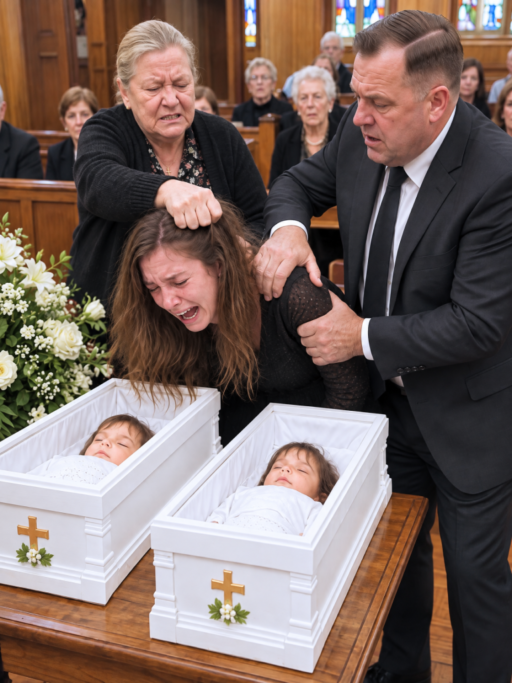
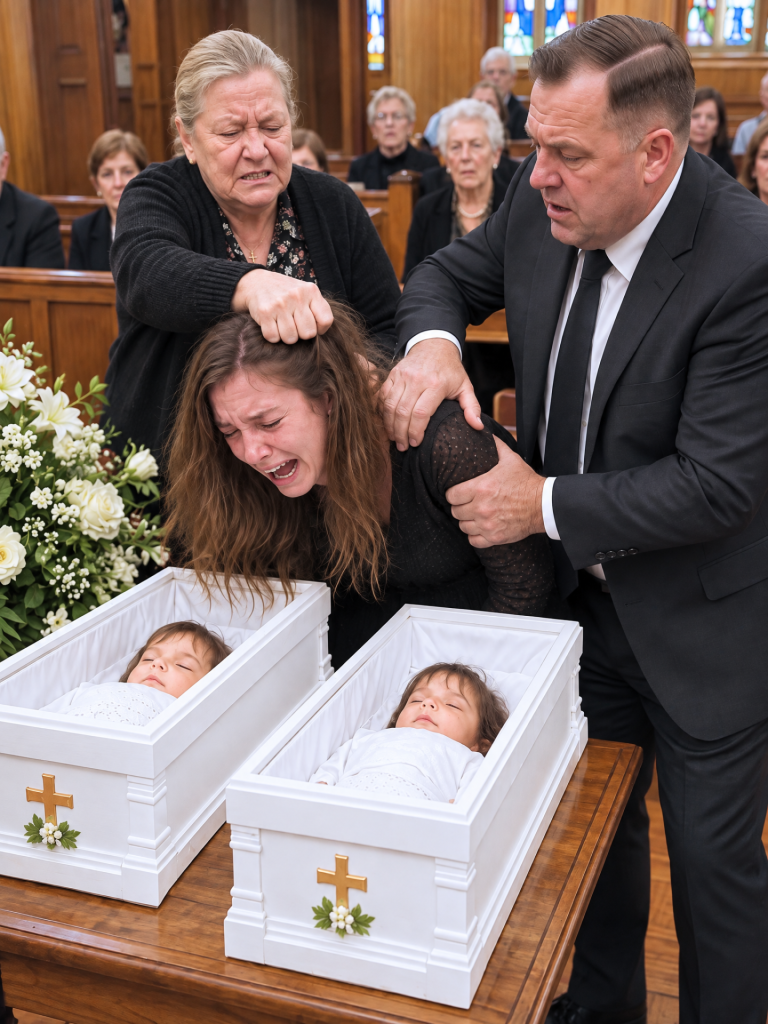
In the picture, I stood beside two white coffins with a red mark on my forehead. Emma had drawn herself next to the pastor, her mouth open in a huge circle.
“I told,” she said quietly.
“You did,” I answered.
“Was Grandma mad?”
“Yes, sweetheart. But being angry never makes it wrong to tell the truth.”
She considered that for a moment, then placed the drawing in my lap. I wanted to tell her she was brave, but the words caught in my throat.
No four-year-old should need bravery just to be heard.
Trevor started therapy too. He moved into an apartment across town after I told him Emma and I needed space, and he did not argue.
One evening, he asked whether I thought our marriage could survive.
“I don’t know,” I said.
He nodded, his eyes filling. “I should have protected you.”
“You should have believed me before there was a crime scene.”
He looked down. “I thought ignoring her kept the peace.”
“It kept you comfortable,” I said. “It left Emma and me alone with her.”
A month later, the medical examiner confirmed that the substance found in the bottle was consistent with the twins’ deaths. Miriam was formally charged, and the police added assault charges for what she did to me at the funeral.
When officers brought her from the courthouse, she looked straight at Trevor.
“I did it for you,” she called. “They were destroying your life.”
Trevor stopped walking.
For years, he had defended her with excuses. This time, he did not speak. He simply turned away.
Then Detective Alvarez approached me with another update. The person behind the online comment had been identified.
It was Miriam’s younger sister.
And she said she had spent thirty years waiting for someone to ask her what she knew.
Miriam’s younger sister, Elaine, arrived at the police station carrying a cardboard box sealed with yellowed tape. She was seventy-two, neatly dressed, and so frightened that she kept both hands wrapped around her purse.
“I should have spoken years ago,” she told Detective Alvarez. “I was afraid of what she would do to me.”
Inside the box were old letters, a diary, and photographs from family visits Miriam had hosted decades earlier. There were notes about babies who became “too sleepy,” arguments over doctors, and one letter Miriam had written after the death of a nephew.
The letter did not confess to a crime. But it revealed how she thought.
Some children ruin families before they are old enough to understand it, Miriam had written. Sometimes someone has to restore order.
Elaine explained that Miriam had always treated children as extensions of the adults who raised them. If a baby created stress, demanded attention, or changed her son’s routine, Miriam saw the child as a problem to be managed.
“She never said she wanted anyone hurt,” Elaine said. “She said she wanted them quiet. She said exhausted mothers made bad decisions.”
The prosecutor did not build the case on old suspicions alone. The strongest evidence remained the laboratory findings, the prepared bottles, Miriam’s statements at the funeral, and Emma’s protected interview.
But Elaine’s records showed that Miriam’s behavior had never been an isolated moment of grief or confusion. It was part of a pattern of control that had gone unchallenged for far too long.
When the trial began, I sat in the courtroom beside my attorney while Trevor sat several rows behind us. He had been granted supervised visits with Emma, but he no longer expected me to make things easy for him.
Emma did not have to face Miriam in person. Her interview was played from a separate room, and the courtroom became completely still as her small voice described the kitchen.
“She said it was our secret,” Emma said. “She said Dad would be happy.”
Miriam watched the screen without moving.
Then the prosecutor played the recording from the funeral. Everyone heard her shout that the twins had been “ruining everything,” and everyone heard her tell Trevor that she had “freed” him.