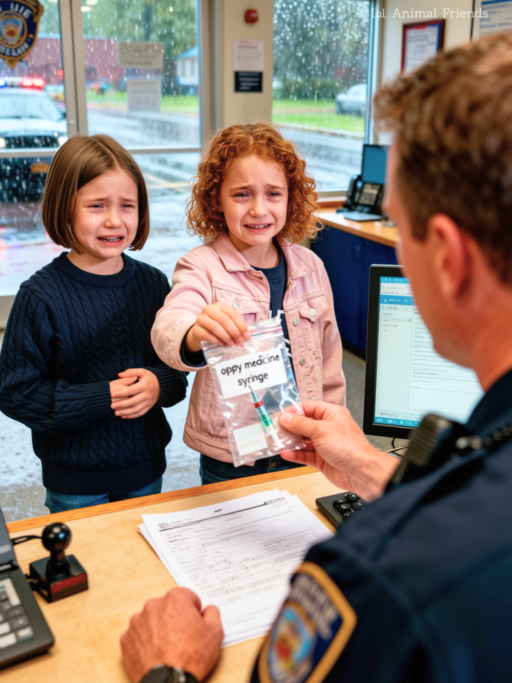
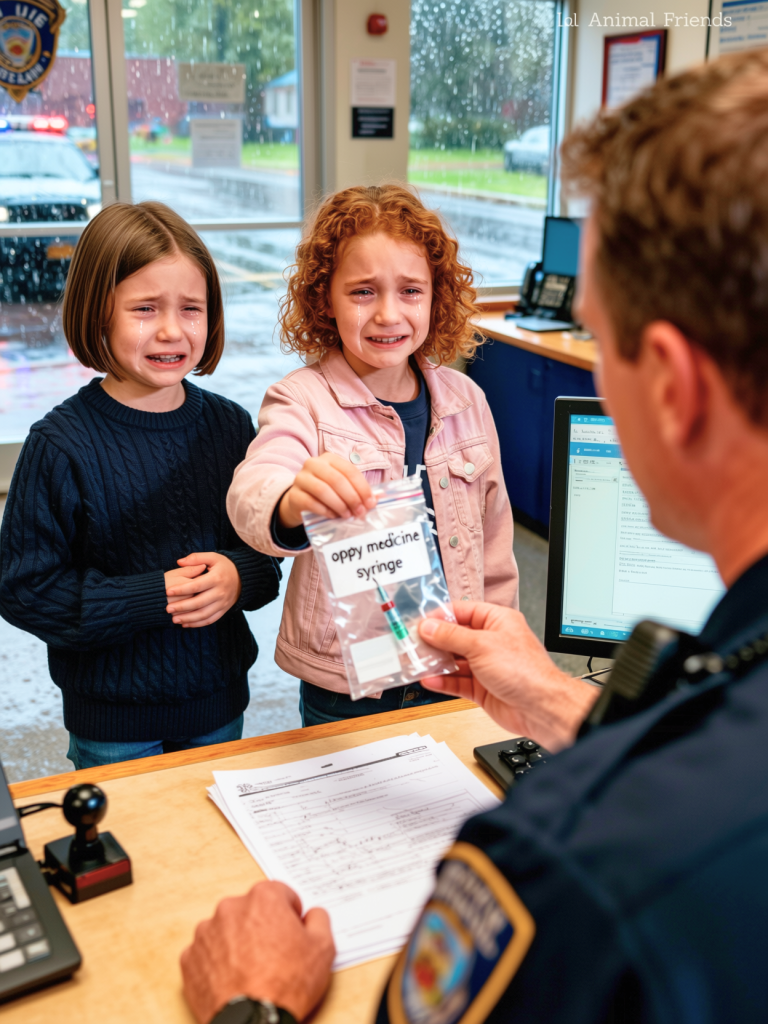

He tried to push the bag through the open vehicle window, but the second officer stopped him before he could. There was no chase and no dramatic struggle—only a backpack placed carefully on the station counter while Michael stood nearby, breathing hard.
Daniel wore gloves before opening it.
Inside the front pocket was another empty oral syringe wrapped in a paper towel. The paper towel also contained half of a torn pharmacy label.
The patient name had been ripped away.
But the transaction number remained.
Daniel matched the digits to the record on his desk. The medication had been authorized under Michael’s prescribing credential—but it was not listed for either twin.
It was linked to an adult patient file.
Michael’s explanation changed immediately. First, he blamed a pharmacy packaging error. Then he claimed he had used a harmless household dose.
Finally, he said Olivia was dramatic and Emma copied everything her sister did.
Each version created another question.
Why was the label torn? Why had Emma hidden the syringe? Why did Michael report the girls missing only after they had fled the house?
At the hospital, clinicians monitored Olivia and worked to identify what she had been given. Daniel made sure neither girl had to repeat the story to every new adult who entered the room.
A trained child interviewer spoke with them separately.
Emma described the kitchen, the syringe, and her father warning them that good girls did not make fathers angry.
Olivia described turning away. She said she did not want to take the liquid.
Their words were not identical, but the central facts matched: the unknown medication, the pressure, the warning to remain silent, and the syringes.
Then Daniel received the pharmacy’s security footage.
It showed Michael collecting the package alone.
And the timestamp proved he had made his missing-child report only after the twins escaped.
The pharmacy footage gave investigators a timeline Michael Carter could not rewrite.
It showed him collecting the medication alone at 3:41 that afternoon. The station camera showed Emma and Olivia entering the police department at 4:12. His missing-child report was filed at 4:19.
He had not called for help when the girls left.
He had called only after they were already somewhere safe.
At the hospital, Olivia was monitored overnight. The clinicians confirmed that the liquid had come from a prescription medication not intended for her, and the medical team documented her stomach pain, drowsiness, and condition when she arrived.
No one needed to turn her suffering into a spectacle. The facts were serious enough.
The syringe Emma hid, the torn pharmacy label, the backpack, and the records all pointed in the same direction. Most importantly, her first statement had been made before Officer Reed knew Michael’s name was connected to the prescription.
That timing mattered.
Michael tried changing his explanation again. He told detectives he had confused the syringes, then said Olivia had asked for the medicine, then claimed Emma invented the story because he had disciplined them.
The problem was that each version contradicted a record someone else had already preserved.
Daniel watched the interview from behind the observation window. Michael spoke with the confidence of someone who believed a polished explanation could overpower the truth.
But confidence was not evidence.
The court issued an emergency no-contact order that evening. Emma and Olivia were placed together in a child-safe temporary home while child-protection investigators reviewed every part of their father’s history.
When Emma heard they would not have to go back that night, she did not celebrate.
She only asked, “What about tomorrow?”
The caseworker knelt in front of both girls.
“Not tomorrow either.”
Olivia reached for her sister’s hand. “What if he gets mad?”
“Adults are responsible for handling their own anger,” the caseworker told her. “You are never responsible for making someone safe.”
For weeks, the girls attended therapy and medical follow-ups. Emma kept checking the doors and asking whether anyone could see through the windows.
Olivia did not want to take medicine, even when a doctor offered something ordinary for a headache. Every adult around her learned to slow down, explain, and ask permission.
Michael was charged based on the medication evidence, his shifting statements, and the children’s recorded interviews. The prosecutor did not rely on the twins to repeat their story in a courtroom filled with strangers.
Their early statements were protected. The evidence formed around their words.
Daniel testified about the afternoon they arrived at the station. He described Emma removing her shoe, lifting the insole, and placing the syringe in his hand.
Then the prosecutor asked what she said after giving it to him.
Daniel looked toward the jury.
“She asked whether they were in trouble.”
The courtroom went silent.
That question explained more than any argument Michael’s attorney could make. The twins had been taught to believe asking for help was something they might be punished for.
Months later, the court made the no-contact order permanent and approved a long-term placement that kept the sisters together.
On the day they were told, Emma looked at Olivia and whispered, “We don’t have to hide anything anymore.”
Olivia nodded.
For the first time since walking into the police station, she smiled.
Michael’s trial began six months after the twins entered the police station.
By then, Emma and Olivia had settled into a foster home with a woman named Mariah Bennett, a retired school counselor who had agreed to take both girls because separating them was never an option.
Mariah did not expect them to be grateful. She did not demand hugs, force cheerful conversations, or call their fears “silly.”
She simply made the same promises every day.
“You can ask questions. You can say no. And you can always tell me if something feels wrong.”
At first, Olivia could not take even a children’s vitamin without crying. Mariah would sit beside her with a glass of water and explain exactly what it was, why it had been recommended, and that Olivia could refuse.
Slowly, those moments became less frightening.
Emma struggled in another way. She watched doors, checked windows, and always wanted to know where Olivia was.
One night, Mariah found her awake in the hallway.
“Are you afraid?” Mariah asked.
Emma shook her head, then whispered, “I’m making sure she’s still here.”
Mariah sat beside her. “You do not have to protect everyone alone anymore.”
At court, the prosecutor built the case carefully. The twins did not have to sit in front of their father and repeat every detail for strangers.