
“Nothing about what he did. It only changes what this says about you.”
Her words stayed with me long after she stopped speaking. Daniel’s betrayal did not make my love foolish; it only proved that he had accepted my sacrifice while deliberately hiding the truth.
For the first time since discovering the affair, I understood something clearly. I had made my decision based on love, while Daniel had made his based on deception.
Daniel tried calling my hospital room that night, but I ignored every attempt. By the next morning, he finally sent a message asking to talk before we were discharged, and I answered with the first decision that truly belonged only to me.
“You’re not recovering at home.”
His response came almost immediately, full of disbelief and irritation. Daniel seemed genuinely shocked that I would make a decision about our house without consulting him after he had spent six months making decisions about our marriage without consulting me.
“What? Why? Seriously?”
Later that day, with permission from the medical staff, he came to my room himself. He looked pale, exhausted, and angry, but beneath all of that I could also see fear.
“The transplant team said I’m going to need help.”
“Then call the person you chose while I was lying in the next room.”
“Jessica isn’t answering.”
“That sounds difficult.”
Daniel stared at me as if I had become a stranger overnight. The truth was that I was beginning to feel like one too, because for the first time in years, I was no longer automatically organizing my choices around what would make his life easier.
“I can decide who recovers in my house.”
“Our house.”
I looked directly at him.
“Your brother said you can stay with him.”
His expression changed.
“You called Eric?”
“Mom did.”
“This is humiliating.”
I felt something inside me harden, not into cruelty, but into clarity.
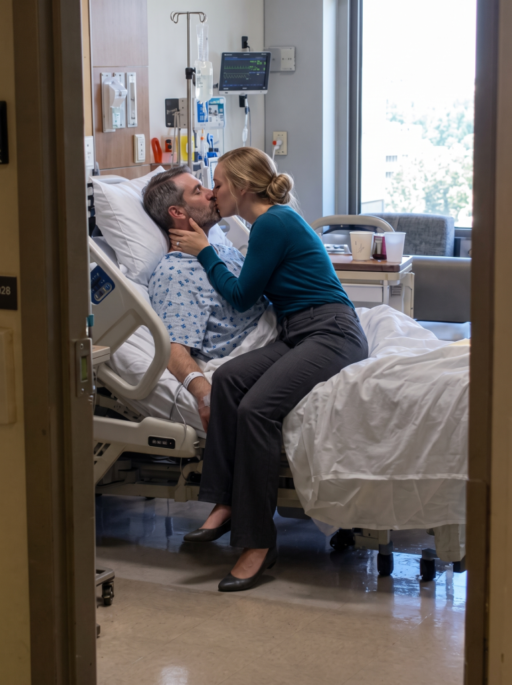
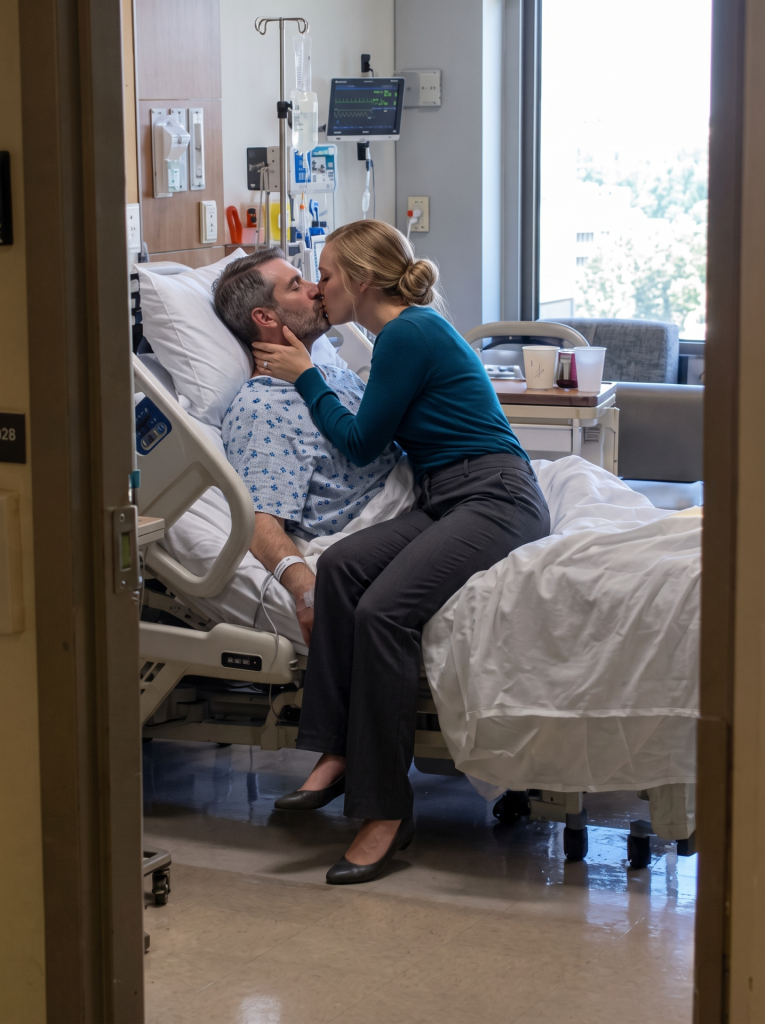
“Humiliating is waking up after surgery and finding your mistress kissing you while my kidney is keeping you alive.”
Daniel flinched and looked away. He tried to reduce everything to one mistake, but I refused to let him hide months of planning behind a single careless word.
“I messed up.”
“You planned this.”
“I was scared.”
“So was I.”
He had nothing left to say after that. Eventually, Daniel recovered at his brother Eric’s house, while I returned home with my mother helping me manage meals, medications, school runs, and all the ordinary tasks my body was not ready to handle yet.
The children learned the truth gradually because I refused to dump adult betrayal onto them all at once. Emma cried when she understood that Daniel had been seeing someone else, while Noah asked the question I had been dreading.
“Does Dad love us?”
I took my time before answering because I did not want my anger to become their answer.
“I think he does.”
Noah looked at me carefully.
“But?”
“Loving someone doesn’t make every choice you make loving.”
After that, I stopped managing the children’s relationship with their father. Daniel called every day, and sometimes they answered while other times they let the phone ring until it stopped.
I never told them what to feel or how quickly they should forgive him. Daniel had made adult choices, and I believed he needed to live with whatever those choices did to the people who loved him.
Months later, mediation put Daniel and me in the same conference room. He looked healthier by then, and I hated that part of me still noticed because his recovery was living proof that the sacrifice I made had worked.
After our lawyers stepped outside, Daniel asked the question I had known would eventually come.
“Do you wish you’d never volunteered?”
I knew exactly what he meant, but I did not need time to decide.
“No.”
He looked surprised.
“No?”
“I made that choice for the father of my children and for the husband I believed I had.”
His eyes dropped toward the table.
“I won’t rewrite who I was just because you rewrote what our marriage was.”
Daniel whispered that he was sorry, and for the first time, I realized I did not have to decide immediately whether forgiveness would ever follow. That choice belonged to me now, just like everything else I was finally learning to reclaim.
A few weeks after mediation, I opened the cedar keepsake box again. For fifteen years, I had filled it with wedding letters, anniversary cards, photographs, notes, and all the small pieces of paper I once believed proved that my marriage was safe.
This time, they looked different. They were no longer evidence of who Daniel really was, only evidence of what I had believed when he gave them to me.
I removed his letters and cards one by one. I did not burn them or tear them apart because I no longer needed a dramatic ending to prove I was done treating his words as something sacred.
Some things still belonged to the children. Emma’s crooked Father’s Day drawing was hers, and Noah’s card showing Daniel as a superhero belonged to him, so I returned those keepsakes without attaching my anger to them.
The rest I packed away separately. I was finally learning that Daniel’s betrayal did not give me the right to rewrite the parts of their childhood that had once made them happy.
By then, Daniel and I were moving steadily toward divorce. His health had improved significantly, and although part of me still felt a strange ache whenever I remembered that my kidney was helping keep him alive, I no longer confused that fact with an obligation to remain his wife.
I had saved his life because I loved the man I believed he was. That choice had been mine, and refusing to regret it was another way of refusing to let his dishonesty define me.
Jessica never returned to Daniel. I heard through mutual acquaintances that she had ended the relationship completely after realizing how carefully he had manipulated both of us, but I never contacted her again.
I did not hate her the way I thought I would. What she had done had hurt me deeply, but once I understood how much Daniel had lied to her too, my anger became more complicated than simple blame.
The children continued deciding for themselves how much contact they wanted with their father. Emma remained guarded, while Noah slowly began answering more of Daniel’s calls, and I kept reminding myself that their relationship with him did not need to mirror mine.
One evening, Noah asked whether I would ever forgive Daniel. I told him the truth because I no longer wanted our family to survive on carefully edited versions of difficult things.
“I don’t know yet.”
He nodded.
“Is that okay?”
“Yes. Some answers take longer than others.”
That was something I had finally learned. Healing did not require immediate forgiveness, and moving forward did not require pretending that what happened had somehow become acceptable.
When I finished sorting the cedar box, I carried it downstairs and placed it on an empty shelf. For the first time since our wedding, there was almost nothing inside.
Years earlier, that emptiness would have terrified me because I had treated the box as proof that my life was secure. Now I understood that empty did not mean ruined.
It meant there was room.
Room for a life I had never planned, for decisions that no longer revolved around Daniel, and for a version of myself I had neglected while trying to hold our family together.
Giving Daniel part of my body had saved his life. But surviving what came afterward taught me something even more important.
Saving someone else did not mean I had to sacrifice the rest of mine.