
The night my father finally came looking for me, he ordered a four-hundred-dollar dinner, watched me work until my feet ached, and disappeared without paying.
At the time, I did not know who he was.
My name is Emily Carter. I was twenty-four, halfway through nursing school, and working five nights a week at an expensive restaurant in downtown Boston. Every dollar I earned went toward rent, tuition, groceries, and caring for my sixteen-year-old sister, Chloe.
Our mother had died four years earlier. No relatives offered to help, and the father we had never met did not appear at her funeral. Since then, I had been the only person standing between Chloe and the foster-care system.
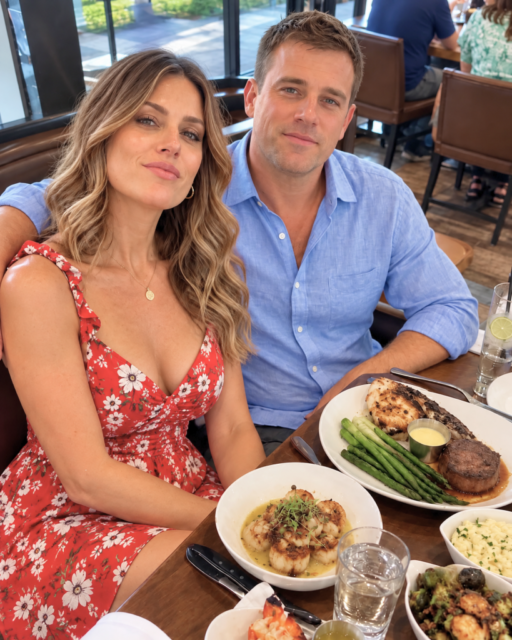
The couple arrived shortly after eight on a rainy Thursday evening. The man was in his early fifties, with silver at his temples and a tailored suit. His wife, Victoria, wore a diamond bracelet and studied me with an expression that made me uncomfortable.
They ordered oysters, steaks, lobster risotto, cocktails, and an expensive bottle of wine. Their bill eventually reached $417.
Throughout dinner, I repeatedly caught the man staring at me. When I placed their entrées on the table, he noticed the silver locket around my neck.
“Where did you get that?” he asked.
“It belonged to my mother.”
“What was her name?”
“Laura.”
His face changed. Victoria immediately reached beneath the table and touched his hand.
Before leaving, the man asked whether I had any family in Boston.
“Only my younger sister.”
“No father?”
I stopped writing on my order pad. “Would you like anything else, sir?”
He lowered his eyes. “Just the check.”
I left the bill on their table and went to serve another group. Five minutes later, their booth was empty.
They had disappeared without paying.
My manager, Julian, refused to check the cameras or call the number attached to their reservation. Instead, he blamed me for allowing them to leave.
“It was your table,” he said. “The loss is your responsibility.”
I could either pay the bill or risk losing my job. Julian knew I could not afford to walk away, so I handed him four hundred dollars—almost all the tips I had earned that week.
The following morning, he called and ordered me to return immediately.
When I arrived, Julian was standing beside the couple’s booth with a thick leather folder. The cleaning crew had found it wedged between the seat and the wall.
“I opened it to find their contact information,” he said. “But your name is inside.”
The first page contained an old photograph of my mother standing beside the man from Table Twelve. Behind it was my birth certificate and the result of a private DNA investigation.
Richard Whitmore: 99.98 percent probability of biological paternity.
The man who had aba:nd0ned the bill was my father.
More photographs showed Chloe and me outside our apartment, school, and workplace. Someone had been following us for months.
Then I found a medical compatibility report bearing my name. Across the bottom, someone had written:
Emily is the strongest potential match. Do not reveal the truth until she agrees to further testing.
The restaurant door opened behind me.
Richard entered with Victoria beside him.
“I can explain,” he said.
I held up the report. “You came here because I’m your daughter?”
Richard looked away.
“No,” Victoria answered. “We came because our son is dying—and you may be the only person who can save him.”
For several seconds, I could only stare at Victoria. She spoke about her dying son as if that explained why they had followed Chloe and me, secretly collected my medical information, and walked out without paying for their dinner.
Richard stepped closer. “Nathan is fourteen. He has a rare kidney condition, and no one in our immediate family is a suitable match.”
“Your immediate family?” I repeated. “What exactly does that make me?”
His expression tightened. “Emily, I know you’re angry.”
“You knew about me for twenty-four years. You knew Mom was raising us alone, yet you never called, never sent money, and never came to her funeral. Now your son needs something from me, and suddenly you remember I exist.”
Richard placed a check on the table. The amount written across it was $250,000.
He explained that the money would cover my tuition, clear our debts, and provide Chloe with everything she needed. In return, I would undergo testing and, if compatible, donate a kidney to Nathan.
“This is not payment for an organ,” Victoria said quickly. “It is compensation for your time and hardship.”
“No,” I replied. “It’s the price you put on my silence.”
Richard’s face went pale. He admitted that no one in his business or social circle knew about my mother or the two daughters he had abandoned. A public scandal could damage his company, his marriage, and the charitable foundation carrying the Whitmore name.
Then I understood the condition hidden behind his offer. I was expected to help Nathan quietly, accept the money, and disappear again.
Before I could respond, Chloe’s voice came from the restaurant entrance.
“She already knows about the agreement.”
I turned and found my sister standing near the locked doors. Her face was tear-streaked, and she held several folded pages in one hand.
“Why aren’t you at school?” I asked.
“Because Mr. Whitmore contacted me three weeks ago.”
The room seemed to tilt beneath me. Chloe admitted that Richard had found her first. He had told her Nathan was sick and promised to pay for her college education if she convinced me to cooperate.
“I didn’t know he was our father at first,” she whispered. “He only said he was someone who knew Mom.”
Richard tried to interrupt, but Chloe pulled away when he approached.