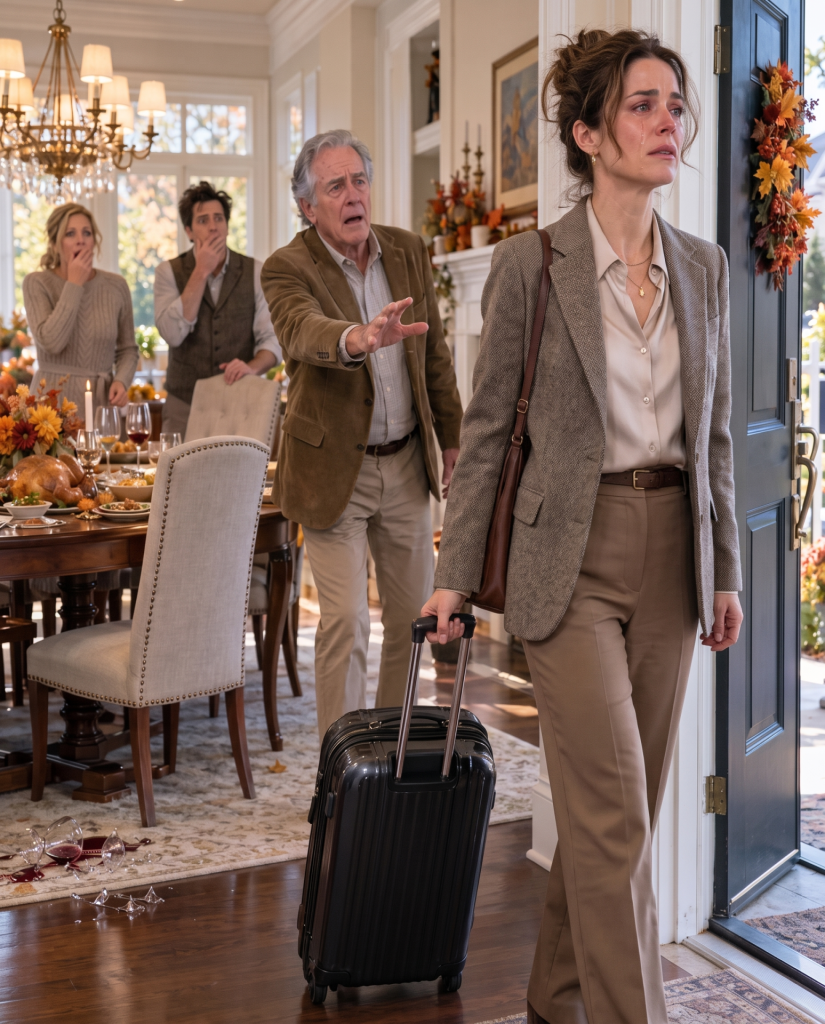

Dad came to my apartment that evening.
He looked older than he had at Thanksgiving, but his first words were not an apology. He stood inside my small living room staring at the boxes stacked against the wall.
“You should have warned us.”
“I asked if you meant what you said.”
He looked away.
“That was anger.”
“No. That was honesty.”
Dad sat on the edge of the chair and rubbed his hands together. Without the big dining room, the familiar fireplace, and the family audience around him, he suddenly seemed much less certain of himself.
“Where are we supposed to go?”
“You have five weeks before closing. The realtor gave you the same timeline she gave me.”
Panic crossed his face because he had apparently expected me to solve that problem too. Jason had nowhere suitable for them to stay, and Diane’s sister had already refused to take them in.
Then Dad said the one thing he knew could still reach inside me.
“Your mother would be ashamed of you.”
I stared at him.
My mother had been dead for twelve years.
I opened the box expecting old tax papers or family records that had simply been forgotten. Instead, I found several account statements, a small stack of legal documents, and an envelope with my name written across the front in my mother’s handwriting.
Seeing it made my chest tighten before I even opened it. Twelve years had passed since she died, but I recognized every curve of those letters immediately, and suddenly the box felt far more important than anything Dad had ever admitted.
Emily,
If your father ever makes you feel responsible for keeping this family together, remember that you are my daughter, not their safety net.
I read that sentence three times because it seemed to reach backward through every year I had spent rescuing people. For so long, I had convinced myself that helping Dad, Jason, and Diane was simply what a good daughter did, and whenever something went wrong, I stepped in because refusing made me feel selfish or ungrateful.
Mom’s letter told a completely different story. She wrote that even before she became ill, she had watched Dad rely on me too heavily and worried that after she was gone, he would turn my reliability into an obligation while Jason learned to expect the same treatment.
She had recognized the pattern long before I did. The more I read, the more clearly I saw that the role I had accepted in the family had never been accidental.
You will always be generous, but generosity must remain a choice. The moment they make you feel guilty for saying no, it is no longer love asking something from you.
I sat at the kitchen table with the letter trembling slightly in my hands and realized that the guilt I had carried for years had never come from my mother. It came from the people who had learned to use her memory whenever they needed me to keep giving.
Beneath the letter, I found one final document that changed even more than I expected. Years before she died, Mom had opened a small investment account in my name and arranged for it to pass directly to me without Dad ever knowing it existed.
The balance had grown steadily over time, and that money eventually became part of what allowed me to save the family house when foreclosure threatened five years earlier. The house had not been preserved by Dad’s sacrifice or Jason’s help, but by money my mother had quietly set aside for me and by what I chose to do with it.
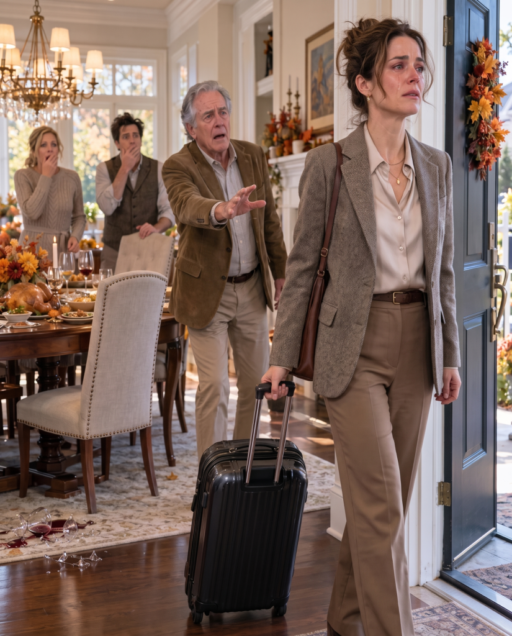
That realization changed the entire meaning of Thanksgiving. Dad had accused me of holding money over the family while living in a house I had rescued partly because Mom had understood that one day they might depend on me too much.
The next morning, Dad returned to my apartment with Diane and Jason. This time, I let all three of them talk without interrupting because I no longer needed to defend myself before they finished saying exactly what they believed.
Jason demanded that I cancel the sale, Diane called me selfish and vindictive, and Dad insisted that family members were supposed to forgive one another. When they finally ran out of accusations, I placed Mom’s letter on the table between us.
Dad recognized the handwriting immediately, and the expression on his face changed before he even touched the page. For the first time since Thanksgiving, he looked less angry than afraid of what he was about to read.
“She knew. She knew exactly what this family would turn me into if I kept rescuing everyone.”
Dad picked up the letter and began reading, and by the time he reached the end of the first paragraph, he slowly sat down. Jason, who always seemed to have another joke or accusation ready, suddenly had nothing to say.
For the first time in years, nobody in that room could use my mother’s memory against me without confronting what she had actually wanted for me. The woman they had invoked to make me feel guilty had left behind the one message that finally gave me permission to stop.
Dad kept staring at Mom’s letter long after everyone else had fallen silent. Diane looked uncomfortable, Jason avoided my eyes, and for the first time since Thanksgiving, nobody tried to tell me what my mother would have wanted.
The letter had taken away the one weapon they had always been able to use against me. They could still call me selfish or dramatic, but they could no longer pretend that sacrificing myself for the family had been Mom’s final wish.
Dad finally looked up.
“Emily, we made mistakes. But you don’t have to sell the house.”
“I already did.”
“You can still stop it.”
“No. I can’t.”
That answer landed harder than I expected. Dad had spent years assuming every boundary I set could eventually be negotiated away if enough guilt, pressure, or family history was applied to it.
This time, there was nothing left to negotiate.
The closing stayed scheduled for December 20. Over the next several weeks, Dad and Diane began searching for an apartment, while Jason discovered that none of the people he had casually assumed would take him in were especially eager to do so.
I did not interfere.
For years, whenever one of them faced a problem, I had immediately started solving it before anyone had to feel uncomfortable. Now I forced myself to let the discomfort remain exactly where it belonged.
Dad called several times during those weeks, sometimes angry and sometimes frightened. Each conversation eventually returned to the same question.
“How could you do this to us?”
I answered the same way every time.
“I didn’t do this to you. I stopped doing everything for you.”
The difference mattered.