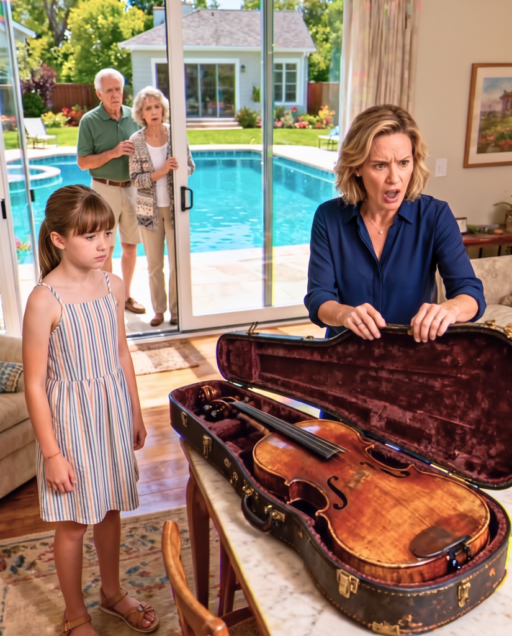
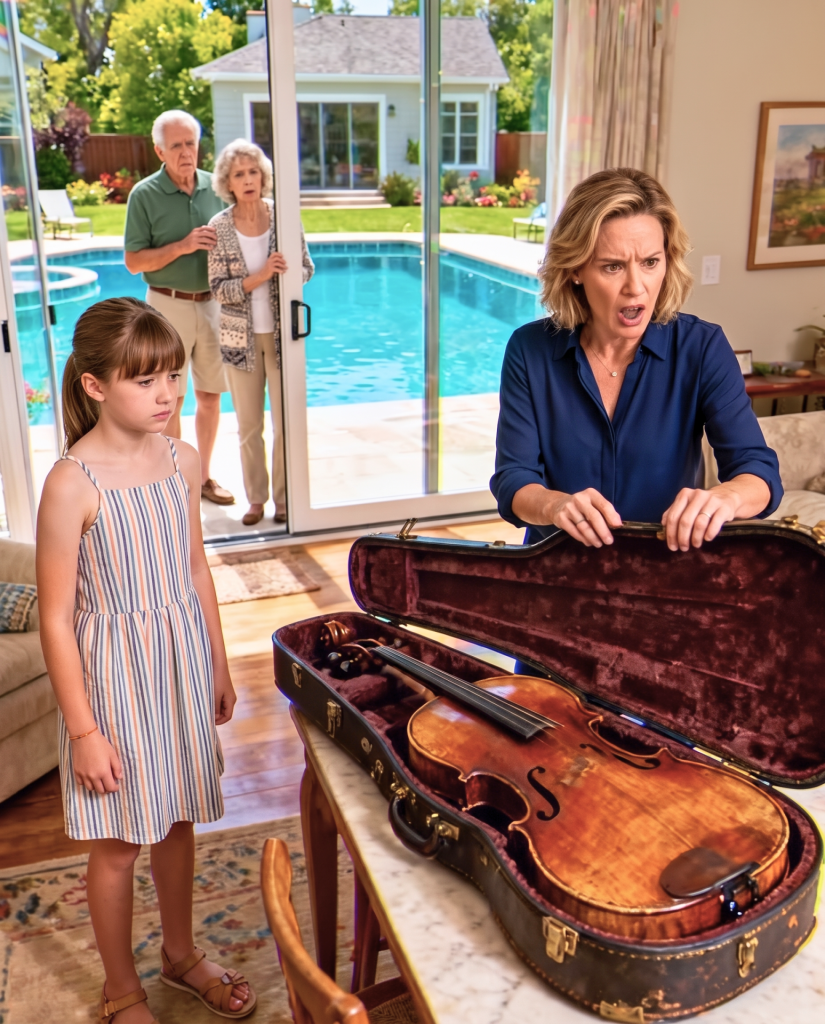

“Where’s Lucy’s cello?” I asked.
My mother looked up from her coffee as though I had interrupted an ordinary morning. Dad sat at the kitchen table with his tablet, and my sister Rachel stood by the counter, drinking something green from an expensive-looking bottle. Through the window, I could see workers digging up the backyard for a pool.
I had come looking for the antique cello my grandmother Margaret had given my eleven-year-old daughter. It always stood in the corner of Grandma’s old music room. Now its stand was empty, and Lucy was beside it, staring at the space where her instrument should have been.
“Your father took care of it,” Mom said.
Dad finally put down his tablet. “We sold it.”
For a moment, I thought I had heard him wrong. Grandma had given the cello to Lucy, who practiced on it every day. My parents knew that.
“It was valuable,” Dad said. “Your grandmother wasn’t playing it anymore.”
“She gave it to Lucy.”
Rachel let out a short laugh. “Lucy’s eleven.”
I asked how much they had received. Neither Dad nor Rachel answered, so Mom told me: eighty-seven thousand dollars.
I looked out at the hole in the backyard. “You used the money for the pool?”
“It’s for the kids,” Rachel said.
“Lucy is a kid.”
Dad told me she could use a student cello instead. He said plenty of children learned on rented instruments, as though Lucy had only lost a piece of equipment we could replace at any music shop.
I went back into the music room. Lucy was touching the empty stand with two fingers. When she saw me, she pulled her hand away.
“Did I do something wrong?” she whispered.
I knelt in front of her and told her she had done nothing wrong. She nodded, but I could see she was still trying to understand why the adults had taken something Grandma had given her.
That evening, her teacher lent us a worn student cello so she could keep practicing. Lucy worked through her music without complaining, though the instrument felt and sounded unfamiliar to her. When she finished, she asked whether Great-Grandma might have changed her mind about the gift.
“No, sweetheart,” I said. But I knew who could tell her that with certainty.
Mom had warned me not to tell Grandma about the sale. The warning had bothered me all day. The next morning, I drove to Grandma’s assisted living community and told her everything: the collector, the price, the pool, and Lucy’s fear that the cello had never truly been hers.
Grandma’s first question was about Lucy. When I told her what Lucy believed, she reached for her phone and made a call. Then she said, “I’m not the one your parents need to worry about.”
Six weeks later, Mom and Dad invited the family over to see the finished pool. Rachel’s children were already swimming when Lucy and I arrived. My daughter stayed close to me, holding her towel and watching them play.
The back gate opened. Grandma came in with Andrew, her lawyer, who carried a narrow folder. Mom’s smile faded, and Dad’s attention went straight to the papers.
Grandma looked at the pool, then at my parents. She took the first page Andrew handed her and placed it in Dad’s hand.
I watched his face as he began to read.
Dad read the page Grandma had handed him without speaking. Andrew placed a second sheet beside it, and I watched Mom reach for Dad’s arm. Around us, the pool party continued in uneasy fragments of conversation, though the people nearest the patio had gone quiet.
Rachel asked what the papers were. Andrew said Grandma had made a record when she gave the cello to Lucy. It described the instrument in detail, including an identifying number that matched the one Dad had supplied to the collector.
Lucy’s name was on the record. So was a date from before the sale.
“She’s a child,” Mom said, looking at Grandma.
“Yes,” Grandma replied. She waited, but Mom had nothing more to say.
Rachel argued that an eleven-year-old could not decide what to do with something worth eighty-seven thousand dollars. Grandma told her Lucy had never been asked to decide whether to sell it. Dad tried to say the paper showed only that Grandma intended to give Lucy the cello someday.
Andrew pointed to the document. Grandma had already transferred the instrument to Lucy, he explained. She had not been holding it for a future gift.
“The cello was not mine when you sold it,” Grandma told Dad. “It belonged to Lucy.”
Dad stared at her. Beside me, Lucy tightened her grip on my hand and asked Grandma if she really meant for the cello to be hers. Grandma turned toward her at once.
“Of course I did, sweetheart.”
Lucy admitted she had thought Grandma might have changed her mind. For the first time since entering the yard, Grandma looked shaken. Mom said no one had told Lucy that directly, and I reminded her of the warning she had given me: I was not supposed to tell Grandma about the sale.
Rachel muttered that we were making too much of it. Grandma glanced at the finished pool behind her and asked whether Rachel considered the money spent on it real. Rachel said yes.
“Then what Lucy lost is real too,” Grandma said.
Andrew took another paper from his folder. This one was a copy of the document Dad had signed for the collector. He asked Dad whether he remembered representing that he had authority to sell the cello.
“I’m Margaret’s son,” Dad replied.
Andrew repeated his question. Dad looked down at his signature. Mom said they had believed Grandma still owned the instrument, but Grandma reminded them they had kept the sale from her. I remembered how plainly she had asked about Lucy when I finally told her.
Rachel claimed she had not known about the paperwork. I told her she had known Grandma gave Lucy the cello. Rachel insisted she had thought Lucy was merely allowed to use it, although she had laughed when I said it belonged to my daughter.
Then Andrew told us he had contacted the collector. He had given him the cello’s identifying information and explained that its ownership was disputed. The number matched, and the collector still had the instrument.