
Then Mr. Lawson appeared in the garage doorway.
“There’s one last thing.”
This time, Dad had not hidden the message in a jacket or written it on a card.
He wanted someone to say it aloud.
Mr. Lawson stood in the garage doorway for a moment before stepping inside. He explained that Dad had saved one final message for us, and unlike everything else, he had not wanted this one hidden inside a jacket, tucked behind a painting, or written on a card.
Dad wanted someone to say it aloud.
Mr. Lawson cleared his throat and told us that our father had understood, especially near the end of his life, how much his difficulty with words had hurt the people he loved. He regretted making Eric and me work so hard to interpret feelings he should have expressed more clearly.
Building things had always been Dad’s language. He knew how to make bridges stand, how to repair a broken cabinet, how to design around weak points, and how to solve practical problems, but he wished he had translated that language into actual words more often.
Then Mr. Lawson delivered the sentence Dad had specifically asked him to remember.
“You were the best thing he ever built.”
Neither Eric nor I responded immediately. For all the letters, hidden compartments, and carefully planned instructions Dad had left behind, those few words were the ones that finally broke through both of us.
Mr. Lawson waited before adding something that made Eric laugh through his tears. Apparently, Dad had made him practice delivering that sentence three separate times because even while dying, our father still had opinions about timing and presentation.
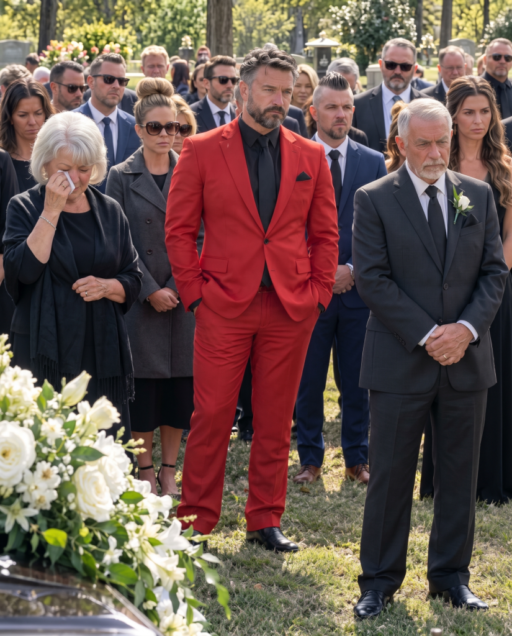
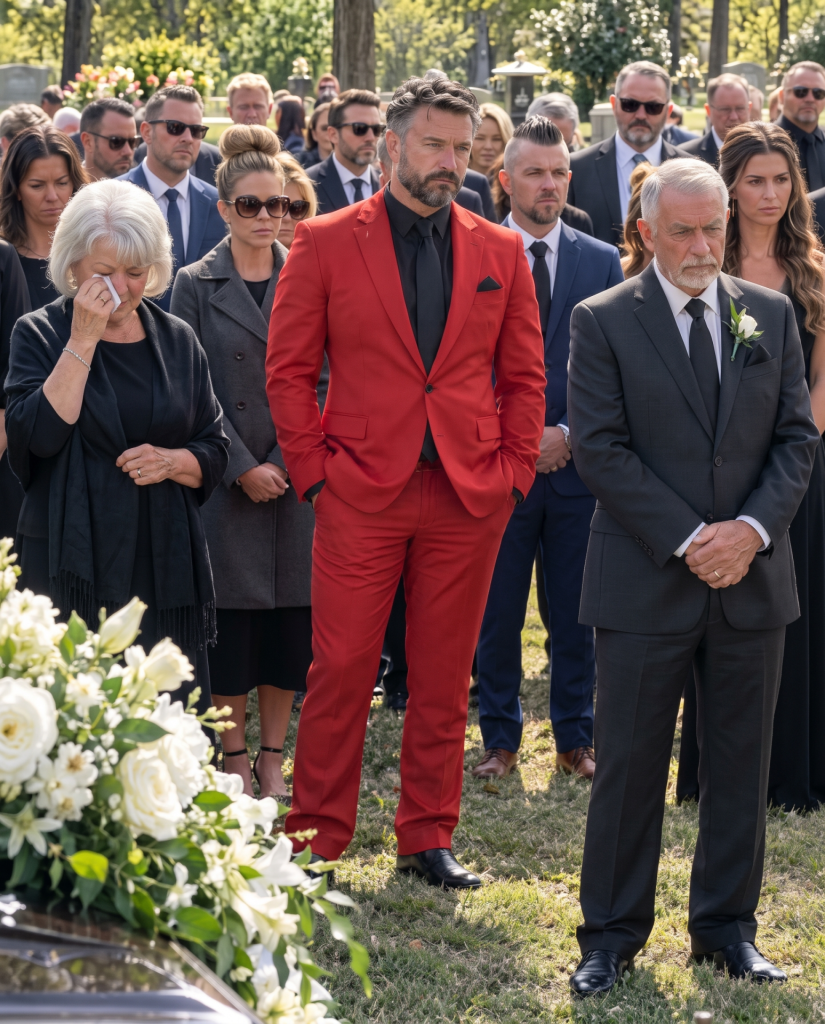
That detail felt so unmistakably like him that the heaviness in the garage briefly lifted. Eric shook his head, and for the first time that day, the red suit looked less like funeral clothing and more like something Dad had deliberately placed into the middle of our grief to remind us who he had always been.
Eric and I stayed at Dad’s house that night. Neither of us wanted to cook, so we ate cereal at the kitchen table, which felt strangely appropriate because cereal had been Dad’s emergency dinner solution whenever we were children and he came home too exhausted to make anything else.
We spent hours talking about the version of Dad no funeral speech could fully capture. We remembered the stubborn man, the unexpectedly funny one, and the father who once quietly repaired something Eric had broken without giving him a lecture because Dad believed the guilt on his son’s face had already taught the lesson.
Eventually, our attention returned to the painting leaning against the wall. Dad had started it after Mom left, when I was eleven and Eric was eight, and he had continued working on it for twenty-five years because he could never get the light exactly right.
Twenty-five years.
Neither of us knew what to say after realizing how long he had carried that image with him.
Eric eventually glanced toward the red jacket draped over a chair.
“He told me I belonged there.”
When he first found the suit, he had no idea a letter was sewn into the lining. The visible note had simply told him the suit was his and instructed him to wear it when the time came.
That meant Dad had deliberately asked Eric to trust him without explaining why. My brother had to choose whether to walk into his father’s funeral wearing something guaranteed to make everyone stare.
Wear red.
Enter the room.
Let people look.
Trust me.
And Eric had done exactly that.
Dad had asked for one final act of trust, and once Eric gave it, Dad returned something much larger in exchange. He gave his son the apology, reassurance, and love he had failed to put into words while he was still alive.
The next morning, Eric prepared to leave. Before he got into his car, we hugged, something neither of us usually did because we had inherited Dad’s habit of showing up rather than saying very much.
That morning, however, we managed both.
Eric took the letter, the key, and the painting with him. He carefully placed the red suit into a garment bag before I asked what he planned to do with it.
“Wear it again.”
“When?”
He thought for a moment.
“Somewhere important. Somewhere I need to remember I’m allowed to walk in like I belong.”
I smiled.
“Dad would like that.”
Eric nodded.
“I know.”
A week after the funeral, I found eight small sketchbooks on a high shelf in Dad’s bedroom. At first I assumed they were filled with engineering notes, but when I opened them, I realized most of the pages had nothing to do with bridges or calculations.
They were filled with us.
There were drawings of Eric laughing when he was eight, of me sitting on the front steps at eleven after Mom left, and of both of us at Christmas over the years. Page after page showed ordinary moments from our childhood and adulthood that I had never realized Dad had been quietly recording.
Inside the first sketchbook, he had written a single sentence.
The things I couldn’t say, I drew.
I sat down on his bedroom floor surrounded by decades of sketches and finally understood something I had spent my entire life trying to interpret. Dad had never been emotionally absent, even when his silence made it feel that way, because he had been watching, remembering, and preserving pieces of us in the only language that came naturally to him.
He had spent his career designing things strong enough to carry weight. Bridges, homes, hidden spaces, paintings, letters, and even that impossible red suit had all been part of the same instinct to build something sturdy enough to hold what words could not.
In the final months of his life, he had created one last structure. It was not made from steel or concrete, but from regret, love, forgiveness, memory, and all the reassurance he had never known how to speak aloud.
And somehow, it worked.
The bridge Dad designed early in his career is still standing today. Last spring, I finally decided to walk across it, and I asked Eric to come with me.
We did not talk much on the way there, which felt appropriate. We were still Dad’s children, and even after everything we had learned, silence remained one of the ways we understood each other.
Eric no longer wore the red suit that day, but I knew he had kept it. He had told me he planned to wear it again whenever he entered a place where he needed to remember that he belonged, and for once, I understood exactly why Dad had chosen something so impossible to ignore.
We walked slowly across the bridge together.
I thought about Dad spending twenty-five years trying to capture the right light in the painting of us. I thought about the hidden closet, the note sewn into Eric’s jacket, the photograph of Dad laughing, and the sketchbooks filled with moments he had never forgotten.
For years, I believed my father’s greatest limitation was that he did not know how to say what he felt. By the end, I realized that was only partly true.
He had been saying it all along.
He said it by showing up.
He said it by remembering.
He said it by building things strong enough to carry the words he could not speak.
Eric and I reached the other side of the bridge and stopped for a moment beneath the afternoon sun. Neither of us said anything because there was nothing left that needed explaining.
The light that afternoon was beautiful.
And somehow, it looked exactly the way it felt.