
I gave birth to my daughter on a gray Thursday afternoon at Hawthorne Military Medical Center, with rain tapping against the hospital window and fluorescent lights humming above me. My husband, Ryan, was nearly a thousand miles away at mandatory military training, and despite repeated requests, his commanding officer refused to release him.
I went through fourteen hours of labor without my mother, my sister, or anyone from my family beside me. A young nurse named Melissa became the closest thing I had to support, staying past the end of her shift to cool my forehead and remind me that I was stronger than I felt.
When my daughter was finally placed against my chest, the loneliness disappeared for a little while. She had dark hair, tiny trembling lips, and one hand curled beneath her chin, and I named her Ava exactly as Ryan and I had planned months earlier.
For those first few minutes, nothing else mattered.
Several hours later, Ava was sleeping in the clear bassinet beside my bed when I finally checked my phone. Messages from people in my unit filled the screen, along with congratulations from my commanding officer and a video from Ryan, whose eyes were red as he told Ava and me how much he loved us.
Then I opened my mother’s message.
“Clara’s kids want new phones for their birthdays. Send me $2,000 tonight before the sale ends.”
That was all she wrote. There was no congratulations, no question about whether Ava was healthy, and no acknowledgment that I had just given birth alone.
My mother, Janet, had spent years turning my older sister Clara’s problems into my financial responsibility. At twenty-three, I used my first deployment bonus to cover Clara’s rent, and after that came car repairs, daycare, groceries, school clothes, medical bills, electricity, Christmas gifts, and one emergency after another.
At first, I believed I was simply helping family. Clara had three children, unstable work, and an unreliable ex-husband, while I had a steady military salary, housing, and health insurance, so Mom constantly reminded me that I was the fortunate daughter.
“You don’t know what real struggle looks like.”
She once said that while I was sleeping in a tent during deployment.
Over time, her requests stopped sounding like requests. She began giving me deadlines, promising my money before I agreed, and using Clara’s children to make every refusal feel cruel.
Ryan had warned me for years that love and obligation were becoming dangerously mixed in my family. Whenever another transfer left our account, he would quietly ask whether Clara ever intended to repay us.
“She’s family.”
“So are you.”
I always defended them.
But lying in that hospital bed with Ava sleeping beside me, Ryan’s words suddenly felt different. Two thousand dollars was no longer just money that disappeared into another family emergency; it was diapers, childcare, savings, and part of the future we were trying to build for our daughter.
For the first time, I saw the pattern clearly.
If I kept saying yes, Ava would grow up watching me surrender money, peace, and boundaries every time someone else demanded them. Eventually, she might believe that was what love was supposed to look like.
I refused to teach her that.
So for the first time in my adult life, I did not answer my mother.
I placed my phone facedown and reached toward Ava’s bassinet. Her tiny fingers wrapped around mine, and I whispered the first promise I would ever make to my daughter.
“This ends with me.”
Two days after Ava was born, I finally returned home. I was still sore and moving carefully, and one of Ryan’s friends from my unit drove us because Ryan remained stuck at training.
Several soldiers had stocked our refrigerator with prepared meals before I arrived. My own mother, however, still had not called to ask whether Ava and I had made it home safely.
Instead, another message appeared.
“Did you see what I sent you?”
I ignored it.
Two hours later, Clara texted me.
“The kids are counting on you. Mom already told them they could choose their phones.”
I stared at the message in disbelief. Mom had promised my money to Clara’s children before I had agreed to anything, creating their expectations first so that if I refused, I would become the person who disappointed them.
Then the guilt started arriving in waves.
“Don’t punish children because you’re stressed.”
“Family shows up for each other.”
“After everything we’ve done for you, this is who you’ve become?”
For six days, I refused to answer. I focused on feeding Ava, changing diapers, recovering physically, and sleeping whenever she allowed me, although every vibration from my phone made my chest tighten.
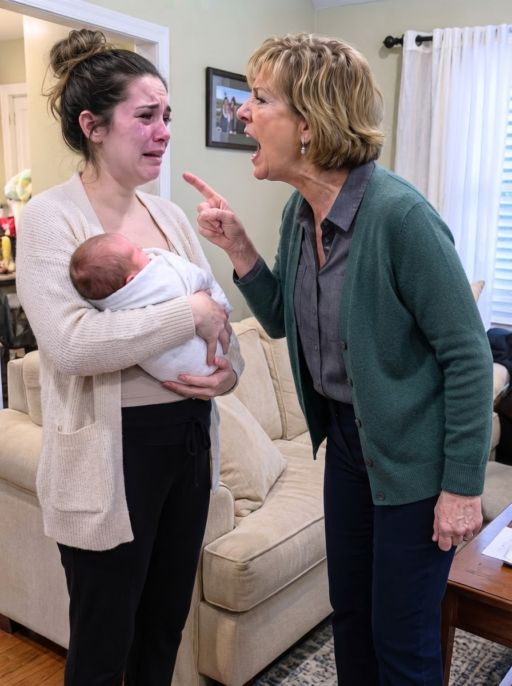
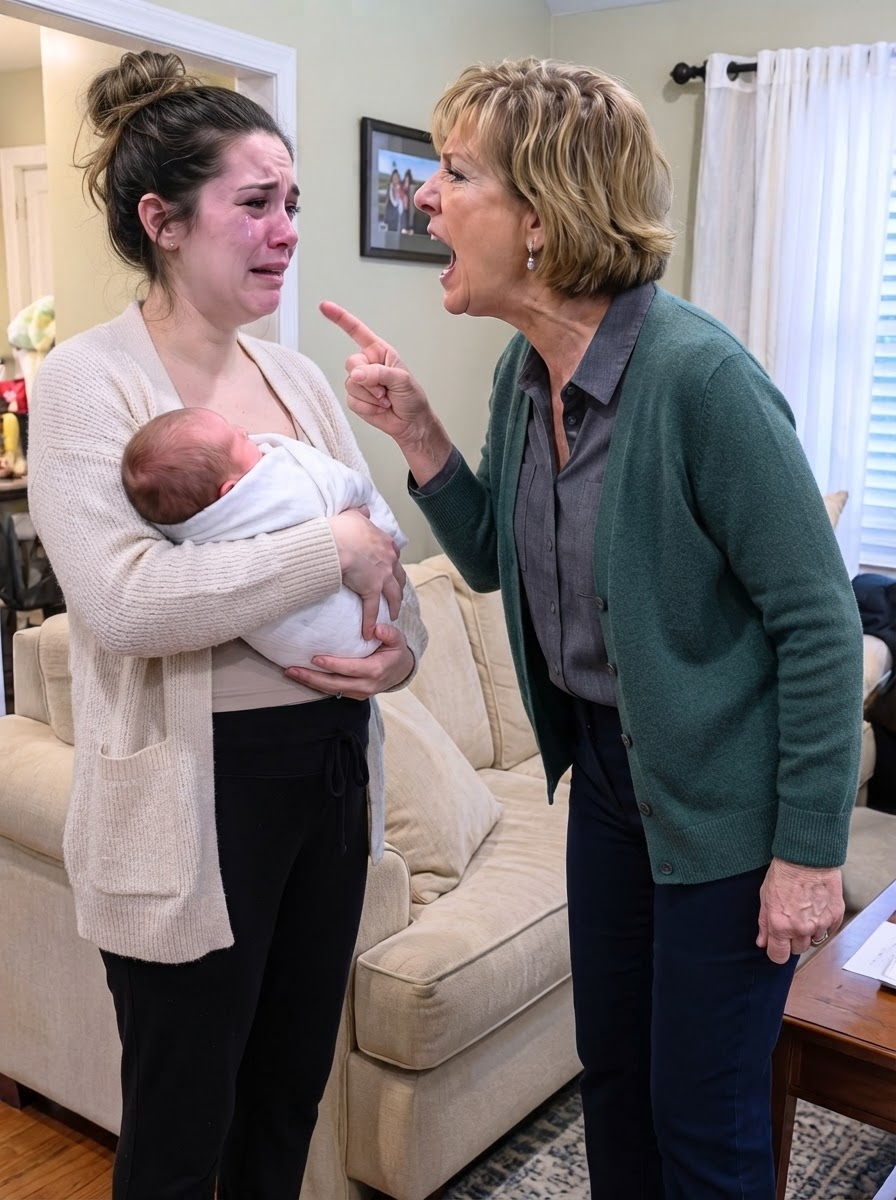
On the seventh morning, Ava had finally fallen asleep after crying for almost an hour. I was sitting in the living room in loose sweatpants and one of Ryan’s old shirts when I heard the front-door lock turning.
My mother walked inside without knocking.
She still had the spare key I had given her three years earlier for emergencies. She entered carrying a large purse and wearing the stern expression she always used when she believed someone had disobeyed her.
“What is wrong with you?”
Her voice woke Ava immediately.
“Lower your voice.”
Mom barely looked at the bassinet.
“Your sister has been humiliated because of you. Those children already picked out their phones.”
“I never agreed to buy them.”
“You didn’t have to agree. You always help.”
Those words hit harder than I expected.
In my mother’s mind, my money had apparently stopped belonging to me years ago.
I carefully lifted Ava into my arms and stood.
“You need to leave.”
Mom laughed.
“Don’t be dramatic.”
“You entered my house without permission, woke my baby, and started shouting. Leave.”
Her face hardened.
“You really think your husband is going to protect you from us?”
“This isn’t about Ryan.”
“It’s always about him. Ever since you married him, you’ve acted like you’re better than your family.”
“Our money is for our daughter.”
“Clara has three children.”
“And they have two parents.”
Mom stared at me for a moment, then turned toward the hallway leading to my bedroom.
“What are you doing?”
“I’m finding your checkbook. You’re exhausted and emotional, so I’ll handle this myself.”
For one second, I thought I had misunderstood her.
Then she kept walking.
Pain pulled through my abdomen as I moved fast enough to block the hallway, with Ava crying against my shoulder.
“Get out of my house.”
“Move.”
“No.”
Before she could push past me, the front door opened again.
Clara walked inside.
She had used the spare key Mom had left in the lock. My sister glanced at Ava, then at me, and finally toward Mom, showing absolutely no surprise that our mother had just announced her intention to search for my checkbook.
“Why are you making this so difficult?”
I looked at both of them standing inside my home.
For years, they had trained me to interpret every violation of my boundaries as another responsibility I owed to family. But with my newborn daughter crying against my chest, I finally understood why they were really there.
They had not come to meet Ava.
They had come because I had stopped giving them money.
I reached for my phone.
Mom immediately noticed.
“Who are you calling?”
“The police.”
Clara gave a nervous laugh.
“You’re not serious.”