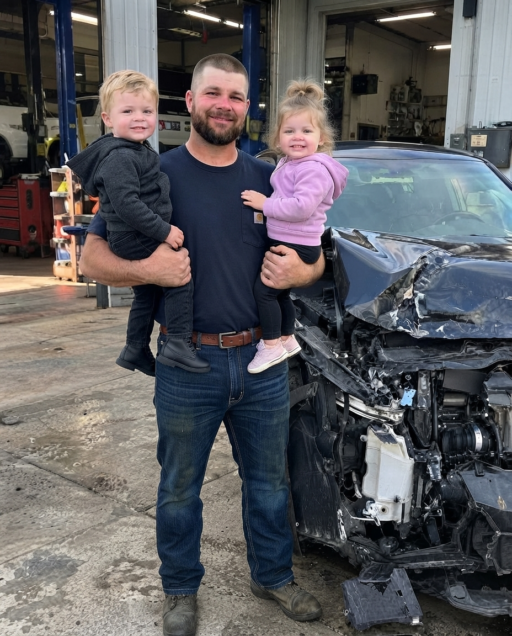
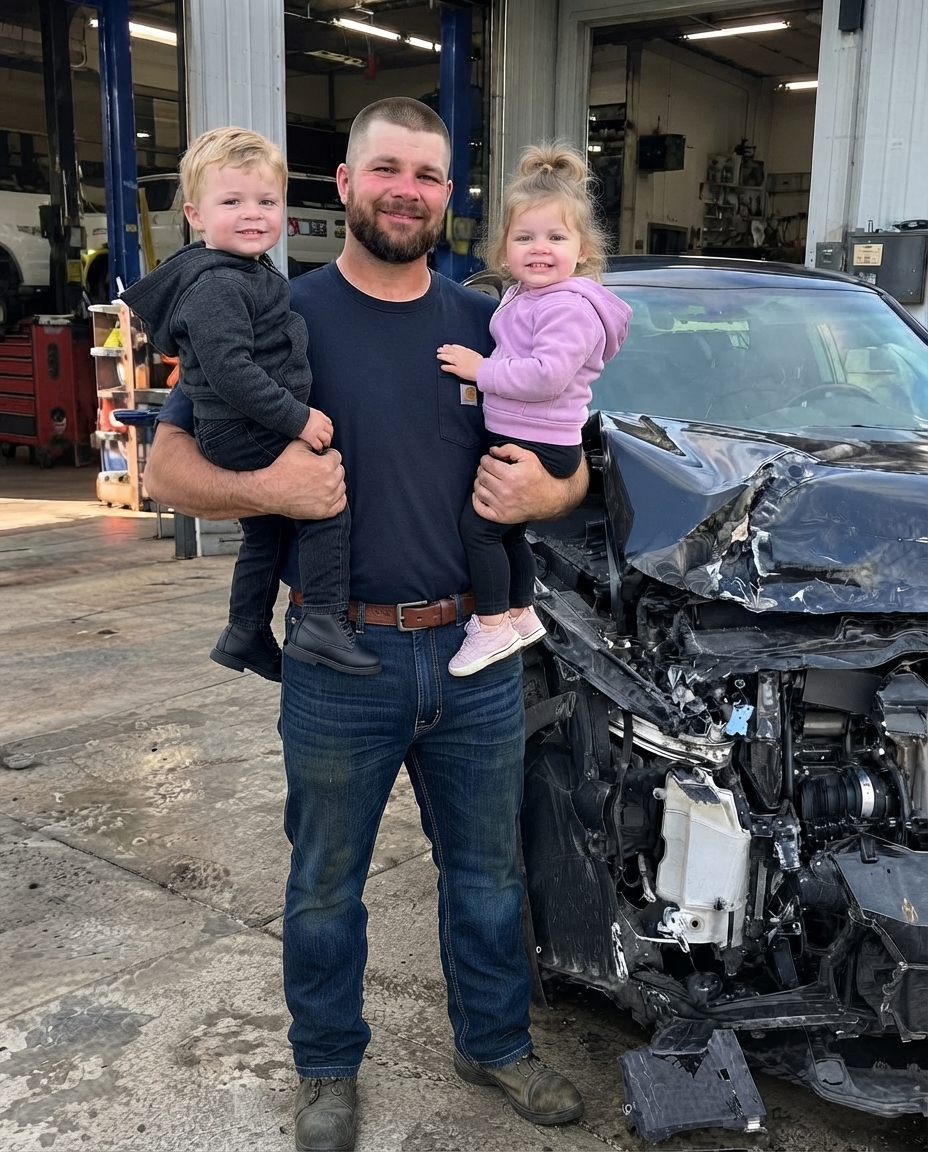

The sign above my garage reads CRAIG’S AUTO REPAIR in uneven red letters, and I have never wanted to replace it. My sons painted it years ago when Rick was seven and Noah was four, leaving behind a smeared C, a tiny red handprint, and the faint outline of a backward P we had painted over together.
My name is Craig, I’m thirty-eight, and cars have been part of my life since I was fourteen. I met Laura at twenty-three when she worked in a coffee shop across from the dealership where I repaired cars, and for eleven years we built a life together that included two boys, Sunday pancakes, lake trips, and a dog named Biscuit.
Laura loved us, but she had grown up poor and spent her childhood dreaming of escaping anything that resembled that life. Our bills were paid and our boys had everything they needed, yet stability never felt like success to her.
“You could open your own shop. Do something bigger.”
“I like fixing cars.”
“That’s not the point.”
I never fully understood her point until Brent Harlow returned to my life. Brent had attended high school with me, but unlike me, he came from money, and by adulthood he controlled his family’s six dealerships, owned a lakefront mansion, and lived the kind of life Laura had always imagined for herself.
I introduced them at a dealership Christmas party.
Eight months later, Laura stood in our kitchen with a suitcase.
“I’m in love with Brent.”
I reminded her that we had two children, but she told me Brent could give Rick and Noah private schools, expensive vacations, and opportunities I never could. Then she looked at me with pity and delivered the sentence I would remember for years.
“You’re going nowhere in life.”
The divorce lasted nearly a year. Laura had Brent’s expensive lawyers and received primary custody, leaving me every other weekend and Wednesday dinners, but six weeks after she moved into Brent’s lake house, I also lost my job at the dealership his family owned.
Instead of disappearing, I used nearly everything I had left to rent an old two-bay garage on Linden Avenue. I repaired the leaking roof myself, fixed the hydraulic lift, bought used tools, and let Rick and Noah paint the plywood sign that still hangs above the entrance.
The first year nearly broke me, but eventually customers discovered that I was the mechanic who wouldn’t recommend a thousand-dollar repair when a twenty-dollar part would solve the problem. By the second year, I had enough work to hire Marcus, a talented nineteen-year-old mechanic, and for the first time the garage began to feel permanent.
Then Laura discovered another use for my custody schedule.
She asked me to collect Brent’s dry cleaning before picking up the boys.
“No.”
“Then maybe the boys should stay home this weekend.”
I collected it.
Later she made me close the garage to take Noah to the dentist because she had a tennis lesson. Soon it became free oil changes, errands, repairs around the lake house, veterinary trips, and money.
Whenever I refused, Laura’s message remained the same.
“It would be a shame if you didn’t see the boys.”
My lawyer warned me that although she couldn’t legally cancel my parenting time without consequences, Brent had enough money to turn every dispute into an exhausting legal battle. So for two years, I swallowed my anger and cooperated.
Then one Saturday morning, a tow truck stopped outside my garage.
Laura climbed out wearing sunglasses and a white tennis skirt.
Behind her sat Brent’s black Mercedes.
Its entire front end had been destroyed.
And Laura wanted me to repair it before Friday.
The Mercedes looked as though it had been through far more than a minor accident. Its hood was crushed, the bumper was missing, one headlight was destroyed, the front wheel was bent, and the windshield was cracked.
“What happened?”
“I hit a deer.”
I had repaired enough deer collisions to know she was lying. When I asked why Brent didn’t simply use one of the body shops at his six dealerships, Laura claimed he didn’t want his employees gossiping about his wife wrecking his Mercedes.
“I need it Friday.”
“I already have customers scheduled.”
“Cancel them.”
When I refused, Laura reminded me that Rick and Noah were supposed to spend the coming weekend with me.
“It would be a shame if they couldn’t.”
I stared at her, realizing she was threatening my time with our children over a car repair. She simply told me not to make her prove she was serious, then left the Mercedes at my shop.
Marcus and I worked on it for six days, sometimes until midnight. I postponed paying customers, lost two jobs, and charged nearly four thousand dollars in replacement parts to the shop credit card.
Then the Mercedes began telling us what Laura wouldn’t.
We discovered silver paint embedded in the damaged bumper and part of an orange reflector lodged behind the radiator beside a bent piece of metal. Whatever Brent’s Mercedes had struck, it certainly hadn’t been a deer.
The worst discovery came when I opened the rear door.
Noah’s blue-and-gray booster seat was still inside, its plastic shell cracked along one side. Underneath it, I found a small green plastic T. rex with one arm chewed off.
Chompy.
Noah had carried that dinosaur everywhere since he was two. Sitting on the garage floor with his broken booster seat beside me and Chompy in my hand, I finally said aloud what I had been afraid to believe.
“The boys were in the car.”
The next morning, I borrowed diagnostic equipment from an old friend who worked in accident reconstruction. The Mercedes contained an event data recorder capable of storing information from the seconds before a serious collision.
The crash had occurred at 1:42 a.m. on Saturday, September 7. The Mercedes had been traveling fifty-eight miles per hour on a road with a thirty-five-mile-per-hour limit, and the brakes had been applied only half a second before impact.
Most importantly, four seatbelts had been buckled.
Two were in the back.
That Wednesday, I took Rick and Noah to our usual diner. When Noah stepped away from the table, I placed Chompy in front of Rick.
His face immediately went pale.
“Where did you find him?”
“In Mom’s car.”
Rick began trembling. I assured him that neither he nor Noah was in trouble and promised that nothing he told me could ever make me stop seeing them.
Then my eight-year-old son told me what had really happened.
There had been a party. Brent had been drinking, but after one in the morning he insisted on driving everyone home despite Laura telling him to stop.
The Mercedes sped down the lake road before leaving the pavement and crashing into a mailbox, then a silver car parked in a driveway. Brent backed away and fled before anyone could come outside.
“Did anyone get hurt?”
Rick told me Noah’s booster seat had broken and his face had struck the door, cutting his lip. Laura later instructed both boys to say Noah had fallen from the swings if anyone asked.
I remembered seeing that injury.
I had believed her.
When Noah returned and saw Chompy, he screamed with happiness, hugging the little dinosaur against his face. Rick watched me carefully.
“Dad, are you mad?”
“Not at you.”
The following morning, I called an old high school friend named Denise Okafor.
She had become a family attorney.