
The upstairs room Mom had assigned to Brittany and her sons became Lily’s playroom instead. Evan and I painted the walls pale green, and he spent an entire weekend building shelves along one side for toys, books, photographs, and all the little things our daughter would accumulate as she grew.
Watching him work made me think about how casually Mom had pointed toward those rooms that first night. She had treated our home like unused space waiting to solve everyone else’s problems, never considering that Evan and I had built our lives there intentionally.
Outside, I planted lavender beneath the front windows. It was a small change, but after months of lawyers, investigators, credit reports, and family arguments, doing something ordinary with my own property felt unexpectedly important.
One warm evening, I sat on the porch with Lily sleeping against my chest while the setting sun turned the windows gold. The driveway where the moving truck had once stood was empty, and the only sounds were insects in the yard and Evan moving quietly inside the house.
Then my phone buzzed.
It was a message from one of my aunts.
“Your mother says she wants another chance someday.”
I read the sentence twice before deleting it. Months earlier, those words would have filled me with anxiety because I would immediately have started wondering what everyone expected me to do, how long I was allowed to remain angry, and whether refusing reconciliation made me a bad daughter.
Now I understood the question differently. Maybe forgiveness would become possible someday, but forgiveness and access were not the same thing, and accepting an apology would never require handing someone another opportunity to violate my boundaries.
Blood didn’t create ownership over my home, my finances, or my decisions. Love didn’t require surrender, and becoming a mother myself had finally taught me how distorted those ideas had become in my own family.
I looked down at Lily and thought about the life I wanted her to have. I never wanted her to believe that saying no to me would make her ungrateful, or that being my daughter meant carrying responsibility for my mistakes.
If she grew up and built a home of her own, I wanted her to know that the front door belonged to her. I wanted her to understand that family should be invited into a life, not entitled to invade it.
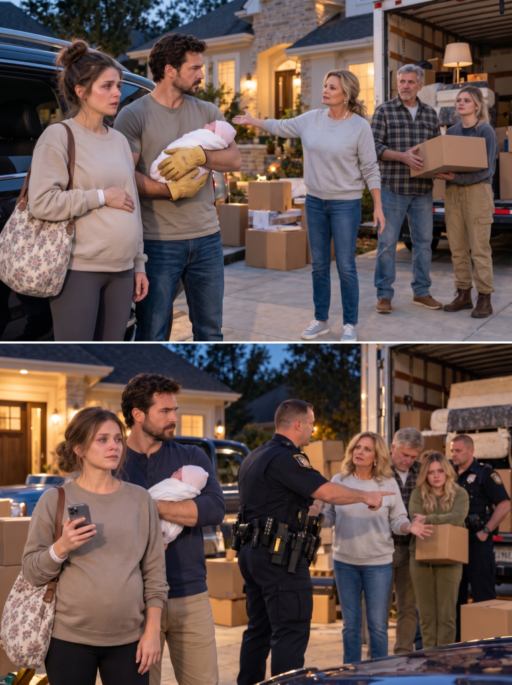
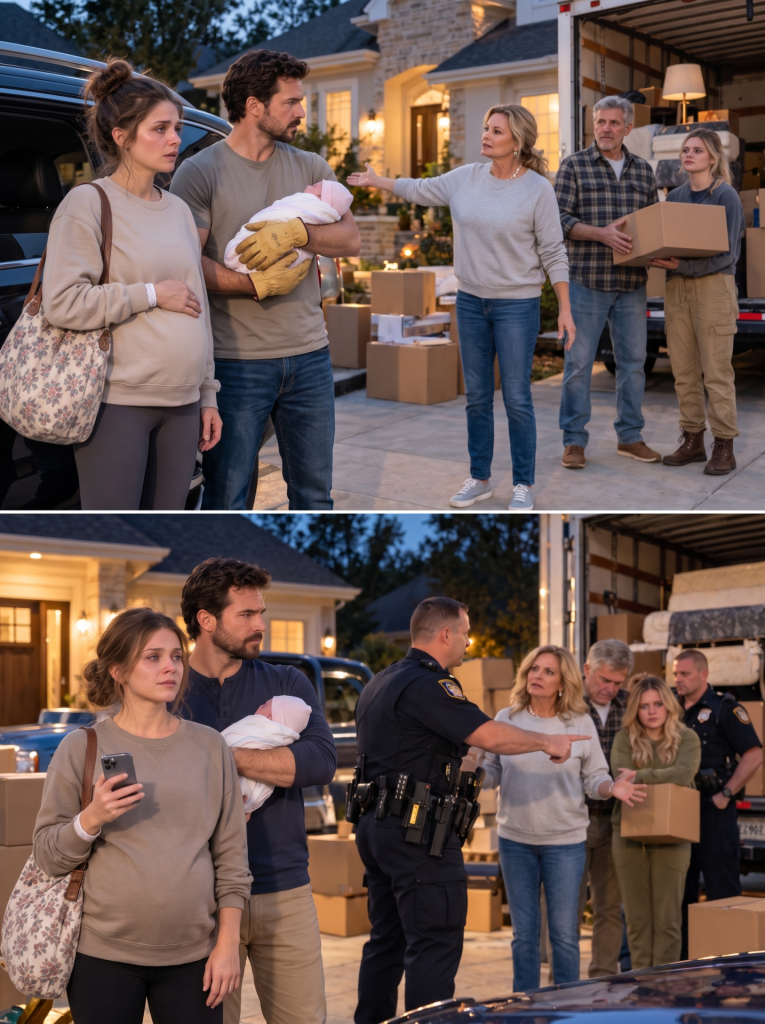
That realization changed the way I remembered the night she came home from the hospital. At first, I had thought the important moment was calling the police, but the real turning point had happened several minutes earlier, when my mother ordered Dale to carry that first box toward the house.
For once, I had told him to put it down and meant it.
I had spent most of my adult life believing that keeping peace required me to absorb whatever chaos my mother created. The night Lily came home, I finally understood that sometimes protecting your family means refusing to preserve peace with the people threatening it.
I kissed my daughter’s forehead and listened to the quiet inside our home.
For the first time in my life, nobody outside the family Evan and I had created could decide they belonged there simply because they wanted to.
And nobody else had a key.
In the months that followed, I began to understand that removing my mother from the driveway had been the easiest part. The harder work was removing the guilt she had spent years planting in me, because even after the legal consequences began, part of me still instinctively wondered whether I had gone too far.
Whenever that doubt surfaced, I returned to the facts. Mom hadn’t simply asked for help and received an angry response; she had forged my signature, redirected mail to my address, copied old house keys, used my identity for financial accounts, and deliberately chosen the night I returned from surgery with a newborn to force her plan into motion.
The difference mattered because my family had spent years teaching me to judge Mom by her intentions while judging me by the consequences of resisting her. If she lied because she needed money, everyone called her desperate, but if I refused because I needed safety, they called me selfish.
Lily changed the way I saw that pattern. Every time I held her, I found myself asking whether I would ever expect my daughter to sacrifice her credit, marriage, home, or peace simply because I had once raised her, and the answer was so obvious that it made my mother’s favorite argument feel almost absurd.
“After everything I’ve done for you.”
For years, those words had sounded like a debt collector knocking at the door. Now they sounded like evidence of a relationship in which love had repeatedly been turned into leverage.
Evan never pressured me to forgive or reconcile. He simply reminded me that our job was to protect the family inside our house, and gradually I stopped treating that responsibility as something I needed to apologize for.
The legal resolution helped because it removed the ambiguity my relatives had relied upon. My mother had accepted restitution, probation, financial-fraud counseling, and restrictions on contacting our home, which meant the situation could no longer honestly be described as an emotional disagreement between a mother and daughter.
Still, occasional messages reached me through extended family. Some said Mom missed me, others said she wanted to meet Lily, and a few suggested that enough time had passed for everyone to “move forward.”
I never responded.
Moving forward didn’t mean returning to the place where the damage started. It meant building something healthier beyond it.
As Lily grew, the house filled with the ordinary evidence of our new life. Toys appeared in the pale-green playroom, tiny clothes accumulated in laundry baskets, and the shelves Evan built slowly filled with books and framed photographs.
The lavender beneath the front windows began to grow too. Whenever I saw it from the porch, I remembered the moving truck that had occupied the same view on Lily’s first night home and how close my mother had come to turning one of the most vulnerable moments of my life into another surrender.
One evening, I stood in Lily’s nursery while Evan rocked her to sleep. Looking around the room my mother had casually assigned to someone else, I realized that protecting this space had never really been about bedrooms or property.
It was about ending an inheritance.
My mother had taught me that family meant unlimited access, that boundaries were insults, and that saying no was something a daughter eventually had to apologize for. I wanted Lily to inherit something entirely different.
Someday she would grow up, make choices I might dislike, and perhaps build a home of her own. When that happened, I wanted her to know that loving me would never require surrendering her independence to me.
That became the real ending to the night of the moving truck. My mother had arrived believing the house belonged to anyone who could claim the word family loudly enough, while I had finally learned that family wasn’t defined by who demanded entrance.
It was defined by who respected the door.
That night, before going to bed, I checked the lock out of habit and looked once more at the empty driveway. Then I slipped my key into my pocket and turned off the porch light.
For most of my life, somebody else had always believed they deserved a key to whatever I had.
My money. My time. My decisions. My home.
That ended the night Lily came home.
The house was quiet, my daughter was safe, and nobody outside the family Evan and I had chosen could enter unless we invited them.
For the first time, that didn’t feel selfish.
It felt like home.