
Still, he began carrying a notebook.
“Just in case.”
Two months after his operation, I finally drove to Marsh Hollow to see Eleanor’s house for myself.
It was smaller than I expected, quiet and carefully maintained despite the garden having grown wild during her illness. Her shelves were crowded with worn mystery novels, and mismatched mugs collected over decades filled the kitchen cabinets.
Then I entered her bedroom.
Inside the bedside drawer was a shoebox.
I opened it and found envelope after envelope, each sealed and addressed in the same careful handwriting.
There was one for every birthday beginning when I turned eighteen.
Across each envelope, Eleanor had written the same words:
Happy Birthday, Wherever You Are.
I sat on the edge of the bed and opened the first letter.
Then the second.
Then the third.
By the fifth, tears blurred the words so badly that I could barely continue reading.
The woman I had never been allowed to know had been quietly watching my life from a distance for years.
As I continued reading Eleanor’s letters, I began discovering how much she had known about me despite never being part of my life. She knew when I graduated from high school, she had seen my wedding announcement, and relatives had quietly passed along small pieces of information about me over the years.
Eleanor had honored the promise she made never to contact me. She had stayed away, but the letters made one thing painfully clear: staying away had never meant forgetting me.
Every birthday, she had sat down and written to a son who didn’t even know she was his mother. She sealed each envelope knowing she couldn’t send it, then placed it away with all the others.
By the time I finished reading, the house felt different. It was no longer simply an unexpected inheritance worth money. It was the only place I had where I could begin understanding a woman whose entire relationship with me had existed quietly from a distance.
I decided not to sell it.
Instead, I began restoring Eleanor’s home one weekend at a time. I worked on the neglected garden, repaired loose boards, repainted rooms, and slowly brought the property back to life.
The work wasn’t about increasing its value. Each repair gave me another reason to remain in a place that had once belonged to someone whose story had been hidden from me for most of my life.
When Dad became strong enough to travel, I brought him to Marsh Hollow.
He walked through Eleanor’s house quietly, carrying memories I could only imagine. When we reached the kitchen, he stopped and remained there for a long time before finally speaking.
“I should have brought you here thirty years ago.”
“Maybe.”
“I thought I was protecting everyone.”
“I know.”
Dad looked around the kitchen.
“I’m not sure I protected anyone very well.”
For years, he had believed silence was the safest choice. Keeping Eleanor’s identity hidden had allowed our family to continue without confronting the complicated circumstances surrounding my birth, but that silence had also cost Eleanor the chance to know her son and me the chance to understand who she really was.
I looked toward the garden outside.
“You fixed it before you ran out of time.”
Dad nodded.
There was nothing else I needed him to say.
That was enough.
The thousand dollars suddenly seemed almost absurd when I thought about everything Dad had been trying to accomplish that afternoon at my house. He hadn’t needed money because he had made some reckless mistake or because asking me for help was becoming a habit, as Natalie had suggested.
He needed certified documents. He needed legal assistance. He needed evidence strong enough to survive questions about his age, his memory, and the unusual adoption arrangement that had remained hidden for decades.
Most of all, he needed enough time to finish what he had started.
His emergency surgery had made me understand how close he came to losing that chance. If the aneurysm had taken him before Priya received the records or before the DNA results confirmed Eleanor’s identity, I might have spent the rest of my life without knowing why my father had suddenly appeared at my house asking for money.
Instead, he survived.
And because he had prepared everything before entering that operating room, I received more than an inheritance. I received the truth about my birth, the letters of a mother I never knew, and a new understanding of the father who had raised me.
Dad had spent his life sacrificing quietly for me.
Even when he finally asked me for something, he was still trying to give me something in return.
Something far more valuable than a thousand dollars.
Today, Dad is doing much better. He moves more slowly and pays closer attention to his health than he did before the surgery, but he is still here, and after coming so close to losing him, that simple fact means more to me than I can explain.
He calls me every week now.
Not because he needs money, a ride, or help solving some problem. Most of the time, he calls simply because he wants to talk, and I have learned not to treat those ordinary conversations as ordinary anymore.
I still return to Eleanor’s letters too. Every year on my birthday, I take them out and read them again, slowly working my way through the words of a woman who had spent decades loving me from a distance.
I keep those letters beside the certified adoption record, the DNA results, and the original folder Dad assembled when he feared his memory might eventually fail him. Together, those documents tell a story that had been hidden for most of my life, but they also remind me how desperately two people had tried to love me in completely different ways.
Dad protected me by raising me as his own.
Eleanor protected me by staying away.
Neither choice was perfect, and both carried consequences that lasted for decades. But after reading her letters and standing beside Dad in her kitchen, I stopped thinking only about what should have happened and began appreciating that the truth had reached me while there was still time to ask questions.
I continued restoring Eleanor’s house instead of selling it. With every repaired board, cleared patch of garden, and freshly painted room, the property became less like an inheritance and more like a bridge to the part of my history I had never been allowed to know.
The sixty thousand dollars mattered far less than I initially imagined it would. What stayed with me were the smaller things: her worn mystery novels, the mismatched mugs in her kitchen, the handwriting on each birthday envelope, and the evidence that she had quietly followed my life even when she couldn’t participate in it.
My separation from Natalie eventually became another part of that transformation. There had been no spectacular revenge or single argument that ended our marriage, only the realization that the inheritance had revealed differences between us that had probably existed long before Eleanor’s will brought them into the open.
Dad had noticed those differences before I was willing to see them.
That was why he had asked Priya to establish everything as my separate property before Natalie learned about it. He hadn’t been trying to destroy my marriage or punish my wife. He had simply spent enough years watching the people around me to understand that the truth needed protection before it was exposed.
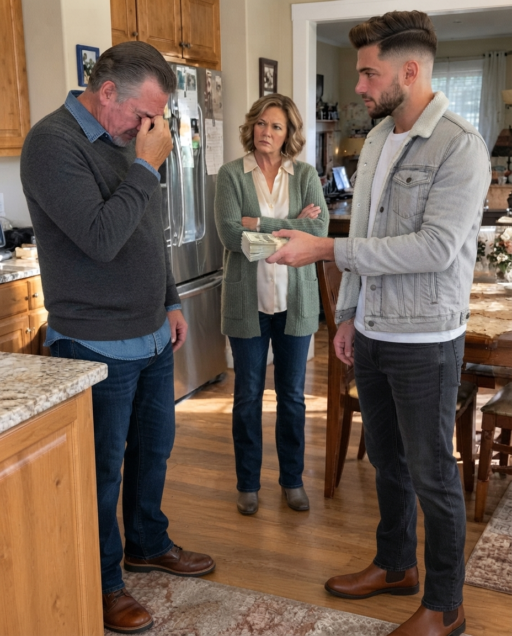
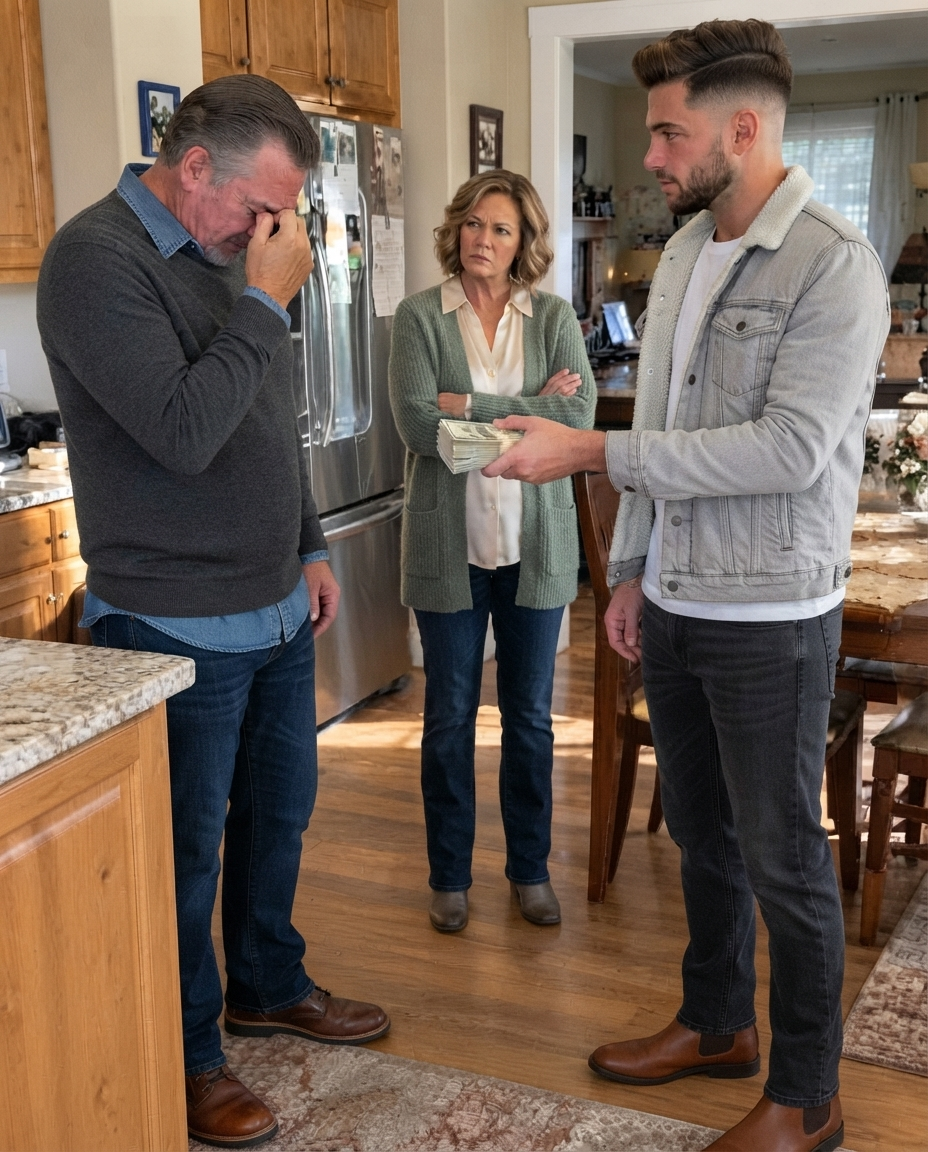
Sometimes I think back to that afternoon when Dad stood in my kitchen asking for a thousand dollars. His hands were trembling, his eyes kept moving toward the house, and he apologized for needing help as though he had somehow failed me.
At the time, I thought I was giving something to him.
Now I understand the opposite was true.
The thousand dollars I handed my father three days before his emergency surgery was the smallest part of what he had been carrying that day. He wasn’t really asking me for money.
He was trying to give me the truth.
It took an aneurysm, an emergency operation, a sealed envelope, DNA evidence, and decades of unopened birthday letters for me to understand what that truth was worth.
Dad had spent his entire life quietly giving me whatever he could.
That afternoon, he almost gave me the one thing I never knew I was missing too late.
Instead, he survived long enough to watch me finally receive it.