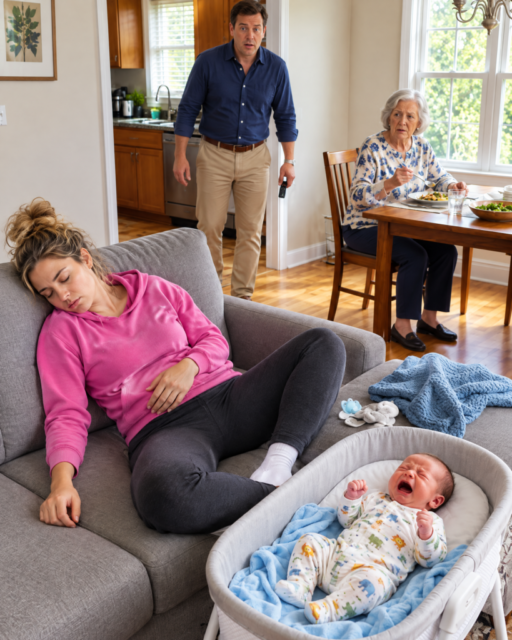
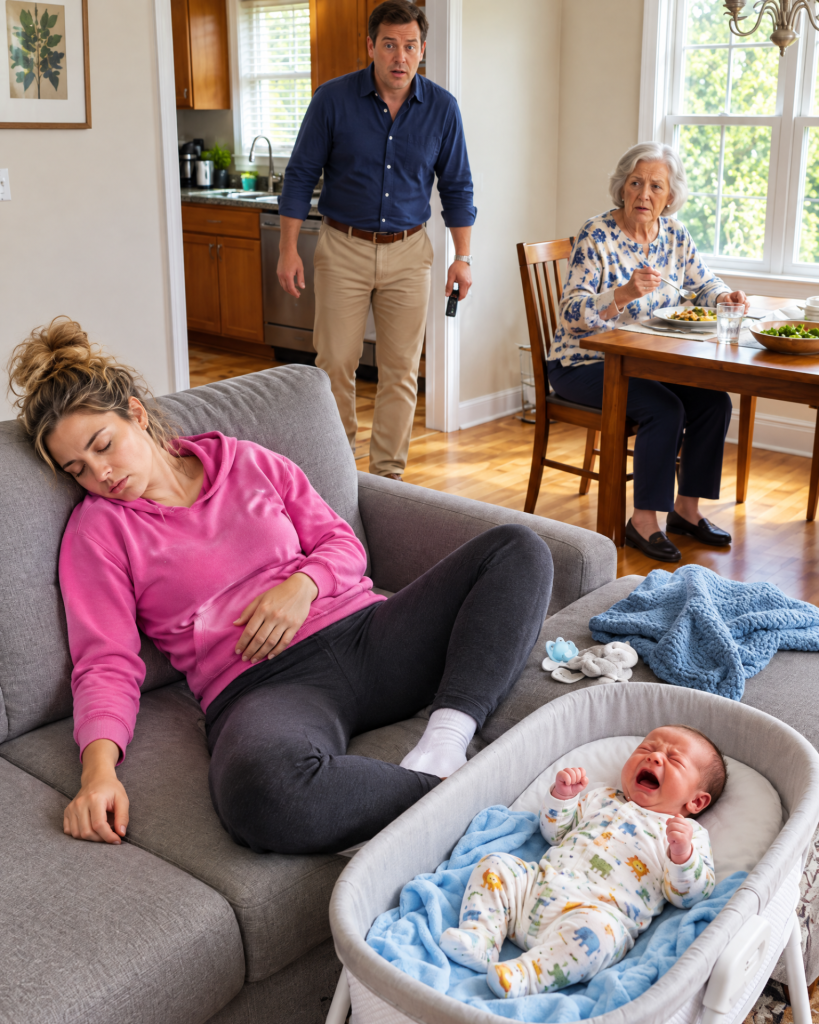

I was supposed to be gone for another four hours, but my meeting ended unexpectedly early. Instead of calling Clara, I decided to surprise her because she had barely slept since our son was born and I hoped I could take over for a while so she could finally rest.
The past few weeks had been exhausting for her. She was still recovering physically from childbirth while feeding our newborn, washing bottles, changing diapers, and surviving on short stretches of sleep, yet whenever I asked how she was doing, she always gave me the same answer.
“I’m fine.”
I knew she wasn’t, which was why coming home early felt like a gift. I imagined walking through the door, taking our son from her arms, and giving her a few quiet hours when nobody needed anything from her.
The moment I opened the front door, I knew something was wrong.
Our son was screaming from the living room, not making the restless noises I had grown accustomed to hearing but crying with an intensity that immediately sent me running toward him. I dropped my keys near the entrance and followed the sound.
He was kicking beneath his blanket in the bassinet, his face bright red from crying. A few feet away, Clara was stretched awkwardly across the sofa with one arm hanging toward the floor.
“Clara?”
She didn’t respond.
I crossed the room and called her name again before touching her shoulder and then her cheek. She was breathing, but even when I tried to wake her, her eyes remained closed.
My mind immediately shifted into emergency mode. I had an unconscious wife, a screaming newborn, and no idea how long either of them had been like this.
Then I smelled roasted chicken and garlic.
The smell was so ordinary that it confused me for a second. When I looked toward the dining room, I finally saw my mother sitting comfortably at our table with a full plate of chicken, potatoes, vegetables, gravy, and fresh bread in front of her.
She wasn’t checking on Clara or trying to comfort the baby. She was simply eating.
“Mom, what happened?”
She barely looked up from her plate. “She’s exhausted.”
I picked up my son, and his tiny hand immediately grabbed my shirt as I held him against my chest. With my free hand, I called emergency services while asking Mom why she hadn’t done anything.
“He’s a baby, Daniel. Babies cry.”
Her dismissive tone disturbed me almost as much as the scene itself. When I asked how long Clara had been unconscious, Mom sighed as though my concern was inconveniencing her.
“She got dramatic, said she felt dizzy, and flopped onto the sofa.”
I looked at the elaborate dinner covering the table and suddenly understood why it was there. Clara used to enjoy cooking meals like that, but that was before pregnancy, childbirth, and nights when two uninterrupted hours of sleep felt like a luxury.
“You made Clara cook all of this?”
Mom immediately objected, insisting she hadn’t forced anyone to do anything. She had simply mentioned that it would be nice to have a “proper meal” because Clara and I had been relying too heavily on takeout.
I couldn’t believe what I was hearing.
I had told Mom repeatedly that Clara wasn’t hosting anyone while recovering from childbirth. If Mom visited, she was supposed to help, not arrive expecting my exhausted wife to prepare dinner for her.
The dispatcher began giving me instructions, and I put the phone on speaker while staying beside Clara. When I asked Mom whether she had checked on her after she collapsed, she rolled her eyes.
“She’s a drama queen. Women have been having babies forever.”
Something inside me went completely still.
For years, I had explained away my mother’s behavior by telling myself she was blunt, old-fashioned, or simply from another generation. Whenever tension developed between her and Clara, I treated it as a personality conflict that could be smoothed over if everyone remained patient.
But this wasn’t an uncomfortable family dinner.
My wife was unconscious.
Mom had heard Clara say she felt dizzy, watched her collapse onto the sofa, and left her there while our newborn screamed nearby. Instead of checking whether Clara needed medical attention, she had returned to the table and continued eating the meal my exhausted wife had prepared.
When Mom realized I had actually called an ambulance, she stood up and accused me of turning the situation into something it wasn’t. She tried to move toward Clara, but without thinking, I stepped directly between them.
“Do not touch her.”
Mom froze.
“Excuse me?”
“You heard me.”
For the first time, I saw genuine surprise on her face. She was accustomed to me softening her words afterward, explaining her behavior to Clara, or asking everyone to keep the peace.
I wasn’t going to do that anymore.
The paramedics arrived minutes later and immediately began assessing Clara. Mom repeatedly tried to explain that Clara was merely tired until one paramedic firmly told her to step back and give them room.
Mom looked at me, clearly expecting me to defend her.
I said nothing.
Then I walked into the dining room, picked up the plate she had been eating from, carried it into the kitchen, and scraped the entire meal into the trash.
“Daniel, what are you doing?”
I put the empty plate on the counter and turned toward her.
“You will never come into this house again and treat my wife like your servant.”
Her mouth fell open, but I wasn’t finished. I told her she would no longer be alone with Clara or our son, and she would be leaving our house that night.
“You’re throwing your own mother out because your wife took a nap?”
Before I could answer, one of the paramedics called my name.
I turned toward the sofa.
Clara’s eyes were beginning to open.
I rushed to her side with our son still against my chest, and after several confused seconds, her eyes finally found mine. I told her I was there, but instead of relaxing, she glanced past my shoulder toward my mother.
Then Clara reached weakly for my hand.
She whispered something I couldn’t understand the first time, so I leaned closer and asked her to repeat it.
When she did, I stopped breathing.
Because whatever had happened that afternoon hadn’t started with dinner.
And from the fear in my wife’s eyes, I suddenly understood that this wasn’t the first time my mother had crossed the line while I wasn’t home.
Clara’s eyes were barely open when I leaned closer, trying to understand what she was saying. Her voice was so weak that I missed the words the first time, but when she whispered again, her eyes briefly shifted past me toward my mother.
That look changed everything.
Until that moment, I believed I understood what had happened. Mom had come over, pressured my exhausted wife into preparing an elaborate dinner, watched her become dizzy and collapse, then continued eating while our newborn screamed nearby.
That alone was enough to change the way I saw her. But Clara’s reaction made me realize the afternoon might not have been an isolated incident.
I didn’t ask her to explain further because she had only just regained consciousness and the paramedics were still assessing her. Instead, I held her hand and told her the only thing she needed to hear.
“I’m here. You don’t have to explain anything right now.”
Behind me, Mom immediately asked what Clara had said. When I ignored her, she repeated my name and moved closer, but I stood and positioned myself between her and the sofa again.
“I told you not to come near her.”
Mom stared at me in disbelief. “I am your mother.”
“I know.”
She seemed to expect those three words to end the argument, as they probably would have many times before. Instead, I remained exactly where I was, with Clara behind me and our newborn resting against my chest.
Mom called the entire situation ridiculous, and I felt my anger rising again. I looked down at my son, forced myself to remain controlled, and told her there would be no more dismissing Clara as dramatic or accusing me of indulging my wife simply because she was exhausted after giving birth.
Mom folded her arms and insisted she had never forced Clara to do anything. When I reminded her about the “proper meal” she had expected, she defended herself by saying that wanting dinner wasn’t a crime.
“This isn’t about dinner,” I told her.
“Then what is it about?”
I looked toward Clara before answering. She was conscious but weak, surrounded by paramedics while the woman who had watched her collapse continued arguing about whether anyone had treated her unfairly.
“It’s about you seeing my wife collapse and deciding she wasn’t worth checking on.”
Mom accused me of twisting what had happened, but there was nothing left to debate. By her own admission, Clara had said she was dizzy, collapsed on the sofa, and remained there while our newborn cried and Mom continued eating.
Those facts didn’t need embellishment.
As the paramedics continued working, something else became painfully clear. When one of them firmly told Mom to give them space, she obeyed almost immediately.
For years, I had told myself Mom couldn’t help crossing boundaries because she was simply “that way.” She criticized, pushed, interfered, and expected everyone around her to adjust, while I repeatedly excused it as part of her personality.
Now I understood that she was perfectly capable of recognizing a boundary when someone refused to negotiate it.
Maybe she had never been incapable of respecting limits.
Maybe she had simply expected family to surrender theirs.