
My daughter Wren was only six minutes old when my mother-in-law, Beverly, lifted her from my chest without waiting for permission. I was exhausted after giving birth, but Beverly carried my newborn toward the window and immediately began announcing that she looked entirely like Roland’s side of the family.
“She hardly looks like you at all, dear. Isn’t that fortunate?”
Roland laughed while I asked quietly for my daughter back. Instead of supporting me, he told me his mother had waited all night and deserved more time with the baby.
That moment should have warned me. For six years, Beverly had treated me as though marrying Roland had rescued me from an insignificant life, and Roland had repeatedly dismissed her insults as harmless comments from a difficult mother.
What neither of them knew was that I had deliberately hidden much of my background. My full name was Simone Caldwell, and my father, Malcolm Caldwell, had built Caldwell Freight from a single rented truck into one of the largest logistics companies in the Southeast.
I had grown up surrounded by wealth, but money had never been what I wanted from him. After my mother Celeste died when I was sixteen while Dad was away negotiating a business deal, I learned to associate his success with all the moments he had failed to show up.
Years later, when he offered me a career inside his company, I refused. I became a fourth-grade teacher instead and eventually distanced myself from the Caldwell name because I wanted a life built around presence rather than status.
“I don’t want to be a Caldwell. I want to be someone who shows up.”
When I met Roland, I told him only that my father had worked in logistics and that we weren’t close. I wanted to know whether someone could love Simone without being impressed by Malcolm Caldwell’s fortune, and for years, I believed Roland had passed that test.
Then Wren was born.
Six days after we brought her home, I was still recovering, barely sleeping, and wearing my hospital bracelet when Roland came downstairs dressed for dinner. His sister Faye was hosting the family because Beverly was leaving for Savannah the following morning.
“What time are we leaving?”
Roland hesitated.
“It might be easier if you stayed here.”
He claimed the gathering would be crowded and that Wren and I needed rest. Then he took my Camry because his SUV was being repaired, even though Wren’s infant-seat base, diaper bag, and everything I needed to transport her safely were inside my car.
“It’s just a family dinner, Simone. Please don’t make this difficult.”
Minutes after he drove away, Beverly sent me a private message.
“He deserves one peaceful night away from you.”
Then Faye posted a photograph from dinner. Seven people sat around the table, laughing beneath a caption that read:
“Family’s all here!”
There wasn’t an empty chair for me or Wren.
Something inside me became completely still. I carried my daughter upstairs, packed one bag with everything we needed, and opened the contact I hadn’t called in almost two years.
My father answered after one ring.
“Simone?”
“Dad, come get me.”
He didn’t ask why I was leaving or whether Roland and I had fought. He asked only two questions.
“Is the baby safe?”
“Yes.”
“Are you safe?”
“Yes.”
His answer came immediately.
“I’m sending Raymond. Thirty minutes.”
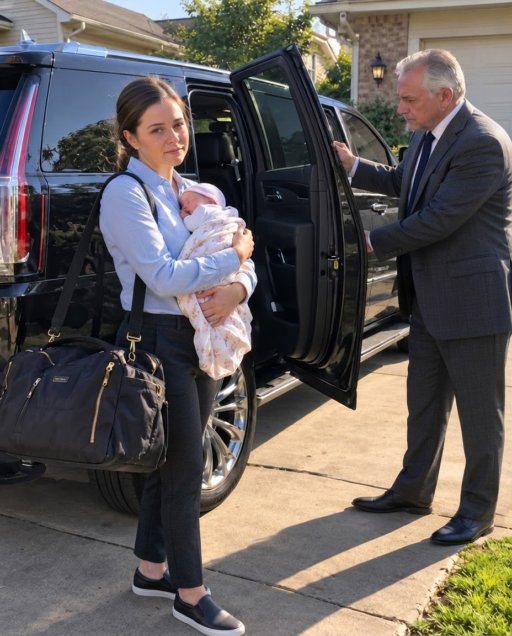
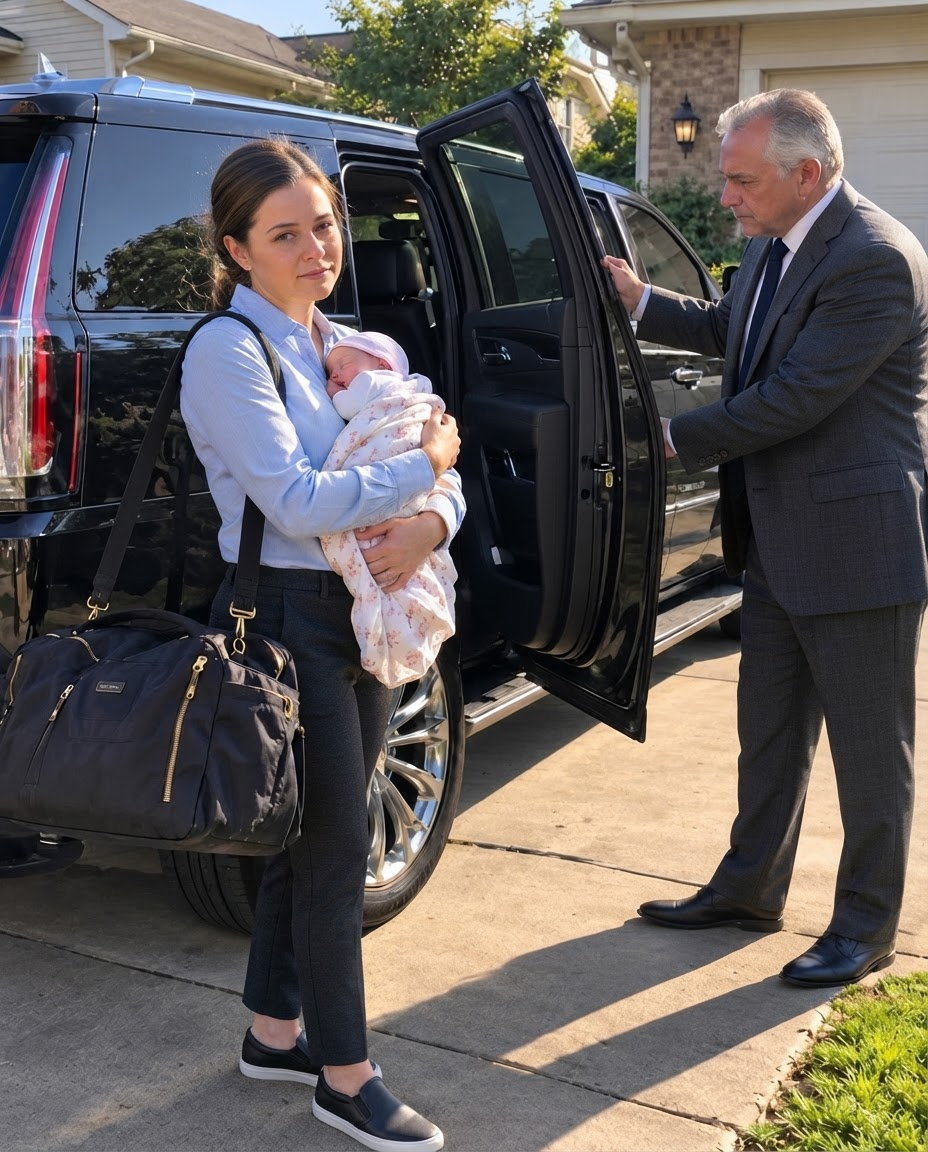
Exactly half an hour later, headlights swept across the front of the house. A black Cadillac Escalade stopped in my driveway, and Raymond, the man who had once held sixteen-year-old me together after my mother died, stepped out.
For the first time in years, I realized that perhaps my father hadn’t forgotten how to show up after all.
Raymond stopped at the front steps and studied me standing there in pajamas, Wren against my chest and the hospital bracelet still circling my wrist. For a moment, his expression carried me back sixteen years to the hospice hallway where he had held me after my mother died.
“Hello, Simone.”
“Hi, Raymond.”
Before taking my bags, he handed me a heavy cream envelope from my father. Written across the front in Malcolm’s precise handwriting was my full name: Simone Celeste Caldwell, not Simone Tran.
I slipped it into my bag unopened. Then Raymond asked permission to see Wren, and after studying her face for several seconds, his eyes filled with emotion.
“She has your mother’s nose.”
No one had said that before. For six days, Beverly had insisted my daughter was entirely a Tran, but Raymond looked at her and immediately saw Celeste.
My father had instructed Raymond to purchase a new infant seat before collecting us. Once Wren was safely secured, I left Roland a note explaining that we were safe and staying with my family until he could explain why his mother counted as family while his wife and daughter did not.
As we drove away, Roland called after seeing us on the driveway camera.
“Where are you going?”
“Somewhere Wren and I both count as family.”
“Simone, it was one dinner.”
“No. It was simply the first time I stopped pretending.”
When Roland demanded to know who had picked me up, I told him Raymond was my father’s driver. His stunned response told me how little he actually knew about the woman he had married.
“Your father has a driver?”
I ended the conversation and watched the familiar oak trees of Peachtree Road appear outside the window. Soon we passed through the iron gates of my childhood home, beyond my mother’s rose garden, and stopped before the enormous brick house I hadn’t considered home in years.
Upstairs, my childhood bedroom had been prepared with fresh sheets, clean towels, a robe, slippers, and even the lemon candies I had loved as a girl. Then I noticed that my mother’s former sewing room had been transformed into a nursery.
Cream walls surrounded a white crib beneath a mobile of tiny paper wrens. There were children’s books, a stocked changing table, my mother’s embroidered cushion on the rocking chair, and fresh white roses on the dresser.
“When did he do this?”
Raymond explained that my aunt had told Dad about my pregnancy six months earlier. Malcolm had quietly spent weekends preparing the nursery, even visiting several stores because he wanted to make sure the birds on the mobile were actually wrens.
“Why didn’t he call?”
“Because he was waiting for you.”
Raymond then repeated what my father had told him.
“If she calls, I’ll be there in thirty minutes. If she never calls, at least the room will be ready.”
My hands trembled as I finally opened Malcolm’s envelope. Inside was the brass key my mother had given me when I was twelve, labeled in her handwriting: Simone’s room.
There was also a short card.
“Your room is ready. Everything else can wait until you are.”
While I cried in my mother’s old rocking chair, Roland returned home with Beverly and discovered the truth another way. He called the emergency number I had once given him for my father, only for our house manager to answer, “Caldwell residence.”
Minutes later, Roland’s brother-in-law searched Malcolm Caldwell online.
“Roland… Malcolm Caldwell? Caldwell Freight?”
Beverly slowly sat down.
For six years, she had treated me like a woman with nothing.
Now she finally knew whose daughter I was.